
Factory decision note
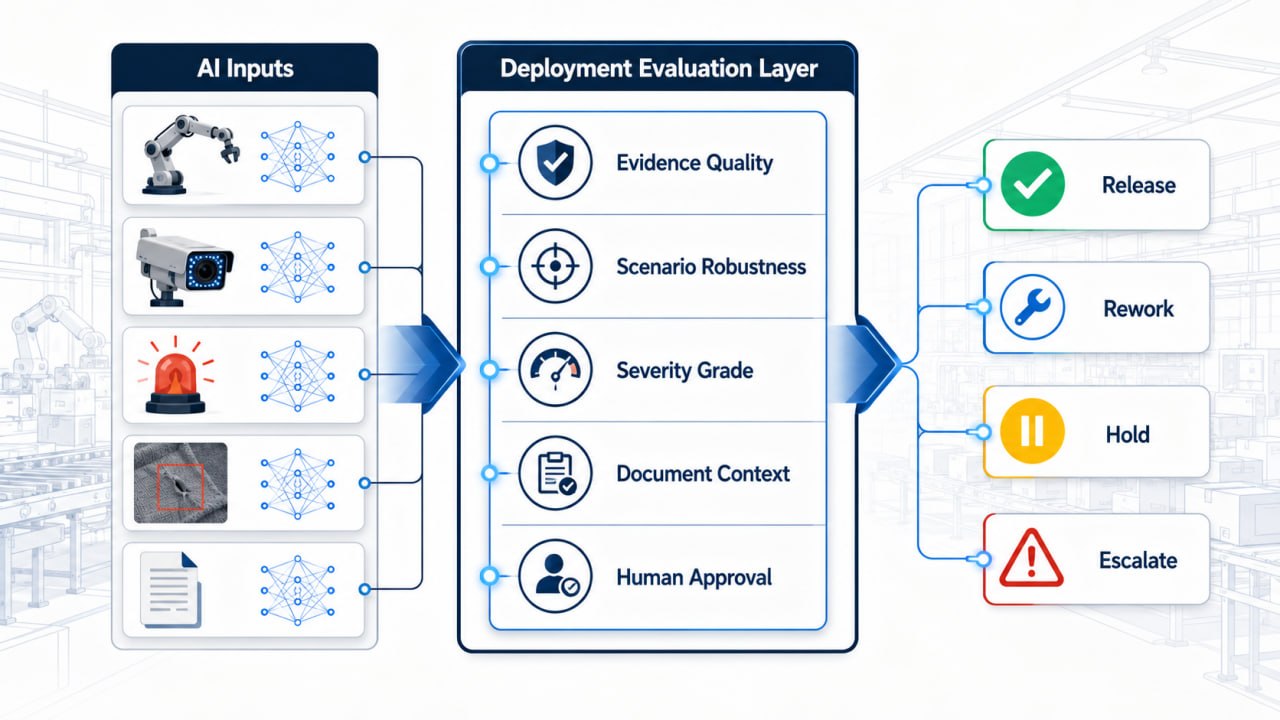
A deployment evaluation layer is the checkpoint between an impressive AI demo and a factory action. Before a robot, vision model, document agent, or alarm assistant influences production, the factory should prove that the evidence is clear, the scenario is realistic, the severity grade is useful, and the approval owner is known.
The mistake factories usually make
The common mistake is to approve the tool because the demo looks accurate. A demo can avoid weak lighting, mixed products, blocked camera views, buyer-specific documents, worker interruptions, layout changes, and rare but expensive exceptions. Those are exactly the conditions that decide whether a deployment survives.
What I would check before approving budget
- Can the system show passed and failed cases from real factory variation, not only selected vendor examples?
- Does every AI output move into a controlled grade such as release, rework, hold, or escalate?
- Who has authority to approve the action: QA, IE, maintenance, production, safety, or management?
- Can the factory keep an audit trail that explains why the AI recommendation was accepted, downgraded, or rejected?
Vendor proof requests
- Show the evaluation checklist used before deployment, including failed-case logs.
- Demonstrate what happens when evidence is weak, a document version is wrong, or scenario drift appears.
- Provide the permission, rollback, and human-approval design before any execution right is granted.
Pilot gate
GO if the evaluation layer catches weak evidence before action. HOLD if the model works but ownership and audit trail are unclear. REDESIGN if deployment trust still depends on demo confidence instead of factory evidence.
The deployment evaluation layer is the missing checkpoint between model output and factory action. A factory may see a robot policy, inspection model, or document-reading agent perform well in a demo, but that does not prove it can influence production safely.
Real factory evidence is messy. Camera views get blocked. Lighting changes by line and shift. Defect photos are ambiguous. Documents follow buyer-specific formats. Machine alarms often arrive without enough context. A model can be technically capable and still be unready for operating trust.
The practical question is simple: before AI touches a production decision, has the factory tested evidence quality, scenario variation, severity grade, document context, and human approval?
Factory answer: what this layer must prove
A factory AI deployment evaluation layer checks whether an AI system is ready for real production use, not just whether it can perform a task in a demo. It sits between models and factory action, and it gives managers a controlled way to move from prediction to reviewed decision.
A factory AI deployment evaluation layer should evaluate five things:
- Evidence quality: whether images, videos, alarms, and documents are clear enough to support a decision.
- Scenario robustness: whether the system works under real factory variation, not only controlled examples.
- Severity grading: whether a detection becomes a useful action grade such as hold, rework, release, or escalate.
- Document transfer: whether the system can read factory documents as operational evidence, not just plain text.
- Human approval: whether the final action remains reviewed, logged, and permissioned before it affects production.
Without this layer, factories risk turning AI into a prediction machine with no reliable path to action. With this layer, AI can become part of a controlled operating system.
Why demos are not deployment readiness
Many AI demos show a model recognizing an object, answering a question, detecting a defect, planning a robot movement, or summarizing an alarm. These demos are useful, but they usually do not answer the factory manager’s real question.
The real question is not, “Can the model produce an answer?” The real question is, “Can this answer safely influence a factory decision under messy operating conditions?”
A visual model may detect a stain in a sample image but fail when the fabric is wrinkled, glossy, shaded, partly hidden, or photographed under mixed lighting. A robot policy may succeed in a controlled manipulation task but struggle when material position, worker movement, or workstation layout changes. A document AI model may extract text from a clean form but miss a buyer-specific field, a revised packing instruction, or a chain-of-custody reference.
Factory AI readiness begins when the factory separates model capability from deployment reliability.
External signals: evaluation matters more than demo strength
Recent robotics and industrial AI signals point in the same direction: the next bottleneck is not only bigger models, but better evaluation before deployment. This is why the factory AI deployment evaluation layer should be treated as an operating requirement, not a nice-to-have governance add-on.
NVIDIA recently discussed how to evaluate general-purpose robot policies for real-world deployment. The important lesson for factories is not that robot policies are ready for every production task. The useful signal is that robot behavior needs task variation, environment variation, and deployment-oriented evaluation before real use.
Industrial vision research is moving in a similar direction. SteelBench, an arXiv industrial vision-language benchmark, focuses on real plant conditions such as distant workers, dust, steam, low light, glare, occlusion, overlapping activities, PPE, and safety reasoning. The exact benchmark is not a garment-factory proof. But the direction is highly relevant: factory vision AI must be tested against real evidence conditions, not only polished demo clips.
Another arXiv challenge on cross-scenario defect detection and fine-grained severity grading points to a second shift. Defect AI cannot stop at detection. Manufacturing needs severity-aware decisions. A defect prediction should connect to whether the factory should hold, rework, release, or escalate the item.
Document AI is also part of the same issue. Domain-adapted visual question answering research shows that industrial documents, presentations, tables, and forms require more than plain OCR. For factories, this matters because BOMs, QC reports, CAPA records, packing lists, trim cards, traceability documents, and chain-of-custody evidence carry operational meaning.
These are research and vendor architecture signals, not guaranteed production proof. But they point to the same Factory AI map: the missing layer is deployment evaluation.
Where this layer sits in the Factory AI stack
The factory AI deployment evaluation layer belongs above chips, devices, models, and data pipelines, but below full production action. It is the layer that turns raw AI output into a reviewed action candidate.
In the existing Factory AI Stack Map, factories need more than compute, models, and dashboards. They need layers that connect physical signals to operational decisions. This article adds a specific missing layer: before the decision layer can be trusted, the deployment evaluation layer must test whether the signal is usable.
It also connects to the factory AI data layer. A factory may collect PLC data, camera images, inspection records, and ERP fields, but still lack reliable timestamps, ownership, defect labels, event definitions, and evidence trails. Deployment evaluation checks whether those records are good enough for AI-supported decisions.
Finally, this layer builds on the cloud vs edge AI decision matrix. Some evaluation must happen locally, especially for fast or sensitive signals. Some evidence should connect to factory systems. Some learning can move to cloud analytics after aggregation and governance. Deployment evaluation decides how those layers interact before action.
The five checks I would require before factory use
A practical factory AI deployment evaluation layer can start with five checks. These checks apply to robotics, inspection AI, alarm agents, and document-reading systems.
1. Evidence quality check
Before a model output is trusted, the factory should ask whether the input evidence is strong enough. For video, this means camera angle, lighting, occlusion, timestamp, line context, and whether the scene actually shows the event. For defect images, it means resolution, color consistency, fabric condition, distance, and whether the defect area is visible.
For documents, evidence quality means the right version, full page visibility, readable fields, correct style/order reference, and linkage to the related production event. A blurry photo of a packing list or a cropped inspection report may be enough for a human conversation, but not enough for AI-supported decision evidence.
2. Scenario robustness check
A factory should test whether the AI system still works when the scenario changes. This is especially important in high-mix production, garment manufacturing, manual assembly, and other environments where material, style, line balance, worker method, and workstation layout change frequently.
An inspection model that works on one fabric color may fail on another. A robot policy that works at one table setup may fail when the bundle position changes. An alarm agent that summarizes one machine type may misread another process. Deployment evaluation should include variation before trust expands.
3. Severity grading check
Factories do not only need detection. They need decision grades. A defect, alarm, or document mismatch should move toward a controlled action category.
- Release: no action needed after review.
- Rework: fixable issue with defined responsibility.
- Hold: stop movement until more evidence or approval is available.
- Escalate: manager, quality, engineering, buyer, or safety review required.
This matters because two defects with the same label may have different business consequences. A small stain on an inside component, a visible shade issue on a main panel, a wrong care label, and a broken needle risk should not be treated as equal AI detections.
4. Document transfer check
Factory AI often fails when documents are treated as generic text. A BOM field, QC result, CAPA response, packing instruction, trim card, carton mark, mill declaration, or traceability document has meaning only when it connects to the order, style, lot, buyer requirement, process step, and responsible owner.
Deployment evaluation should test whether the AI system can preserve that context. If the model extracts a field but cannot connect it to the correct production decision, it is not ready for deployment. It may still be useful as a draft assistant, but not as an action engine.
5. Human approval check
The final check is approval. The first version of a factory AI system should usually be read-only or draft-only. It can gather context, suggest a severity grade, prepare a recommendation, and point to evidence. But it should not silently control production, release shipments, change quality disposition, or trigger buyer-facing communication without permission.
This connects to the broader need for factory AI agent safety cases. Execution rights should be earned gradually, logged clearly, and blocked by default for high-risk actions.
Garment factory example: from defect photo to action candidate
Consider a garment factory using camera-assisted quality inspection. A model flags a possible stitch defect. Without deployment evaluation, the factory may simply accept or reject the model’s prediction. That is too thin for real operations.
A factory AI deployment evaluation layer would ask several questions first. Is the image clear? Does it show the correct operation and panel? Is the fabric color reliable under the lighting? Is there a bundle, style, line, or timestamp link? Has this defect type appeared in this style before? Is the issue cosmetic, functional, safety-related, or buyer-critical?
Only after those checks should the system suggest an action candidate. It may recommend rework if the defect is visible and repairable. It may recommend hold if the image is unclear or the issue could affect a larger lot. It may recommend escalation if the defect connects to measurement, label, needle, shade, safety, or buyer compliance risk.
This is the difference between inspection AI and factory AI. Inspection AI predicts. Factory AI connects evidence to an accountable decision path.
Alarm agents should triage before they control
The same logic applies to factory AI agents. NVIDIA’s industrial alarm-management example shows an AI agent gathering historical context and drafting recommendations for technicians. The important factory lesson is that the first useful agent is often not an autonomous controller. It is a triage assistant.
In a garment or labor-intensive factory, alarm-like events may include output drops, repeated rework, shade discrepancies, machine stoppage, missing trims, buyer inspection holds, packing mismatch, or abnormal WIP movement. An agent can help gather context across logs, reports, messages, and system records.
But the factory AI deployment evaluation layer should limit the agent’s role. It can summarize, compare, highlight missing evidence, suggest severity, and draft next steps. A human owner should still approve the action, especially when the result affects shipment, buyer communication, quality disposition, or worker assignment.
A simple deployment readiness matrix
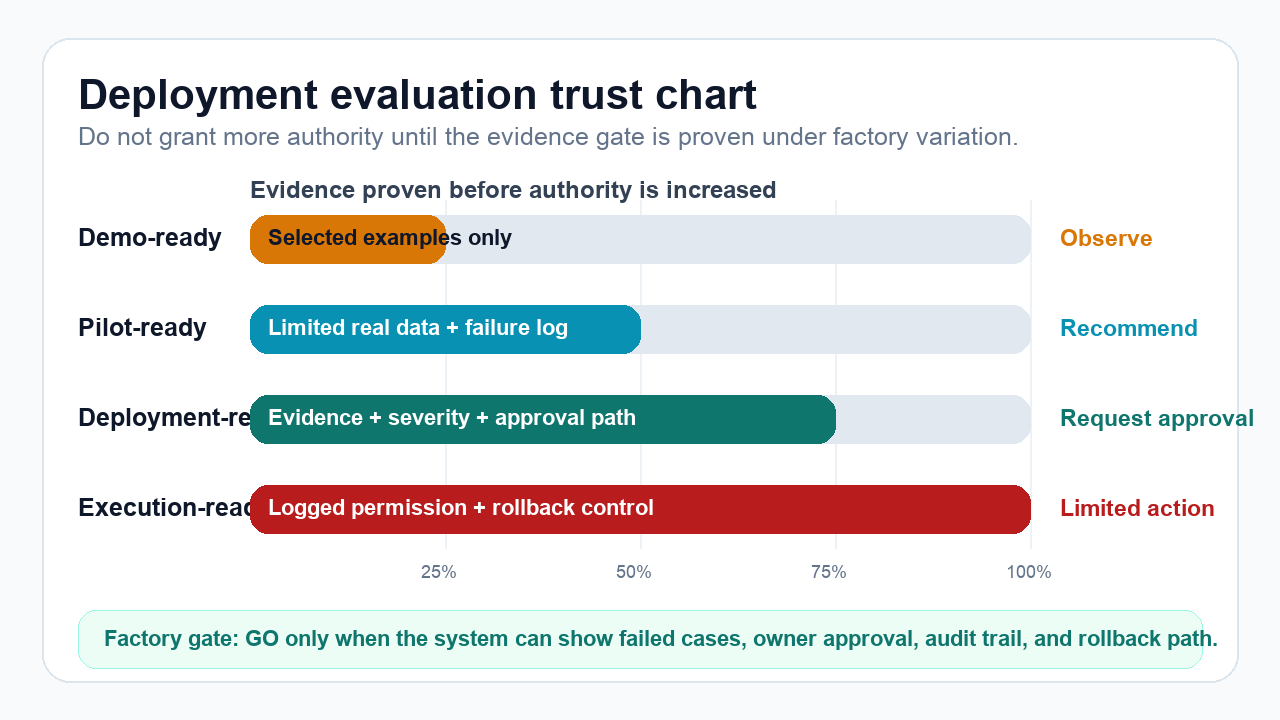
Factories can use a four-level matrix to decide how much trust an AI system deserves.
- Demo-ready: works on selected examples, but real factory evidence and variation are not yet tested.
- Pilot-ready: tested on limited real data, with human review and clear failure logging.
- Deployment-ready: connected to evidence records, severity grades, operating context, and approval workflow.
- Execution-ready: allowed to perform limited actions only after strong controls, audit logs, permissions, and rollback paths exist.
Many factory AI tools should stay at pilot-ready or deployment-ready for a long time before any execution rights are granted. That is not failure. It is responsible adoption.
How this strengthens the Market Map section
This topic belongs in a Factory AI market map because it defines a category, not just a use case. The market will not be divided only into robotics vendors, camera vendors, AI PC vendors, cloud platforms, and MES providers. A separate layer is emerging around deployment evaluation: evidence validation, model monitoring, severity mapping, audit trails, approval workflows, and action governance.
This layer may be built inside MES, QMS, vision platforms, edge AI systems, robotics stacks, or agent governance tools. But the function is the same: help factories decide when AI output is reliable enough to influence operations. In market-map terms, the factory AI deployment evaluation layer is a category signal because it defines a repeatable buying question.
For buyers of factory AI systems, this becomes a vendor-screening question. Do not only ask what the model can detect. Ask how the vendor evaluates real-world evidence, scenario variation, false positives, false negatives, severity grades, document context, human approval, and audit trails.
Final deployment-evaluation takeaway
Factory takeaway: do not move directly from model demo to factory action. First prove that the evidence is reliable, the scenario is realistic, the severity grade is useful, the document context transfers correctly, and the human approval path is controlled.
- Use AI early for evidence organization, comparison, missing-signal detection, and draft recommendations.
- Delay execution rights until failed cases, approval owner, audit trail, and rollback path are visible.
- Judge vendors by deployment evidence, not only by demo accuracy or model capability.
The factory that builds deployment evaluation before execution rights will be better prepared for robotics, inspection automation, traceability, alarm triage, and future Factory AI agents. The factory that skips this layer may get faster predictions, but not safer decisions.
Author and factory-deployment perspective
Factory AI Atlas is written from a manufacturing operations perspective shaped by hands-on apparel and textile production experience, including overseas factory management, woven and knit operations, production control, quality systems, and operational restructuring.
The site focuses on practical factory judgment: what evidence exists, who owns the decision, what risk remains, and whether the pilot can survive real production conditions. See the Editorial Policy & Disclaimer for sourcing standards and AI-use disclosure.
Deployment-evaluation source anchors
- NIST AI Risk Management Framework — useful for testing, monitoring, and governing AI behavior before deployment.
- NIST manufacturing resources — relevant for connecting deployment evaluation to measurable factory process evidence.