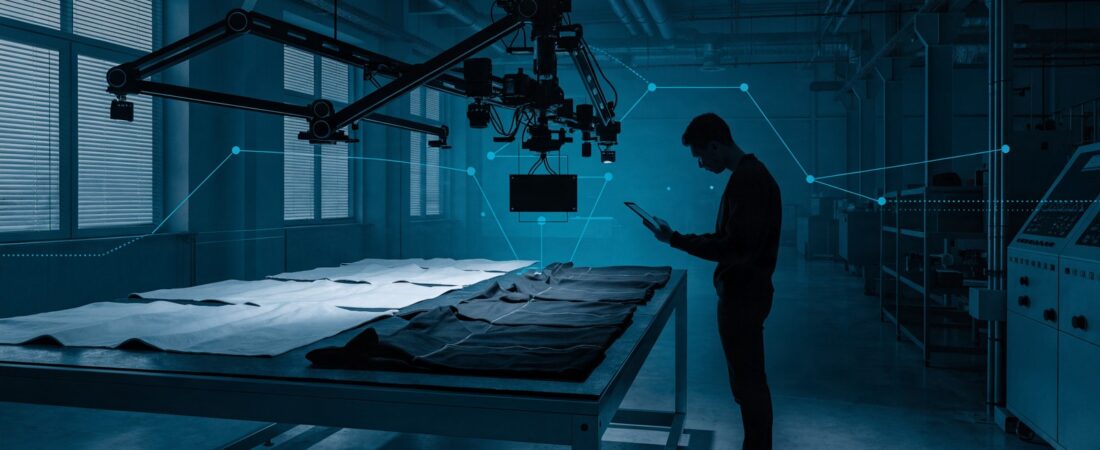
Many factory AI pilots start with the wrong buying question: Which camera should we install, and which model should we use? That sounds practical, but it skips the harder factory question. Before AI can inspect a line, the factory must be able to show what a defect is, where it appears, how severe it is, what action it requires, and who approved the final decision.
In other words, the first bottleneck is not always computer vision. It is factory defect evidence: the proof trail that connects defect names, images, camera conditions, validation, and human QC decisions.
This is especially true in apparel and soft-goods production. A factory may have thousands of good pieces, but only a small number of useful examples for a specific defect: shade band, print misregistration, open seam, broken stitch, puckering, stain, wrong label, missing hangtag, barcode mismatch, carton mark error, or needle-control evidence gap. The defects that matter most are often the ones that appear least often in a clean training set.
Factory decision note: Do not approve an AI inspection pilot because a demo detects visible defects on sample images. Approve the pilot only when the factory can show a defect taxonomy, real image bank, camera-condition standard, small line validation, and a human HOLD / REWORK / RELEASE gate.
Factory defects are rare until they become expensive
Factories do not fail because every defect is common. They fail when a rare defect reaches the buyer, shipment, store, or consumer before the factory can explain what happened. A few missed shade problems can create a claim. A wrong label can block a shipment. A missing needle-detection record can turn a normal quality issue into a compliance issue.
That is why AI inspection is not the same as ordinary image classification. The model is not only deciding whether pixels look unusual. It is entering a production decision chain. The output may influence whether a piece is released, reworked, held, escalated, or reported to a buyer. If the evidence behind that decision is weak, the AI system may only make a weak process move faster.
A common mistake is to collect many images of normal production and a few obvious defect examples, then treat the pilot as a model-selection problem. This creates a clean demo but not a trustworthy QC process. The factory still does not know whether the system can handle borderline stains, shade variation under different lighting, subtle seam puckering, mixed fabric texture, reflective trims, or operator occlusion at the inspection table.
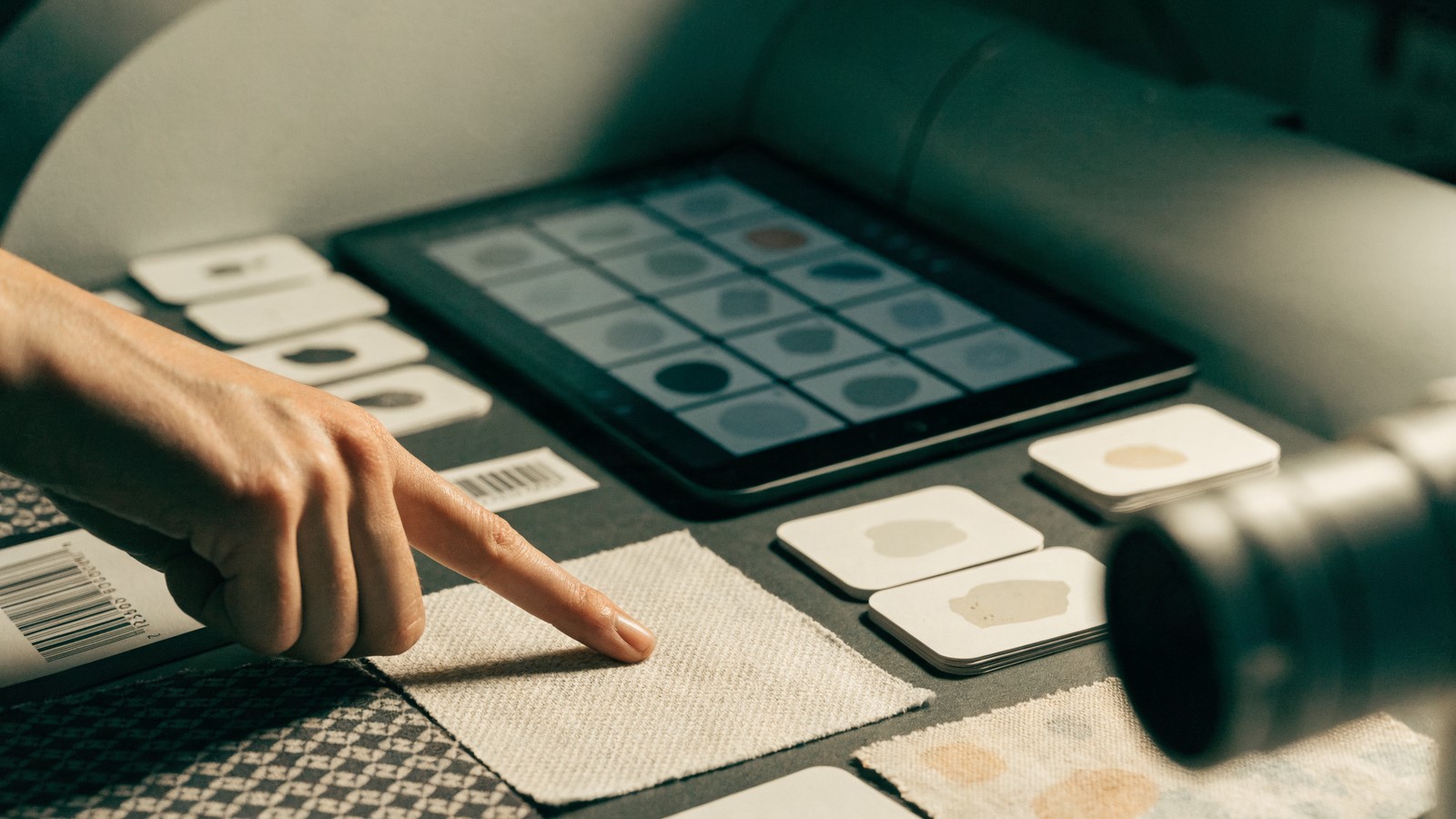
AI inspection needs a defect taxonomy before it needs more cameras
A factory defect taxonomy is not a decorative spreadsheet. It is the operating language that connects image evidence to action. If the same issue is called “stain” by one inspector, “contamination” by another, and “spot” in a buyer report, the AI system will inherit the confusion. If “major defect” and “critical defect” are mixed casually, the model may appear accurate while the action rule is wrong.
For an apparel factory, the taxonomy should not stop at the defect name. It should include at least:
- Defect type: stain, shade band, print misregistration, open seam, broken stitch, puckering, label mismatch, barcode issue, carton mark error.
- Location: front body, sleeve, cuff, collar, inside label, hangtag, carton side, polybag, or inspection record.
- Severity: minor, major, critical, buyer-specific exception, or compliance-sensitive issue.
- Action rule: release, rework, hold, re-inspect, segregate, escalate, or block shipment.
- Evidence requirement: image angle, close-up, full-piece view, lot/style/PO reference, inspector note, and approval owner.
Without this structure, the AI model may detect “something wrong” but still fail to support a factory decision. A blurry stain and a critical label mismatch are not the same operational event. A print defect on a sample panel and a misprinted production garment are not the same risk. A missing barcode image is not a visual defect, but it may be a release-blocking evidence gap.
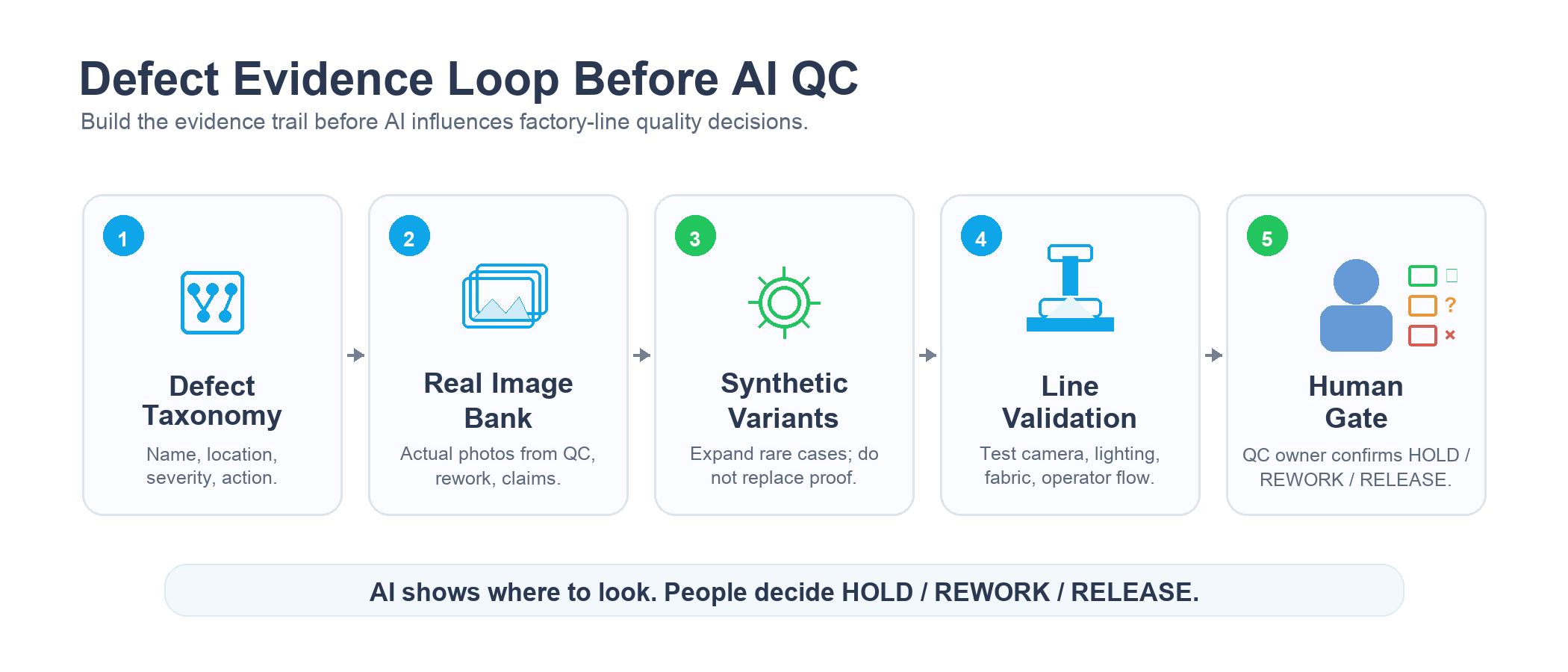
Synthetic defect data can help, but it cannot replace factory proof
Recent research signals point to a useful direction: synthetic data can help factories train or pre-test defect detection when real defect examples are scarce. Scratch simulation research and synthetic quality-control data for printing show why this matters. If rare scratches, creases, streaks, or registration errors are hard to collect in enough volume, synthetic variants can expand the training set and reduce annotation cost.
That logic is relevant to apparel, but it must be translated carefully. A synthetic stain, synthetic print error, or synthetic seam defect can help a model see more variation. It can help the team define what to annotate. It can help edge detectors face more examples before a live pilot. But it does not prove that the system is ready for production release decisions.
The factory still has to test the model against real fabric behavior: cotton vs polyester, white vs black, matte vs shiny, printed vs solid, loose vs stretched, flat table vs hanging garment, daylight vs LED inspection lamp, and operator movement around the inspection area. Synthetic evidence is a support layer. Real-line validation is the decision layer.
This distinction matters because synthetic data can make an AI pilot look more mature than the factory process actually is. The model may have more images, but the factory may still lack the approval trail that a QC manager, buyer, or auditor needs.
Camera evidence is a process, not a picture
Factories often talk about “adding a camera” as if the camera itself creates quality evidence. It does not. A camera only records what the process allows it to see.
For garment inspection, image quality changes with the working condition. A white garment under strong light can wash out surface defects. Black fabric can hide stains and seam issues. Glossy trims can reflect light into the camera. A hand can cover the exact area the model needs to inspect. A folded garment can make a measurement or label placement issue invisible. A camera angle that works for a front panel may not work for a sleeve cuff, inside care label, or carton mark.
This is why sensor simulation and camera-condition testing are useful topics for factory AI. The goal is not to create a perfect digital twin for every line. The practical goal is simpler: list the failure conditions before the pilot goes live.
- Which fabric colors reduce visibility?
- Which defect types need a close-up and a full-piece view?
- Which inspection table lighting creates reflection or shadow?
- Which operator movements block the camera?
- Which defects require human tactile checking, not only images?
- Which buyer requirements require original photo evidence in the report?
If these conditions are not tested, the factory is not running an AI inspection pilot. It is running a camera demo inside a production environment.
The mistake factories usually make
The usual mistake is giving AI a pass/fail role too early. A model demo says “defect detected,” and the team immediately imagines automatic sorting, automatic reporting, or automatic shipment release support. That leap is dangerous.
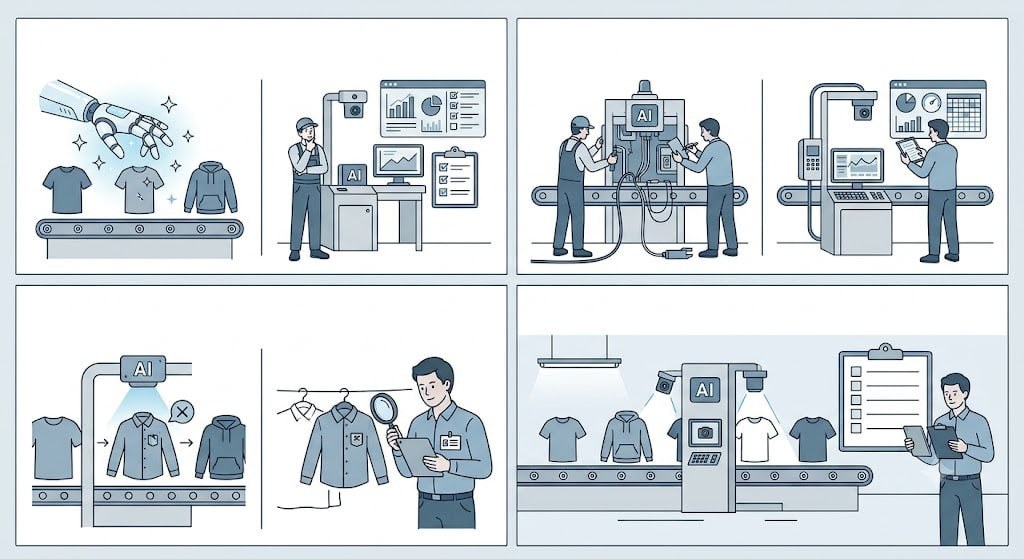
A better first role is evidence organization. The AI system can help group similar images, flag missing close-ups, suggest defect categories, compare current photos with known defect cards, or draft a review queue. It can show where the QC team should look. But it should not silently close the decision loop.
For apparel factories, the safer starting point is:
- Read-only: AI reviews images and highlights possible defects.
- Draft-only: AI suggests defect category, severity, and missing evidence.
- Approval-required: QC owner confirms HOLD, REWORK, RELEASE, or ESCALATE.
- Limited execution: only low-risk routing or reporting steps are automated after repeated validation.
This sequence keeps the factory decision where it belongs. People still decide. AI shows where to look.
What I would check before approving budget
Before approving a factory-line AI inspection pilot, I would not start with a model comparison table. I would ask for the evidence package.
- Show the top 20 defect types that create rework, claim, delay, or buyer dispute.
- Show real examples for each defect, not only perfect training images.
- Show which defects need multiple views or human touch confirmation.
- Show the false-pass and false-reject cost for the target process.
- Show the camera standard: angle, distance, lighting, background, garment presentation, and operator steps.
- Show how AI output is linked to style, PO, lot, color, size, inspection stage, and final action.
- Show who can override the model and how that override is recorded.
If the vendor or internal team cannot answer these questions, the factory may still run a research pilot. But it should not call the system production-ready QC.
Vendor proof requests
A factory should ask vendors for proof that matches the real workflow, not only polished demo clips.
- Can the system separate defect type, severity, location, and recommended action?
- Can it handle fabric color and texture variation without constant retraining?
- Can it show confidence and uncertainty in a way QC staff can use?
- Can it flag missing evidence instead of pretending the inspection is complete?
- Can it export an audit trail for HOLD, REWORK, RELEASE, and override decisions?
- Can it support buyer-specific defect rules without rewriting the factory’s whole QC process?
The best vendor answer is not “our model is accurate.” The best answer is “here is how the evidence, exception, and approval trail works when the model is uncertain.”
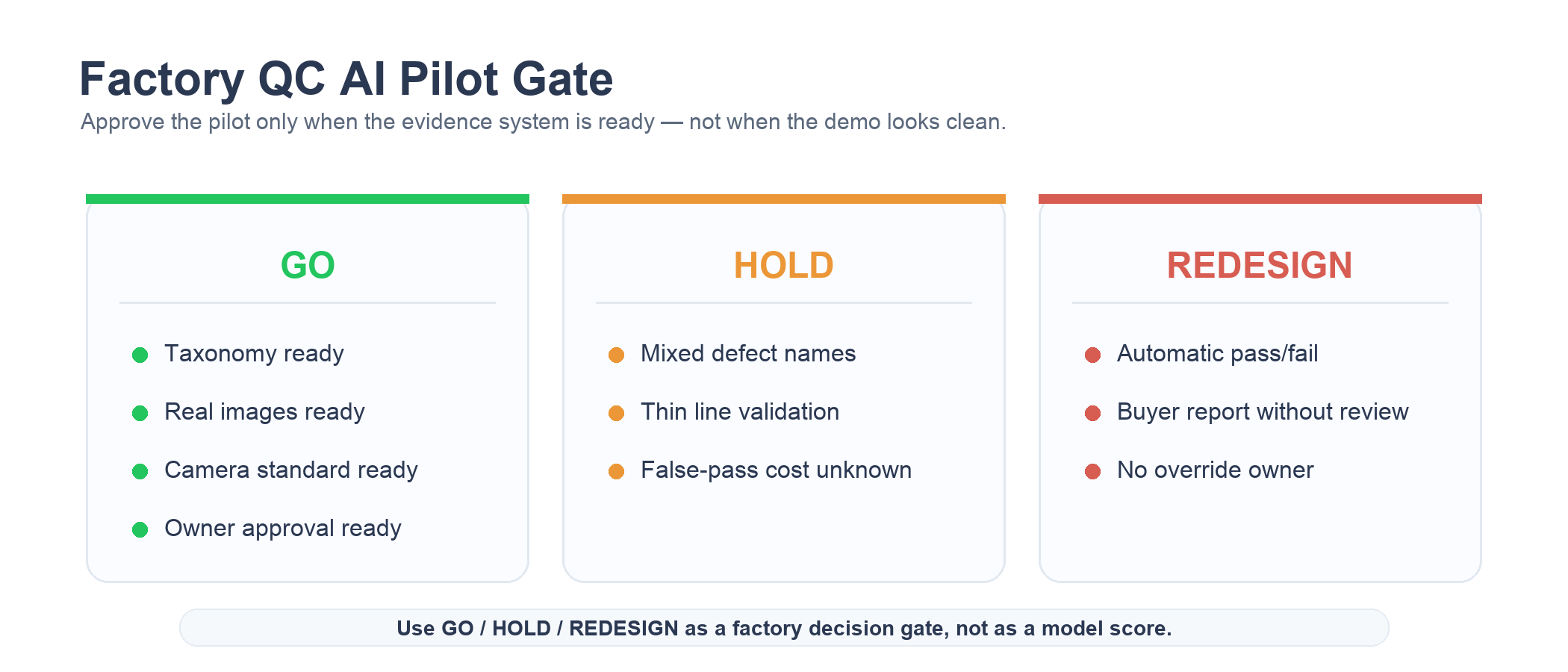
Pilot gate: GO / HOLD / REDESIGN
GO
Proceed when the factory has a clear defect taxonomy, enough real image examples for the target process, defined camera conditions, small real-line validation, and a human owner for final HOLD / REWORK / RELEASE decisions.
HOLD
Pause when the demo works but the evidence is thin. This includes mixed defect names, inconsistent photo angles, unclear false-pass cost, weak line validation, or no defined escalation path when the model is uncertain.
REDESIGN
Redesign the pilot when AI is being used as an automatic pass/fail authority, when buyer-facing reports are generated from unreviewed model output, when the system cannot flag missing evidence, or when no one owns the override record.
Final factory approval check
Factory AI inspection should not begin with trust in a model. It should begin with trust in the evidence loop around the model.
A camera can see a surface. A model can flag a pattern. But a factory needs more than a visual match. It needs a repeatable way to connect defect evidence to production action, buyer expectation, rework cost, shipment risk, and human approval.
That is the practical line between a useful AI inspection pilot and another impressive demo. The demo shows that AI can see. The evidence loop shows whether the factory can decide.
Related Factory AI Atlas reading
- Broken Needle Traceability: A Practical Factory AI Readiness Gate
- Cutting Plan: A Factory AI Readiness Layer for Apparel
- Factory AI Needs an Edge Evidence Gate Before Agents Touch Workflows
- Garment Factory Machines Are Becoming Data Systems, Not Just Equipment
Sources checked and claim boundary
The sources below are not presented as Factory AI Atlas production test results. They are public anchors for the article’s claim boundary: synthetic data and sensor simulation can support defect-evidence preparation, but a factory still needs real-line validation and human approval before AI influences QC release decisions.