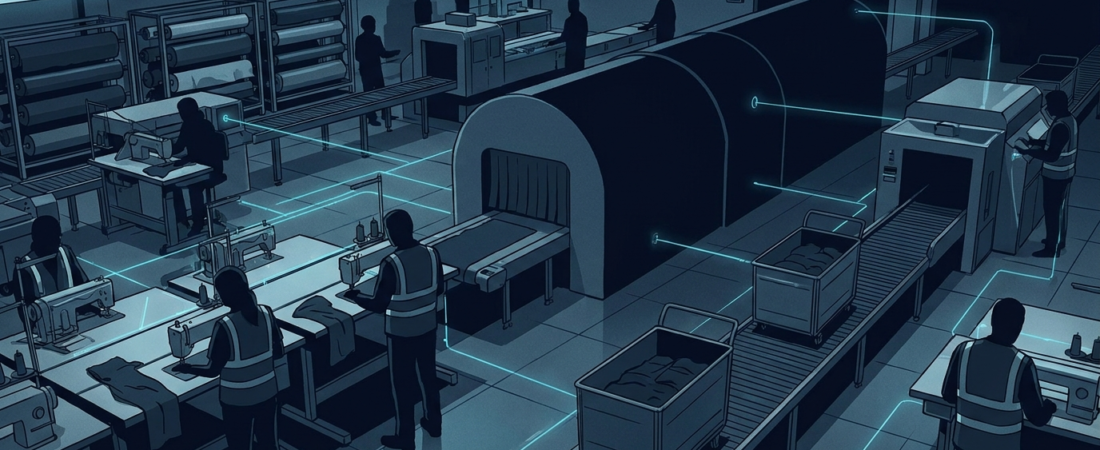
Garment automation is often described through machine speed: faster cutting, faster inspection, faster printing, faster output.
That is not wrong. Speed still matters. But for most apparel factories, the more important shift is quieter and more operational: ordinary factory equipment is beginning to create usable production evidence — in other words, garment equipment data systems are becoming part of the factory operating layer.
A needle detector is no longer only a machine at the end of the line. A cutting system is no longer only a mechanical tool for fabric layers. A digital printer is no longer only a decoration device. Each one can become a signal point in a wider factory data layer — if the factory knows what evidence it needs and how that evidence will be used.
The important question is not, “Does this machine have AI?” The better factory question is, “What operating decision does this machine help us prove?”
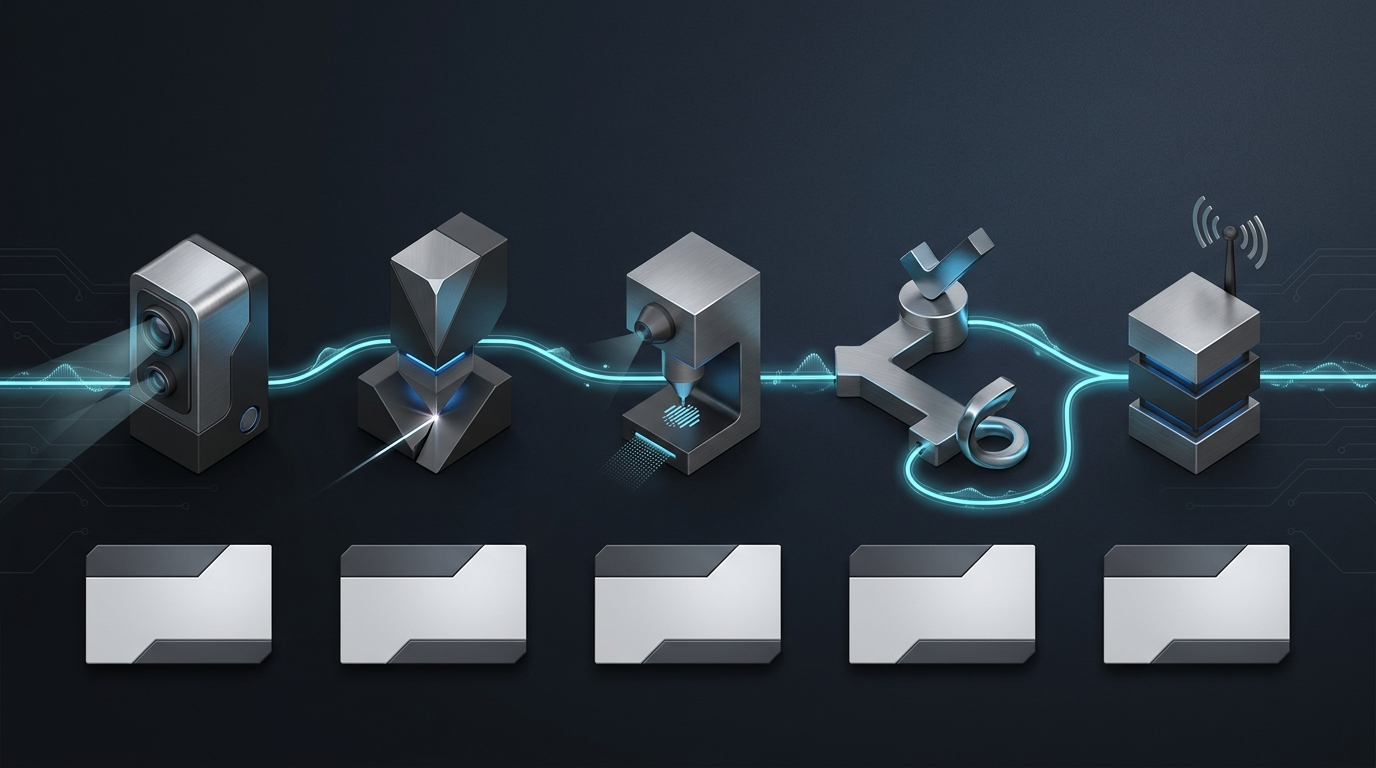
Factory decision note
Before approving a new inspection, cutting, or digital decoration system, I would not start with the demo video. I would start with five practical checks:
- What event does the machine record?
- Can that record be connected to product, bundle, lot, carton, or order information?
- Does the data help supervisors act faster, or does it only create another report?
- Can operators still work when the system fails or the data is incomplete?
- Can the evidence support quality review, rework control, packing accuracy, or buyer communication?
This is where Factory AI becomes practical. AI is not valuable because the machine name sounds advanced. AI becomes useful when the machine creates clean, repeatable signals that humans can trust.
Inspection is becoming an evidence gate
Needle detection and final inspection have always been important in apparel manufacturing. The traditional purpose was simple: detect risk before shipment and prevent a safety or quality claim.
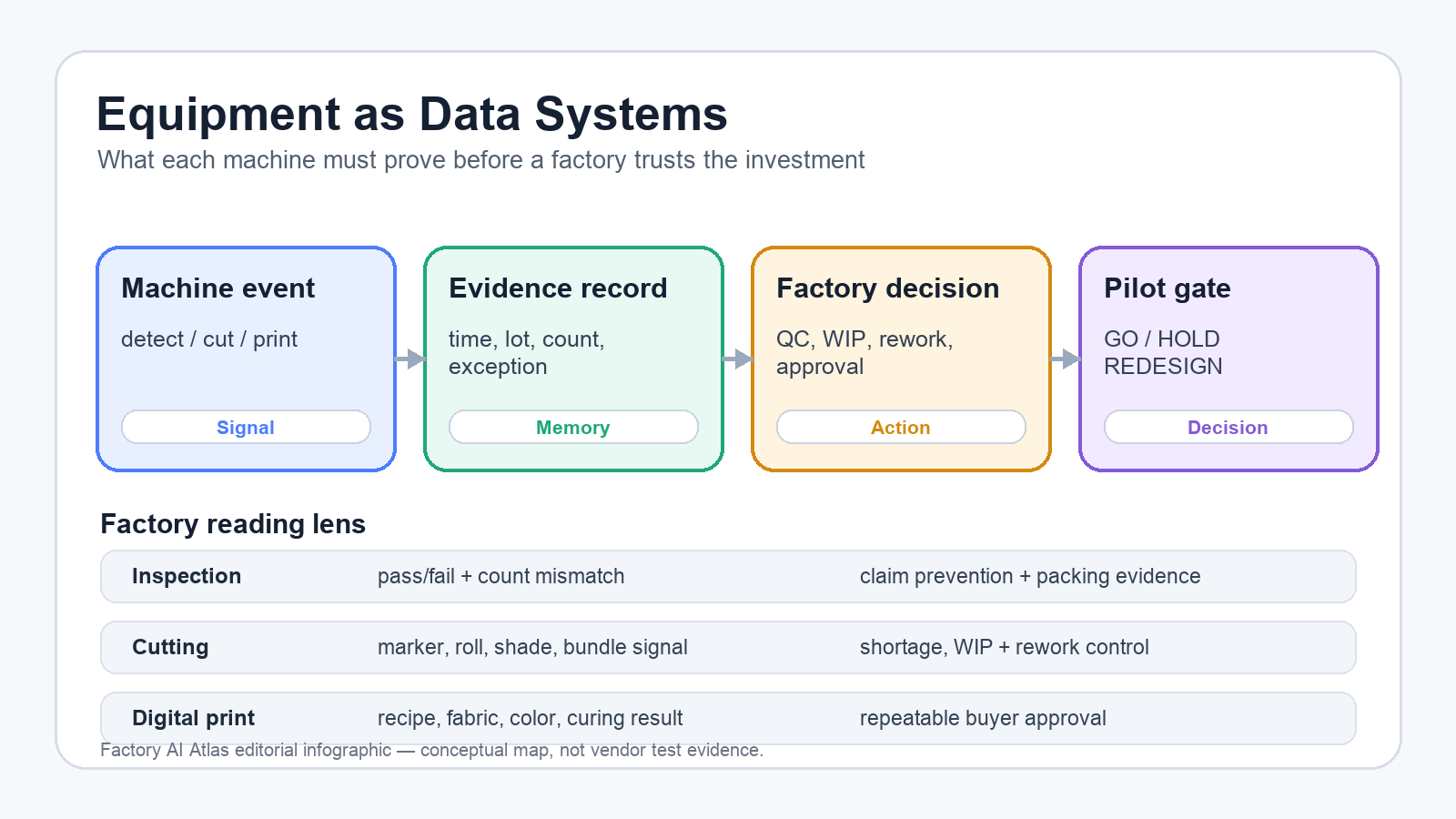
But inspection equipment is moving toward a wider role. When an inspection machine can connect with count control, RFID, X-ray, image capture, or automatic recording, it begins to function as an evidence gate.
That changes the factory conversation.
The question is no longer only whether a garment passed through the machine. The question becomes whether the factory can prove what passed, when it passed, how many pieces passed, whether any tag or count mismatch appeared, and whether the result can be connected to packing or traceability records.
This does not replace QC judgment. It gives QC and production teams a stronger memory layer. When a claim appears later, the factory is not relying only on people’s recollection, paper notes, or disconnected Excel files. It has a clearer signal to review.
Cutting equipment is also part of the data layer
Cutting room automation is often evaluated by speed, layer height, cutting precision, marker efficiency, and fabric utilization. Those metrics are important. But in real production, the cutting room is also where many downstream problems begin.
If shade control, shrinkage allowance, numbering, bundling, size-color balance, roll behavior, or fabric defect handling is weak, the sewing line may inherit the problem later. By the time the issue reaches sewing or finishing, it can look like a line-performance problem even though the root signal started before sewing.
This is why cutting equipment should be evaluated not only as machinery, but as part of production memory. A factory should ask what cutting decisions are captured and whether those decisions can be reviewed when WIP, rework, or shortage problems appear.
A smart cutting system is not automatically a smart factory. It becomes useful when its data is connected to the production questions supervisors actually face: what was cut, what changed, what risk was accepted, and what needs follow-up before the line feels the impact.
Digital printing is becoming a workflow decision
Digital printing platforms are another example. The visible result is decoration: the print, the color, the hand feel, the graphic effect. But the factory decision is much broader than the image on the garment.
For apparel factories, digital decoration is a workflow decision. It affects fabric compatibility, pretreatment, dye migration, color consistency, artwork changeover, operator skill, curing, wash performance, rework, minimum order quantity, and buyer approval timing.
When a platform claims it can handle cotton, polyester, blends, DTG, DTF-style workflows, visual correction, or 3D decoration effects, the factory should not treat those as marketing words only. It should translate them into pilot questions:
- Which fabric types represent our real orders?
- What happens on dark polyester or blended materials?
- How stable is color after wash and rub tests?
- How much operator skill is still required?
- What is the changeover cost between designs?
- Can quality settings be repeated across shifts?
- Can the output support buyer approval without creating hidden rework?
The business case is not just impressions per hour. It is the ability to manage product variation without losing control of quality and approval evidence.
The mistake factories usually make
The common mistake is to evaluate advanced equipment as a single machine purchase.
A factory sees the speed, the specification sheet, the trade-show sample, or the AI label. But the real value depends on whether the machine fits into the factory’s operating system.
If the data stays inside the equipment, it may help the machine operator but not the factory. If the output is not connected to WIP, QC, rework, packing, or shipment evidence, it may become another isolated island. If supervisors cannot understand or act on the signal, the system can look modern while the factory still runs on manual chasing.
The strongest automation projects usually do not begin with a question about technology. They begin with a bottleneck:
- Where do we lose quality evidence?
- Where does rework become invisible?
- Where does packing count become uncertain?
- Where do sample and bulk expectations separate?
- Where do supervisors spend time confirming what already happened?
Then the factory chooses equipment that can reduce that uncertainty.
Vendor proof requests
For any inspection, cutting, or digital decoration vendor, I would ask for proof in factory language, not only technology language.
- Show the actual data record produced by the machine.
- Show how the record links to product, lot, bundle, carton, or order information.
- Show what happens when a piece fails, is reworked, or is rechecked.
- Show the manual override and fallback process.
- Show how supervisors review exceptions.
- Show what data can be exported or connected to MES, ERP, PLM, QA, or traceability tools.
- Show the pilot result by defect reduction, rework control, changeover time, operator dependency, and claim-prevention evidence — not only by machine speed.
These questions are not anti-technology. They are how a factory protects technology investment from becoming a showroom purchase.
Pilot gate: GO / HOLD / REDESIGN
GO
The equipment creates useful records, the operator workflow is realistic, exception handling is clear, and supervisors can use the data to make faster decisions.
HOLD
The machine performs well, but the data is isolated, export is unclear, or the factory has not decided who owns the signal after the machine creates it.
REDESIGN
The project depends on perfect data, perfect operator behavior, or a vendor-controlled dashboard that does not connect to the factory’s real WIP, QC, packing, or approval process.
The Factory AI Atlas view
The next wave of apparel automation will not be only faster machines. It will be equipment that helps factories prove what happened.
Inspection systems can become quality evidence gates. Cutting systems can become production-memory nodes. Digital printing platforms can become flexible-manufacturing workflow engines.
But this only works when the factory asks the right question.
Do not ask only whether the machine has AI. Ask whether it creates evidence your factory can trust.
That is the practical bridge between garment manufacturing and Factory AI.
Equipment data-system map
Related Factory AI Atlas reading
- Factory AI Needs an Edge Evidence Gate Before Agents Touch Workflows
- Garment Label Traceability: How QR Labels Reveal Factory AI Readiness
- AI Lockstitch Machine Pilot: 5 Costly Factory Mistakes to Check Before Buying
Public source anchors used for this draft
The examples above are not presented as Factory AI Atlas test results. They are public source anchors used to frame what a factory should ask vendors to prove during a pilot.
- Hashima official English site
- Hashima RFID count device for conveyor needle detector
- Hashima KM automatic cutting machine page
- Kornit Atlas MAX / MATRIX official product page
- Kornit XDi technology page
- Kornit polyester / dye migration technology page
- Mimaki textile and apparel printer product category
- Brother DTG official site