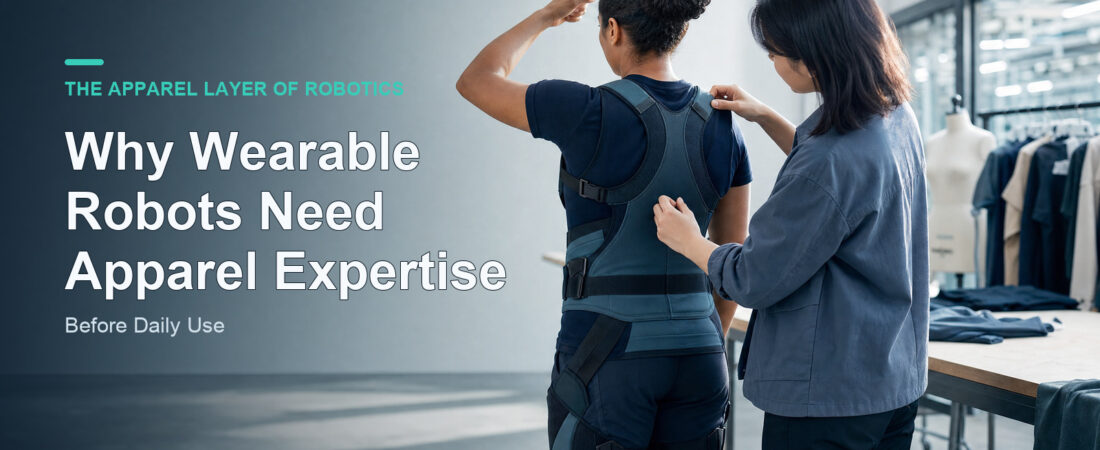
A company known for school uniforms entering wearable robots sounds, at first, like an unusual diversification story. In July 2026, Hyungji Elite’s robotics subsidiary was reported to have signed a technology cooperation and Korean commercialization agreement with a Chinese wearable-robot company. The stated direction was walking and daily-life assistance for older users.
The important question is not whether an apparel company has suddenly become a robotics company. The more useful question is why wearable robotics may need apparel capability in the first place.
Wearable robots are not machines that work beside people. They are machines that must fit people, move with them, transfer force through the body, survive sweat and repeated motion, and remain comfortable enough to be used again tomorrow. That makes the garment interface part of the technology.
The robot creates assistive force. The garment decides whether the body can accept that force every day.
The product is robotics, but the interface is apparel
A wearable robot has at least two connected layers.
The robot layer includes actuators, sensors, batteries, controllers, mechanical structures, and software. It creates or redirects force. It measures movement and decides how the device should respond.
The apparel layer includes the pattern, fit, anchor points, straps, textile panels, seam construction, padding, size grading, skin-contact materials, ventilation, washing method, and the process of putting the product on and taking it off.
These layers cannot be evaluated separately. If an anchor point moves, the intended force path changes. If pressure is concentrated at one edge, the user may loosen the system or stop wearing it. If the product traps heat, takes too long to put on, or fits only one body type, strong robotic performance may not become daily use.

Why fit becomes performance
In ordinary clothing, poor fit can create discomfort, restricted movement, or an unsatisfactory appearance. In a wearable robot, fit can also affect force transfer, alignment, safety, and repeatability.
- Slipping anchor points can waste assistance or change where force enters the body.
- Concentrated pressure can create pain, skin irritation, or early rejection by the user.
- Heat and sweat can reduce the time a person is willing to wear the product.
- Poor size grading can turn one successful prototype into inconsistent performance across users.
- Difficult donning and doffing can make a product impractical for older users or busy workers.
Harvard’s Wyss Institute describes soft exosuits as wearable robotic devices for demanding lifting and reaching tasks. Academic reviews of soft wearable robots also show how textile structures, actuation methods, fabrication, and the human interface must work together. These sources do not prove that every garment company can build a successful robot. They do show why the soft interface is not a decorative cover around the machine.
What apparel manufacturing experience adds
From an apparel-manufacturing perspective, I would not treat comfort as a cosmetic issue. Small changes in pattern balance, seam placement, material stretch, friction, padding, and size grading can decide whether a product works across real bodies.
My factory experience also makes me cautious when a wearable product is judged from one controlled sample. A sample may look acceptable on one person and still fail after grading, repeated bending, sweating, washing, a material substitution, or a different sewing process. Production begins when the same design must perform repeatedly, not when one prototype photographs well.
This does not mean garment knowledge replaces robotics engineering. It means robotics teams need apparel specialists earlier. This is where apparel expertise becomes part of functional engineering, not a cosmetic afterthought. Pattern engineers can help define force-transfer paths. Material teams can test stretch recovery, breathability, friction, and skin comfort. Sewing and QA teams can test reinforcement, seam slippage, repeated loading, washability, and repair. Fit teams can identify where a design works for one body but fails across a size range.
The hidden challenge is production repeatability
Wearable-robot discussions often focus on torque, battery life, sensors, or control accuracy. Those are important. But a product also needs a repeatable softgoods specification.
A factory would need clear answers to practical questions:
- Which dimensions control alignment with the body?
- Which seams carry load and which seams only close the garment?
- What happens when fabric stretch changes between lots?
- Can electronics or actuators be removed before washing?
- How are straps, webbing, pads, and attachment points inspected?
- What repair is allowed after wear or damage?
- How is fit confirmed across the full size range?
These are familiar production questions, but the consequence is higher when the garment transfers robotic assistance. Sewing quality can become functional quality. Size variation can become control variation. A wash test can become a reliability test.
There is no single wearable-robot market
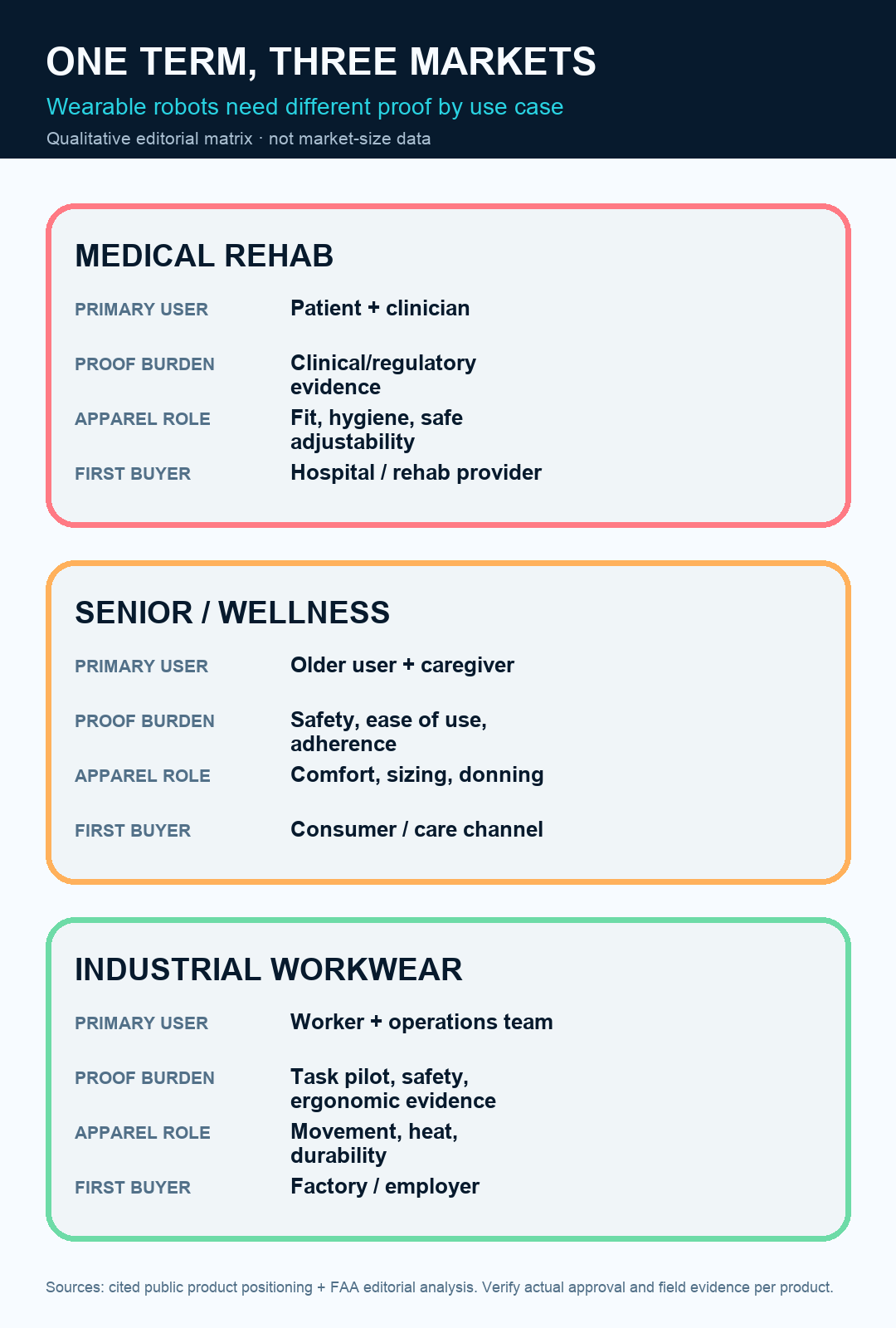
The phrase wearable robot market can hide very different products and evidence requirements. Medical rehabilitation, senior or wellness assistance, and industrial workwear should not be treated as one market.
Medical rehabilitation
Products such as Angel Robotics’ M20 are positioned for gait rehabilitation. This segment requires clinical and regulatory evidence, professional use protocols, and a clear medical-device pathway. Apparel comfort still matters, but it operates inside a much stricter evidence environment.
Senior and wellness assistance
Walking-assistance products for older users must be safe, easy to put on, understandable, serviceable, and acceptable for repeated use at home or in community settings. Training, fit, confidence, and after-sales support may matter as much as technical assistance.
Industrial workwear
Industrial products such as Hyundai’s X-ble Shoulder are positioned around work assistance. The factory question is not whether the device looks advanced. It is whether it reduces a defined ergonomic burden without introducing a new safety, heat, movement, maintenance, or work-method problem.
The first question is therefore not, “How large is the wearable-robot market?” It is, “Which use case, user, approval path, and evidence standard are we discussing?”
Where garment factories can realistically participate
Not every sewing factory should become a robotics company. The realistic entry point is narrower and more practical.
- Technical softgoods production for robotics companies
- High-load seams, webbing, straps, pads, and reinforced anchor structures
- Pattern development and size grading for body alignment
- Breathable, washable, replaceable, or modular textile layers
- Fit testing and repeated-use garment QA
- Small pilot production before mass manufacturing
- Workwear integration for specific factory tasks
The opportunity is not “add AI to a garment.” It is to manufacture the human interface of a physical system with the same discipline used for other safety- and performance-sensitive products.
What I would verify before calling it a product
Before treating a wearable robot as ready for daily use, I would want evidence for both the robot layer and the apparel layer.
- Fit range: Which body measurements control performance, and how was the size range tested?
- Pressure map: Where does the product load the body during real movement?
- Movement stability: Do anchors stay aligned after repeated bending, walking, lifting, or reaching?
- Heat and wear time: How long will people actually keep it on?
- Donning and training: Can the intended user put it on correctly without expert help?
- Wash and maintenance: What is removable, washable, repairable, and replaceable?
- Production tolerance: Which fabric, seam, and attachment variations change performance?
- Use-case evidence: Was the device tested in the task and environment where it will be used?
A vendor demonstration can answer only a small part of these questions. Daily use requires product engineering, manufacturing control, service, and user trust.
The next robotics supply chain may look partly like apparel
Hyungji’s move is still an early business signal. Public reporting does not yet prove product performance, regulatory success, user adoption, or commercial scale. The headline market-size claim also needs an original source, year, and segment definition before it should be repeated as fact.
But the broader direction is credible: wearable robots expose a productization gap between a machine that can assist movement and a product people will actually wear.
The winner may not be only the company with the strongest actuator. It may also be the company that can make the device wearable, washable, adjustable, repeatable in production, and trusted enough to be used every day.
Sources checked and claim boundary
- Segye Ilbo — Hyungji wearable-robot business report
- Harvard Wyss Institute — Soft exosuits for back support
- Peer-reviewed review of soft wearable robots
- Hyundai Robotics — X-ble Shoulder
- Angel Robotics — M20 gait-rehabilitation robot
- WIRobotics — wearable-robot product positioning
- Hurotics — soft wearable-robot positioning
Claim boundary: company pages support how products are publicly positioned; they do not independently verify performance. The body visuals are conceptual editorial frameworks. Factory-specific fit, safety, durability, ROI, and adoption must be tested in the intended use environment.