Factory decision note
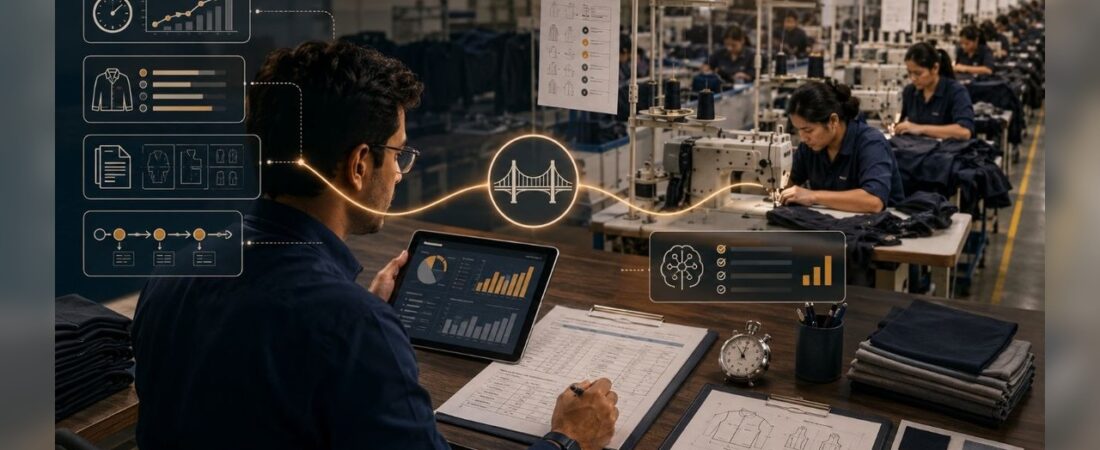
I would not approve a standard-time system just because it contains many SMV, SAM, or GSD values. I would first ask whether each number can be traced back to the method used on the sewing floor. A time value becomes useful only when IE, production, planning, and costing can explain what work it represents and why the factory should trust it.
The mistake factories usually make
The common mistake is to copy an old time value because the operation name looks similar. But the fabric, attachment, handling method, quality point, operator learning curve, or allowance may be different. The number moves into planning, while the method proof stays missing.
What I would check before approving budget
- Is the operation method clear enough for another IE or supervisor to repeat?
- Are observed cycle time and standard time stored as different values?
- Can the team explain the allowance, attachment, fabric condition, and quality requirement?
- Does the factory update the standard after kaizen, method change, or repeated actual-versus-standard gaps?
Vendor proof requests
- Show one time value with its method note, observed samples, allowance logic, revision history, and approval owner.
- Show how a changed standard affects line balance, capacity, costing, and target setting.
- Show how the system stops users from copying a value into a different product or method without review.
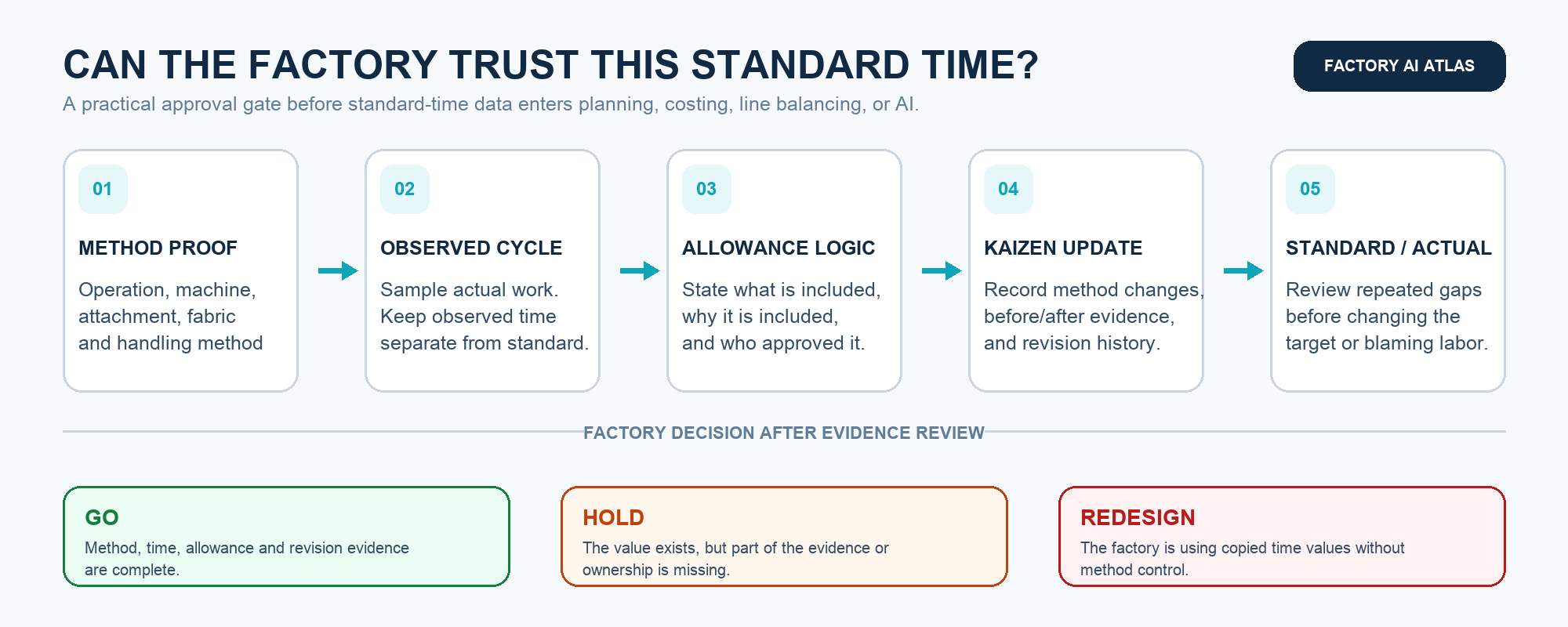
Pilot gate: GO / HOLD / REDESIGN
GO if method, time, allowance, and revision evidence are complete. HOLD if the value exists but part of the evidence or ownership is missing. REDESIGN if the factory is digitizing copied time values without controlling the method behind them.
Cycle time shows what happened on the floor. Kaizen changes how the work is done. Garment standard time connects those two lessons to planning, costing, line balancing, and target setting.
From my factory experience, the hardest argument is rarely about the formula itself. The argument starts when IE, planning, costing, and production use the same number but mean different things. One team sees an achievable method. Another sees a costing assumption. The sewing line sees a target that may not match the real fabric and handling condition.
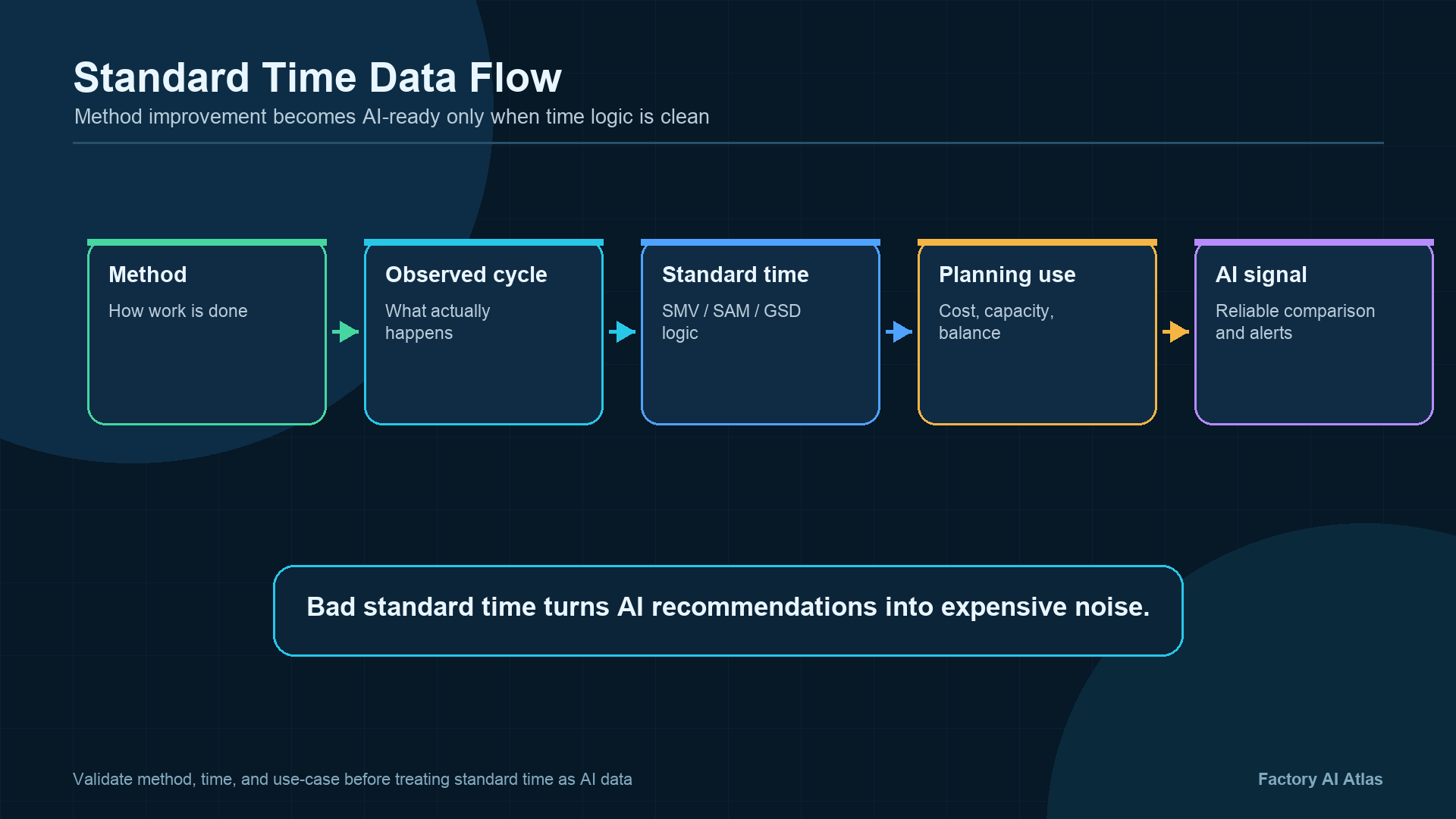
Before standard-time data is used for AI, the factory should prove the method behind the number: operation scope, machine and attachment, fabric behavior, allowance logic, observed samples, and what changed after kaizen.
The factory may call the value standard time, SMV, SAM, allowed time, or GSD-derived time. The name matters less than whether the team can explain and repeat the method.
If the factory cannot explain where a time value came from, AI will only repeat the same argument faster.
Standard-time article map for factory readers
- Why standard time matters after cycle time and kaizen
- Cycle time vs standard time
- SMV, SAM, GSD, and the factory time language
- Where standard time breaks in garment factories
- Why Factory AI needs clean standard-time logic
- A practical standard-time system for apparel factories
- Standard-time readiness checklist
Why standard time matters after cycle time and kaizen
The previous articles in this Factory AI Atlas sequence covered two practical foundations.
- Cycle time helps the factory see whether an operation is actually running as expected.
- Kaizen helps the factory improve the method, motion, layout, work aid, or handling process.
But improvement still needs a common measurement system. A sewing operation may become faster after a method change, but the factory needs to know how that change affects standard time, line balance, capacity, costing, incentive logic, and future style planning.
This is why garment standard time matters. It is not only an IE calculation. It is the agreement that connects the sewing method to planning, costing, capacity, and factory management.
When standard time is disciplined, managers can ask better questions:
- Is this style difficult because the method is complex or because the line is unstable?
- Is the bottleneck caused by real operation content or poor balancing?
- Did a work aid reduce actual time enough to update the standard?
- Are factories using the same method assumptions when comparing performance?
- Can the planning team trust the capacity calculation?
Without this discipline, AI dashboards may look advanced while the underlying numbers remain weak.
Cycle time vs standard time
Cycle time and standard time are related, but they are not the same.
Cycle time is what is observed in actual work. It can be affected by operator skill, fabric behavior, workstation layout, machine condition, fatigue, bundle flow, waiting, quality checks, and many other real production factors.
Standard time is the expected time for a defined method under defined conditions, usually including appropriate allowances. It should reflect the work content and the method, not every temporary instability on the floor.
In garment factories, confusion between cycle time and standard time creates many management problems.
- If the factory treats a temporary fast cycle as the new standard, the target may become unrealistic.
- If the factory ignores improved methods, the standard may remain too loose.
- If different teams use different time assumptions, costing and planning will not match production reality.
- If actual cycle time is always far from standard time, the factory needs to investigate the gap instead of blaming only operators.
A useful factory AI system must understand this gap. The question is not only, “What was the cycle time today?” The better question is:
Why is actual cycle time different from the expected standard time for this method?
SMV, SAM, GSD, and the factory time language
Factories use different terms for standard time. Some teams say SMV or SAM. Others use allowed minutes, predetermined motion-time systems, or GSD-style methods. The label should never hide how the number was built.
For practical management, the important point is consistency. A factory should know how the time value was built, what method it assumes, what allowance is included, and when it should be reviewed.
Garment standard time should not be treated as a fixed number disconnected from real methods. In a practical factory, garment standard time must stay connected to the method that operators actually use. It should be connected to:
- operation description;
- machine type and attachment;
- workstation layout;
- fabric and component handling difficulty;
- quality requirement;
- operator skill assumption;
- method sequence;
- allowance logic;
- style or product-family similarity.
This is where many apparel factories lose data quality. They may have an SMV number, but the number is not always linked to the method behind it. Once the method changes, the time value may not be updated. Once the same operation appears in a new style, teams may copy a number without checking whether conditions are truly comparable.
For Factory AI, that is a serious problem. AI can help retrieve similar operations, compare planned and actual performance, and recommend balancing logic only if the time data is structured enough to trust.
Where standard time breaks in garment factories
In practice, standard-time problems rarely come from one bad formula. They build up through several small gaps: an unclear method, an old copied value, a hidden allowance, a kaizen change that was never recorded, or teams using different time bases.
1. Method not defined clearly
If the operation method is vague, the standard time is also vague. “Attach pocket” is not enough. The factory needs to know fabric behavior, positioning method, guide or attachment, quality check point, and handling sequence.
2. Time values copied without context
Old SMV or SAM values are often reused because they are convenient. Reuse is not wrong, but copying without method comparison creates hidden errors.
3. Kaizen not reflected in standards
If a work aid or method improvement reduces handling time, the standard-time library should capture the learning. Otherwise, the factory improves the floor but loses the knowledge system.
4. Allowances not transparent
Standard time often includes allowances, but teams may not understand what is included. If allowance logic is unclear, comparisons between lines, factories, or product types become weak.
5. Planning and IE use different numbers
Sometimes IE, costing, planning, and production teams do not use the same time basis. This creates conflict: one team believes the target is realistic, another sees it as impossible.
6. Actual performance is not fed back
Standard time should not be changed every time actual output varies. But consistent gaps between standard and actual performance should trigger review. If there is no feedback loop, the factory cannot learn.
Why Factory AI needs clean standard-time logic
AI cannot repair a weak standard-time library by itself. It can compare, retrieve, flag gaps, and support a draft recommendation, but the factory still has to approve the method and the evidence behind the number.
For garment factories, standard-time data affects many AI use cases:
- line balancing recommendations;
- bottleneck prediction;
- capacity simulation;
- costing support;
- operator skill matching;
- style difficulty comparison;
- production target setting;
- kaizen prioritization;
- factory-to-factory performance benchmarking.
If standard time is inconsistent, AI may produce recommendations that look precise but are operationally wrong.
For example, an AI system may recommend adding operators to an operation because the output is low. But if the standard time was built on a different method, a different attachment, or an unrealistic handling assumption, the recommendation may not solve the real issue.
Another system may compare two factories and conclude one is more efficient. But if the two factories use different SMV logic, different allowance assumptions, or different method definitions, the comparison may be misleading.
This is why standard time is not a boring technical detail. It is one of the control points that determines whether Factory AI becomes useful or confusing.
A practical standard-time system for apparel factories
A practical garment standard time system does not need to be complicated at the beginning. It should be clear, consistent, and connected to real factory decisions.
1. Link every time value to a method
Each standard-time value should be connected to a method note. The note should explain the operation, machine, attachment, fabric or handling condition, quality requirement, and any special work aid.
2. Separate observed cycle time from standard time
The factory should keep actual cycle-time observations separate from standard time. Both are useful, but they answer different questions.
3. Record before-and-after kaizen impact
When a method improvement changes cycle time or work content, record the before-and-after condition. This makes kaizen searchable and helps future style planning.
4. Use product-family logic
Garment factories do not need to rebuild every time value from zero. But reuse should be based on product-family similarity and method similarity, not only a similar operation name.
5. Keep allowance logic visible
Teams should understand what allowances are included and why. Hidden allowance assumptions create weak planning and unfair performance comparisons.
6. Review large gaps between standard and actual performance
When actual cycle time is consistently far from standard time, the factory should review method, skill, material behavior, machine condition, layout, and line balance before changing targets.
What I would ask IE before approving a new standard
- Show the method, not only the final minute value.
- Show three to five observed cycles and explain unusual samples.
- State the allowance and the reason it belongs in this operation.
- Show what changed after the last method improvement.
- Explain why the same value should—or should not—be reused for the next style.
If those answers are missing, I would hold the standard-time update before it moves into costing, planning, incentives, or AI.
7. Build a searchable operation library
The long-term goal is a library where IE, ME, supervisors, and planning teams can search previous operations, methods, work aids, standard times, and actual performance history.
This is where AI becomes practical. It can find similar operations, compare actual-versus-standard gaps, and surface missing evidence. The factory is not asking AI to guess; it is giving the system a controlled memory of methods, revisions, and actual performance.
Standard-time readiness checklist
Before using AI for line balancing, capacity planning, or production optimization, a garment factory should ask:
- Are standard-time values linked to clear method descriptions?
- Can the factory separate observed cycle time from standard time?
- Are SMV or SAM values updated when methods change?
- Are work aids, attachments, and guides reflected in the time library?
- Is allowance logic documented and understood?
- Do IE, costing, planning, and production teams use the same time basis?
- Can teams compare similar operations across styles without guessing?
- Are large gaps between planned and actual performance reviewed systematically?
- Can previous kaizen cases be connected to standard-time changes?
If the answer is no, the factory may not need a more advanced AI tool yet. It may need a better standard-time discipline.
Sources checked and claim boundary
- ILO apparel-sector resources — useful context for labor-intensive production, productivity, and work-method realities.
- NIST manufacturing resources — relevant for repeatable measurement, process evidence, and data-supported manufacturing improvement.
Final factory approval check
I would not approve standard-time data for AI because the library looks complete. I would approve it only when the factory can explain the method, observed work, allowance, revision owner, and repeated gap between standard and actual performance.
Cycle time tells the factory what happened. Kaizen changes how the work is done. Standard time sets the expectation for what should happen next. When those three are connected, planning, costing, line balancing, and AI can work from the same factory logic.
If that evidence is missing, the right decision is not to buy a smarter dashboard. It is to repair the standard-time discipline first.
Related Factory AI Atlas reading
- Cycle Time: 5 Practical Lessons for Factory AI
- Why Garment Factory Kaizen Is Still About Motion, Not Robots
- Before AI in Garment Factories: 5 Data Foundations Every Factory Must Fix First
- AI Apparel Costing: 7 Essential Ways to Support ME and IE Teams
- Lean Enterprise Institute: Standardized Work
- NIST Manufacturing Extension Partnership