Efficiency-baseline control note
Garment factory efficiency should be treated as a baseline-quality problem before it becomes an AI target. AI can compare, warn, and explain only if standard time, attendance, WIP, quality loss, method changes, and planning assumptions are recorded consistently.
Efficiency percentages are chased before losses are classified
The common mistake is to chase a higher efficiency percentage without asking whether the number is clean. If lost time, rework, absenteeism, style learning, and method variation are hidden, AI will optimize a false baseline.
Checks before using AI on efficiency data
- Can the factory separate low output caused by method, skill, material, quality, machine, or planning issues?
- Are SMV/SAM values connected to the actual operation breakdown used on the line?
- Can supervisors record recovery actions, not only the final efficiency number?
Proof requests for efficiency-analytics vendors
- Show how the system calculates efficiency and which assumptions it uses.
- Provide examples of root-cause classification behind an efficiency drop.
- Demonstrate how learning curve, absenteeism, rework, and line balance affect the recommendation.
Baseline-quality gate
GO if the tool improves baseline clarity and action discipline. HOLD if the data is available but definitions conflict. REDESIGN if AI is asked to raise efficiency without exposing the loss structure.
Many factory dashboards treat garment factory efficiency as a single percentage. The number looks simple. It is easy to compare across lines, styles, supervisors, or factories.
The control point is not the percentage alone; it is whether the factory can explain the loss structure behind the number before AI ranks a line, recommends a change, or compares one supervisor against another.
But in apparel manufacturing, efficiency is rarely a clean number by itself. It is a compressed result of standard time, actual output, attendance, learning curve, line balance, quality loss, machine condition, feeding stability, and planning assumptions.
This is why Factory AI should not begin by trying to “improve efficiency” blindly. First, it must understand whether the efficiency baseline is reliable.
If the baseline is misleading, AI will optimize the wrong problem faster.
This is the fifth practical layer in the Factory AI Atlas garment IE sequence: cycle time, kaizen, standard time, line balancing, and now factory efficiency.
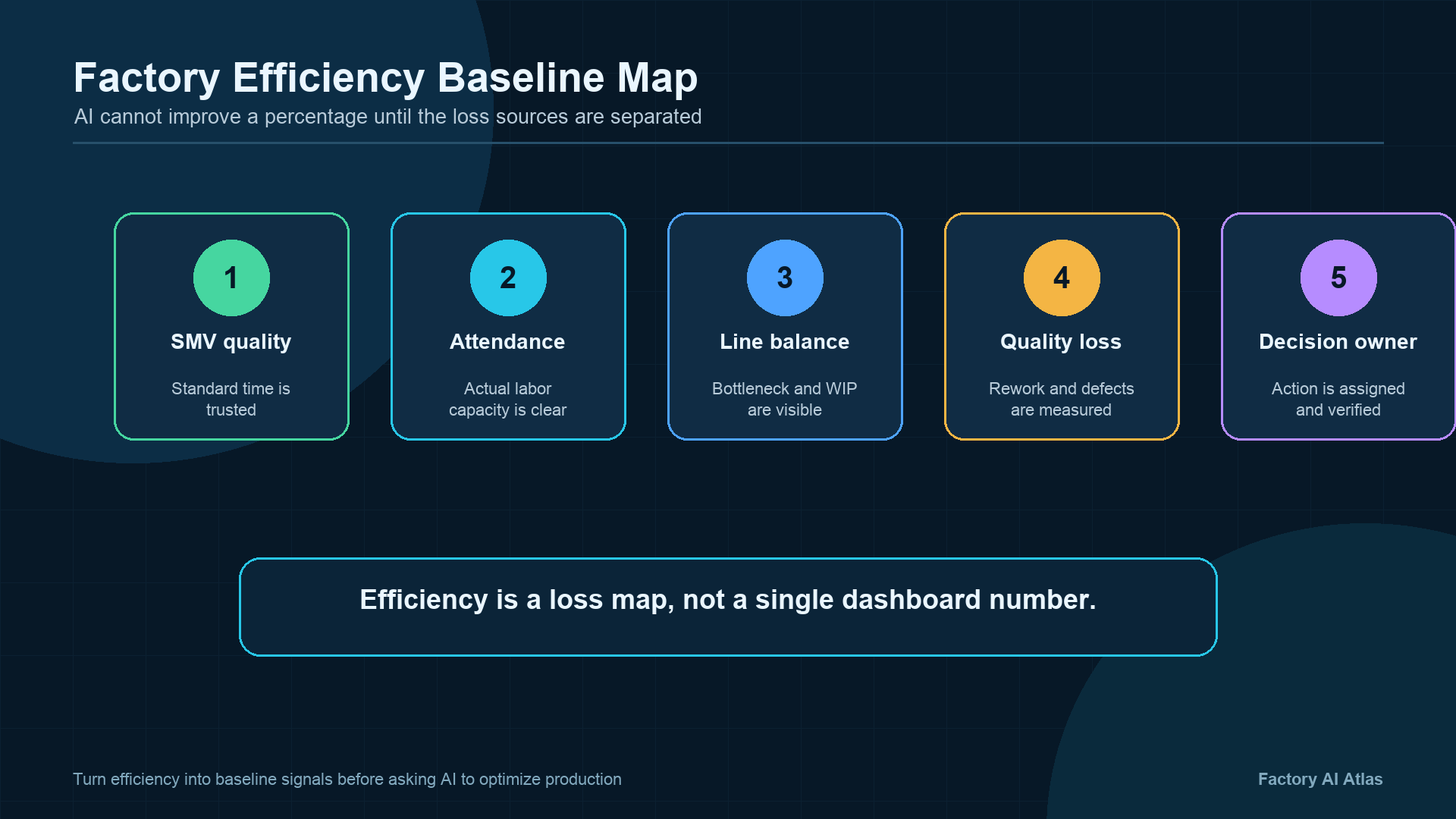
Garment efficiency baseline map
- Why efficiency is not one number
- Baseline 1: SMV and standard time quality
- Baseline 2: Attendance and learning curve
- Baseline 3: Line balance, WIP, and bottlenecks
- Baseline 4: Quality loss and rework
- Baseline 5: Planning assumptions and product mix
- Garment factory efficiency readiness checklist
Why efficiency is not one number
In many garment factories, efficiency is calculated from output, standard minute value, working time, and manpower. The basic logic is useful because it connects production results to expected work content.
However, the number can become dangerous when it is treated as a final truth instead of a question. In practice, garment factory efficiency should be read as a diagnostic signal, not as a standalone performance verdict.
Two lines may show the same efficiency percentage but have very different operating conditions. One line may be stable, balanced, and improving. Another line may reach the same number through overtime, helper work, quality sorting, supervisor intervention, or a style that is easier than the plan assumes.
The same line may also show lower efficiency for a reason that is not poor performance. A new style may still be inside the learning curve. The fabric may be difficult to handle. A critical operator may be absent. Rework may be flowing back into the line. Cutting or trims may be feeding unevenly.
For human managers, these conditions are usually visible on the floor. For Factory AI, they are invisible unless the factory records them.
That is why garment factory efficiency should be treated as a baseline to investigate, not only a score to chase.
Baseline 1: SMV and standard time quality
Efficiency depends heavily on the standard time used in the calculation. If the SMV is wrong, the efficiency number will be wrong too.
A style can look efficient because the standard time is generous. Another style can look inefficient because the standard time is too tight, the construction changed, or the method used on the floor does not match the original standard.
Before AI compares efficiency across lines or factories, it needs to understand the quality of the standard-time baseline.
Useful questions include:
- Was the SMV built from a clear method?
- Does the operation breakdown match the actual sewing sequence?
- Were attachments, work aids, fabric behavior, and quality requirements considered?
- Was the standard time reviewed after pilot run or bulk start?
- Are method changes reflected in the current standard?
- Is the same operation name used consistently across similar styles?
This connects directly to standardized work. A factory cannot expect AI to read efficiency correctly if the standard behind the number is unstable.
The goal is not to make every SMV perfect. The goal is to label the confidence level of the baseline so AI and managers know whether the comparison is fair.
Baseline 2: Attendance and learning curve
Garment production still depends heavily on human skill, coordination, and rhythm. A line’s efficiency can change when one key operator is absent, when several new workers join, or when a difficult operation is assigned to someone still learning.
This is not only an HR issue. It is an efficiency-data issue, because garment factory efficiency changes when skill coverage, attendance, and ramp-up conditions change.
If the factory records only output and manpower, AI may treat a skill gap as a general productivity problem. It may recommend pressure, manpower movement, or target changes when the real issue is training, operation coverage, or line-leader support.
Learning curve also matters. A new style cannot always be judged against a mature-style baseline on day one. The line may need time to stabilize the method, feeding, layout, quality checkpoints, and operator confidence.
A practical garment factory efficiency baseline should record:
- critical operation coverage;
- operator replacement status;
- new worker ratio;
- style start date and ramp-up day;
- training or method-correction status;
- line-leader intervention;
- overtime or fatigue condition.
With this context, Factory AI can become more useful. It can separate normal ramp-up from abnormal loss. It can compare a line against a fairer baseline. It can help managers see where coaching or skill backup is needed.
Baseline 3: Line balance, WIP, and bottlenecks
Efficiency can hide line-balance problems. A line may produce enough pieces for part of the day and still be unstable because WIP is building before one operation while downstream stations wait.
This is why the previous article focused on garment line balancing. Efficiency is the result. Line balance explains the flow behind the result.
If Factory AI sees only daily efficiency, it may miss the bottleneck. It may not know whether the line needs manpower, method improvement, feeding support, work-aid redesign, machine adjustment, or quality intervention.
For AI-readiness, the factory should connect efficiency data to flow signals:
- hourly output by line;
- operation-level bottleneck notes;
- WIP accumulation points;
- waiting or starvation at downstream operations;
- helper work and support tasks;
- balance changes made during the day;
- reason codes for line interruption.
When this information is connected, garment factory efficiency becomes more than a percentage. It becomes a diagnosis path.
A good AI assistant should not simply say, “Efficiency is low.” It should help ask, “Which constraint is making this efficiency number low, and has that constraint appeared before?”
Baseline 4: Quality loss and rework
Poor quality often appears as lost time. In sewing production, defects do not only affect inspection results. They also affect flow, output, manpower, supervisor time, and delivery risk.
If rework is mixed into normal production, garment factory efficiency can become misleading. The line may appear slow, but the root cause may be repeated repairs, late inline detection, unclear workmanship standards, shade or measurement issues, or a difficult operation creating quality interruptions.
Factory AI needs quality context because productivity and quality are connected on the shop floor.
Useful signals include:
- inline defect trend by operation;
- rework quantity separated from first-pass output;
- repair time or repeated handling;
- quality checkpoint location;
- defect cause linked to method, machine, material, or training;
- whether quality loss creates a secondary bottleneck.
Without this context, AI may recommend speeding up a line that actually needs method correction or quality containment. That can make the factory worse, not better.
A realistic AI system should help managers see when efficiency loss is really quality loss in another form.
Baseline 5: Planning assumptions and product mix
Factories often compare efficiency between lines, departments, or factories. This can be useful, but only when the comparison is fair.
Garment styles are not equal. Product mix changes everything: fabric type, construction difficulty, trim complexity, size ratio, color count, order quantity, buyer requirement, inspection pressure, and changeover frequency.
A line producing a repeat basic style should not be compared casually with a line starting a complicated new style. A factory producing short runs with frequent changeover should not be judged the same way as a factory running long, stable programs without normalizing the operating conditions.
For Factory AI, planning assumptions are part of the efficiency baseline.
The system should know:
- style complexity and construction type;
- repeat style versus new style;
- order quantity and run length;
- planned manpower and actual manpower;
- planned working hours and actual working hours;
- changeover frequency;
- material or trim readiness;
- cutting and feeding stability;
- quality and inspection requirement level.
This does not mean the factory needs a perfect data warehouse before improving. It means the factory should stop treating every efficiency number as equally comparable.
AI becomes more credible when it compares similar conditions, explains the assumptions, and warns when the baseline is not fair.
Garment factory efficiency readiness checklist
Before using AI to improve production efficiency, a garment factory should ask whether its baseline can answer practical questions:
- Is the SMV current and linked to the actual method?
- Can we separate new-style ramp-up from mature-style performance?
- Do we record attendance, critical skill replacement, and new worker ratio?
- Can we connect efficiency to line balance, WIP, and bottleneck notes?
- Can we separate first-pass output from rework and repair handling?
- Do quality issues feed back into productivity analysis?
- Are product mix, order size, and changeover conditions visible?
- Can supervisors explain why the number moved, not only report that it moved?
- Can similar styles or similar line conditions be compared fairly?
- Can the factory use efficiency data without exposing private buyer, factory, style, or order details outside the organization?
If these questions are weak, the first AI project should not be an advanced optimization engine. It should be a baseline-cleaning project.
External validation anchors for garment efficiency data
- ILO textiles, apparel, leather and footwear sector resources — useful context for productivity, skills, and working-condition assumptions.
- Better Work reports and publications — helpful for connecting productivity improvement with factory operating reality and compliance discipline.
Final efficiency-baseline takeaway
Garment factory efficiency matters. But it should not be treated as a simple scoreboard.
For Factory AI, efficiency is useful only when the factory can explain what sits behind it: method quality, standard time confidence, attendance, learning curve, line balance, WIP, quality loss, rework, changeover, and planning assumptions.
Once those baselines are visible, AI can use garment factory efficiency context to compare similar styles, detect abnormal loss, retrieve previous improvement cases, support capacity planning, and guide managers toward the right constraint.
Before AI improves production, it must first understand what the efficiency number really means.
That is why garment factory efficiency is not the end of the IE sequence. It is the baseline that connects IE knowledge to practical Factory AI decisions.
Related Factory AI Atlas reading
- Cycle Time: 5 Practical Lessons for Factory AI
- Why Garment Factory Kaizen Is Still About Motion, Not Robots
- Garment Standard Time: From Method Improvement to Factory AI
- Garment Line Balancing: Why Bottlenecks Break Factory AI Before Robots Begin
- AI Apparel Costing: 7 Essential Ways to Support ME and IE Teams
- Factory Data Readiness for Garment AI
- Lean Enterprise Institute: Standardized Work
- Lean Enterprise Institute: Takt Time