
Readiness-checklist buying note
An AI readiness checklist should protect the factory from buying tools before the process can learn. The checklist is not a paperwork exercise; it is a budget gate for problem clarity, baseline loss, data reliability, owner discipline, and action rules.
Vendor selection starts before readiness is proven
The common mistake is to answer readiness questions optimistically during vendor selection and then discover during the pilot that definitions, data capture, line ownership, and follow-up routines are not stable enough to support AI.
Checks before using the AI readiness checklist
- Can the factory name the exact loss, baseline, decision owner, and expected action before choosing a model or platform?
- Are the data definitions consistent across shifts, departments, buyers, machines, and production styles?
- Is there a stop rule for cases where the pilot exposes weak process discipline rather than a technology gap?
Proof requests for readiness claims
- Map every readiness question to the vendor’s required data, integration, user role, and operating assumption.
- Show what happens when required data is missing, late, inconsistent, or manually overridden.
- Provide a pilot plan that reports process-readiness findings separately from model performance.
Checklist-to-pilot gate
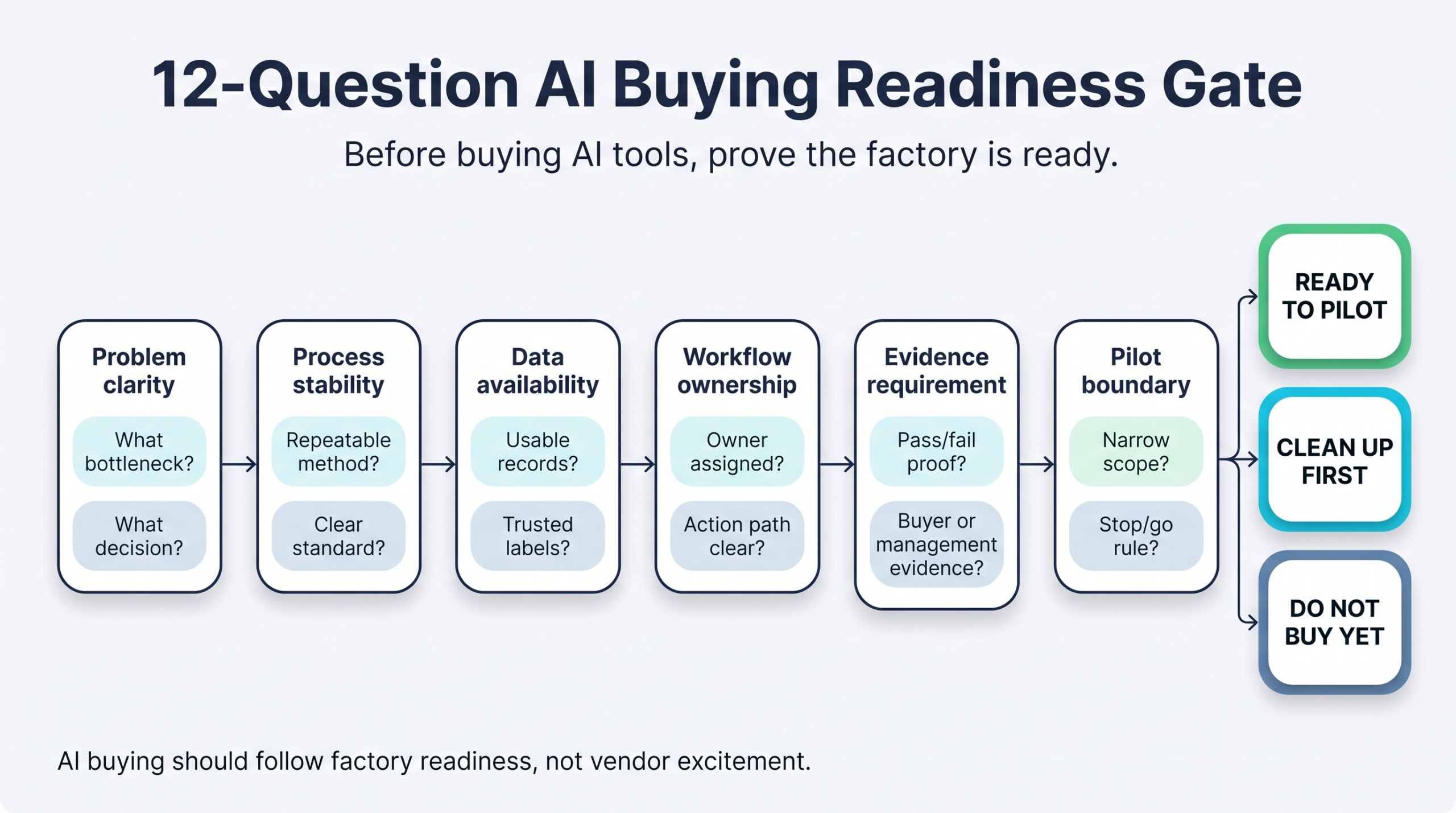
GO if readiness checks identify a narrow, measurable factory decision. HOLD if the use case is good but baseline or ownership is weak. REDESIGN if the checklist becomes a justification document instead of a risk filter.
Many factories start their AI journey with the wrong first question.
A readiness checklist is useful only if it can stop budget momentum. If the answer exposes weak baseline data, unclear ownership, or unstable definitions, the checklist should force a smaller pilot or a redesign before vendor selection continues.
They ask, “Which AI tool should we buy?” or “Which vendor has the best demo?” Sometimes they start with cameras, dashboards, chatbots, robots, or predictive maintenance software.
Those questions are not useless. But they are not the first questions. Before buying AI tools, a factory should ask a more basic question: are we ready to make this tool work in our real operating environment?
This Factory AI readiness checklist is designed for that moment. It helps factory leaders test whether the process, data, people, quality system, and business case are ready before money is spent on an AI pilot. It is also a practical first step before Physical AI in smart manufacturing moves from analysis to real shop-floor action.
Why factories buy AI too early
AI tools often look impressive in a demo. A dashboard summarizes production status. A vision model detects defects. A chatbot answers questions from documents. A robot moves materials. A planning assistant suggests priorities.
But factory reality is different from a demo. Production data may be late. Defect names may not be standardized. Operators may use different terms for the same issue. WIP locations may change during the day. Approval rules may live in people’s heads instead of systems. A process may look stable in a report but behave differently on the floor.
When these basics are not ready, the AI project does not fail because the model is weak. It fails because the operating system around the model is weak.
A practical Factory AI readiness checklist prevents this mistake. It does not ask whether AI is exciting. It asks whether the factory has enough structure to turn AI output into reliable action.
1. What exact factory problem are we solving?
The first question is not about technology. It is about the operational problem.
A factory should be able to describe the target problem in one clear sentence. For example: reduce repeated endline defects, identify shipment-risk WIP earlier, shorten maintenance response time, improve line balancing decisions, or reduce manual reporting time.
If the problem is described only as “we need AI,” the project is not ready. AI should be attached to a measurable workflow, not to a vague modernization goal.
2. Is the process stable enough to learn from?
AI works best when the underlying process has some repeatable structure. It does not require perfection, but it does require a pattern.
If the same production issue is handled five different ways by five different supervisors, an AI system will struggle to recommend the right next step. If defect classification changes by customer, line, inspector, or shift without documentation, an AI vision project will become confusing very quickly.
Before buying tools, check whether the target process has a defined flow, clear checkpoints, known exceptions, and stable responsibilities. If not, process cleanup may be the first AI investment.
For this reason, a Factory AI readiness checklist should be reviewed before vendor demos, not after the purchase decision has already been made.
3. Do we have usable data, not just data?
Many factories have data, but not all data is usable for AI. Excel files, ERP exports, QC reports, maintenance logs, inspection photos, shipment records, and line reports may exist, but they may not connect cleanly.
Usable data has a few basic qualities. It is recent enough, structured enough, connected to the right process, and understandable by the people who must act on it.
For example, a defect photo library is more useful when each image is connected to style, line, operation, defect name, severity, rework result, and final decision. A production dashboard is more useful when the output number is connected to WIP status, manpower, bottleneck operation, and quality risk.
This is why a Factory AI readiness checklist should test data quality before vendor selection.
4. Are terms and definitions standardized?
Factories often underestimate vocabulary. AI systems need consistent meaning. If “repair,” “rework,” “alteration,” “reject,” and “hold” are used casually, the system may misunderstand risk.
This matters in garment factories. A carton may be packed but not released. A WIP rack may contain normal sewing WIP, shade-band separation, rejected panels, or urgent shipment pieces. An inspection table may represent inline check, endline check, measurement, buyer audit preparation, or CAPA review.
The article on Factory AI semantic maps explains this problem in more detail. AI does not only need to know where something is. It needs to know what it means.
5. Who owns the decision after AI gives an answer?
An AI recommendation is not the same as a factory decision. Someone must own the action.
If AI flags a defect trend, who responds first: line leader, QA supervisor, IE, production manager, or merchandiser? If AI predicts shipment delay, who changes the plan? If AI suggests a maintenance priority, who has authority to stop the machine?
Without ownership, AI becomes another report. The dashboard may be accurate, but nothing changes. Readiness means the factory knows who acts, when they act, and what evidence they need.
A Factory AI readiness checklist also helps leaders compare AI vendors against real factory constraints instead of demo quality alone.
6. Can operators and supervisors use the output?
AI adoption is not only a management issue. Operators, line leaders, mechanics, inspectors, and supervisors often determine whether an AI tool becomes useful or ignored.
A factory should ask whether the output is understandable at the user level. Does the line leader know what to do with the alert? Does the QA inspector trust the classification? Does the IE team understand the dashboard logic? Does the supervisor see the system as support, or as surveillance?
The Operator Skill Matrix is useful here because skills, training, and task capability affect AI readiness. If people cannot interpret or act on AI output, the tool will not create factory value.
7. Is the quality system ready for AI evidence?
AI in factories often touches quality. Visual inspection, defect classification, measurement review, claim investigation, and CAPA tracking all depend on evidence.
Before buying an AI quality tool, check whether the current quality system can store and use evidence properly. Are defect names consistent? Are photos linked to orders and operations? Are pass/fail rules documented? Are rework results recorded? Are buyer-specific standards separated from internal standards?
For visual projects, the article on AI visual inspection in garment factories is a useful companion. The tool is only as good as the evidence and decision rules around it.
8. Is the pilot small enough to prove value?
A good AI pilot is not a full factory transformation. It is a controlled test of one workflow, one problem, one decision loop, and one success metric.
For example, instead of “AI for quality,” start with “detect and reduce repeated open-seam defects on two sewing lines over six weeks.” Instead of “AI for planning,” start with “identify shipment-risk styles earlier using WIP, output, quality hold, and packing status.”
The smaller the pilot, the easier it is to learn. The goal is not to prove that AI is magical. The goal is to prove that one factory decision can become faster, clearer, or more reliable.
At this stage, the Factory AI readiness checklist becomes a practical pilot gate, not a theoretical document.
9. Do we know the baseline?
Factories cannot calculate AI value without a baseline. Before starting a pilot, measure the current condition.
How long does the current task take? How often does the problem occur? What is the defect rate? How many hours are spent making reports? How many shipment risks are identified too late? How much rework is repeated? How often does maintenance response delay production?
If the baseline is missing, the pilot may still feel successful, but the business case will be weak. A readiness checklist should force baseline thinking before purchase approval.
10. What risk controls are required?
Factory AI can affect production, quality, people, and customer commitments. That means risk control is not optional.
The NIST AI Risk Management Framework is useful because it frames AI around governance, mapping, measurement, and management of risk. A factory does not need a complex policy document on day one, but it does need basic guardrails.
Ask simple questions. What decisions can AI support but not make alone? When must a human review the output? What data should not be used? How are errors recorded? Who can override the system? How do we prevent over-trust in a dashboard or model?
AI readiness is not only technical readiness. It is also management readiness.
11. Can the system connect to existing work?
An AI tool that sits outside the daily workflow will be hard to sustain. The factory should know how the tool connects to existing reports, ERP, MES, QC records, Excel files, communication channels, and review meetings.
This does not mean every system must be fully integrated on day one. But the workflow must be clear. If AI detects a problem, where does the result go? If a supervisor confirms the issue, where is that confirmation stored? If the pilot succeeds, what will be scaled next?
The article on Physical AI vs Generative AI is helpful here. Some tools support knowledge work. Others affect physical movement. Each type needs a different integration plan.
12. What will we stop doing if the AI works?
This is one of the most important questions in the entire Factory AI readiness checklist.
If the AI tool works, what manual report, meeting, rechecking activity, waiting time, duplicate entry, or firefighting loop will be reduced? If nothing changes, the factory may add AI on top of existing work instead of improving the system.
AI value comes from changed decisions and reduced friction. A tool that creates more screenshots, more dashboards, and more meetings may be interesting, but it may not be valuable.
A practical 12-question Factory AI readiness checklist
Before buying AI tools, review these questions with production, quality, IE, maintenance, IT, and management together.
- What exact factory problem are we solving?
- Is the target process stable enough to learn from?
- Do we have usable data, not just data?
- Are key terms and definitions standardized?
- Who owns the decision after AI gives an answer?
- Can operators and supervisors use the output?
- Is the quality system ready for AI evidence?
- Is the pilot small enough to prove value?
- Do we know the current baseline?
- What risk controls are required?
- Can the system connect to existing work?
- What will we stop doing if the AI works?
If the answers are weak, that does not mean the factory should avoid AI. It means the first project may need to be readiness work: process mapping, data cleanup, skill matrix improvement, defect taxonomy, baseline measurement, or pilot scoping.
How to use this checklist before vendor selection
A simple scoring method can help. For each question, score the factory from 0 to 2.
- 0: not ready or unclear.
- 1: partly ready, but gaps remain.
- 2: ready enough for a controlled pilot.
A total score below 12 suggests that the factory should improve foundations before buying tools. A score between 12 and 18 suggests that a narrow pilot may be possible if the risk is controlled. A score above 18 suggests that the factory may be ready for vendor comparison and pilot design.
For a broader self-assessment, compare this article with the Factory AI readiness scorecard and the main Factory AI readiness hub.
Final readiness-buying takeaway
AI tools can help factories. But they do not remove the need for clear processes, reliable data, trained people, quality discipline, and management ownership.
The best factories will not buy AI because the demo looks impressive. They will buy AI when the operating problem is clear, the data is usable, the decision owner is known, and the pilot can prove value.
That is the purpose of a Factory AI readiness checklist. It turns AI from a technology purchase into an operational decision.
Factory AI readiness source anchors
A readiness checklist should not be treated as a sales form. It should be tested against external anchors such as the NIST AI Risk Management Framework, NIST smart manufacturing resources, and NIST manufacturing resources. For factory leaders, those references translate into practical gates: stable process evidence, known risk controls, clear ownership, and a pilot small enough to prove value before expanding spend.
- NIST AI Risk Management Framework — useful for readiness questions around validity, reliability, governance, and human oversight.
- NIST manufacturing resources — relevant for tying AI readiness to measurable manufacturing evidence and process capability.