Turn factory AI questions into operating decisions.
Use this page as the practical checklist hub before approving a robot, AI pilot, vendor demo, or garment automation investment. The goal is not to collect more tools. The goal is to decide what is ready, what needs evidence, and what should wait.
Use checklists as operating gates, not document storage.
This audit-board view shows how FAA checklists convert AI interest into process stability checks, data-quality signals, ownership questions, vendor proof requests, and ROI baselines.
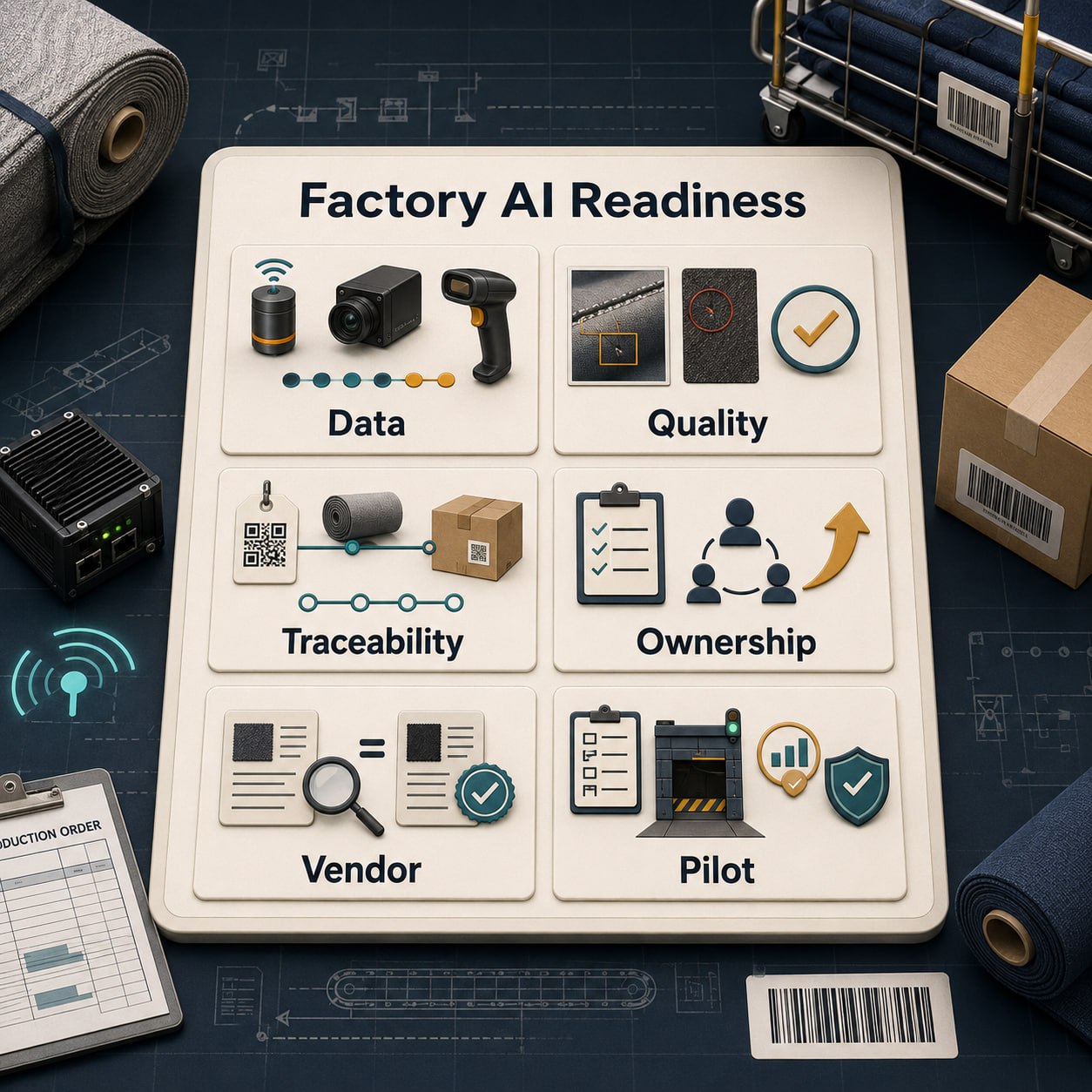
Checklist thinking before buying automation.
The checklists are for factory leaders, IE/ME teams, production managers, QC teams, IT/OT owners, and vendor-evaluation teams who need practical evidence before committing to AI, robotics, edge systems, or apparel automation pilots.
Factory leaders
Use the scorecard to separate operational readiness from a persuasive vendor presentation.
IE / ME and production teams
Use baseline and process-control questions to check whether cycle time, WIP, rework, and operator decisions are measurable.
QC, safety, and IT/OT owners
Use risk questions before a pilot creates quality, maintenance, safety, or data-integration problems.
Use the checklists in four passes.
A good factory AI decision moves from readiness to economics to pilot risk, then only finally to vendor selection.
Stabilize the process
Confirm the target work is observable, repeatable enough, and measured before adding AI or robots.
Test the ROI logic
Separate real cost drivers from optimistic savings assumptions and missing integration costs.
Choose a lower-risk pilot
Start where route, zone, task boundary, human fallback, and measurement window are clear.
Challenge vendor claims
Ask for proof under your materials, changeovers, QC tolerances, and factory constraints.
Four practical checklist families.
These are intentionally short. They should fit into a meeting before a larger pilot, purchase request, or vendor evaluation.
Factory AI Readiness Checklist
Check whether the target process has the basic operating conditions needed for an AI or robot pilot.
- Inputs, outputs, defects, WIP, and rework are recorded consistently.
- Production, QC, maintenance, IT/OT, and safety owners are identified.
- The pilot has a stop/go rule before spending expands.
Robot ROI Pre-Investment Checklist
Test whether the business case survives real factory conditions, not only a sales-deck payback model.
- Labor, downtime, scrap, quality, and rework baselines are known.
- Maintenance, tooling, fixture, training, and integration costs are included.
- Payback is tested under conservative and normal cases.
Garment Automation Reality Check
Use this before treating cutting, sewing, finishing, packing, and inspection as one generic automation problem.
- Fabric behavior, style changes, and operator micro-decisions are mapped.
- QC tolerance and buyer requirements are clear.
- Automation starts where WIP visibility and process control are strongest.
Lower-Risk Robot Pilot Checklist
Choose a pilot that can be measured without disrupting the main bottleneck or hiding behind vague innovation language.
- The task has a defined route, zone, or boundary.
- Human fallback and maintenance routines are assigned.
- Results can be measured in 30–90 days.
Which checklist should you use first?
Start with the decision you need to make. Do not start with the tool category.
Before a pilot expands, require evidence.
- A baseline was captured before the pilot.
- The target process owner accepts the problem definition.
- Safety, maintenance, and fallback work are assigned.
- Quality impact is measured separately from throughput.
- The next spending step depends on a written stop/go rule.
Red flag
If the proposed pilot cannot explain what will be measured in 30–90 days, it is probably still a demo, not a factory improvement project.
Factory AI Atlas treats demos as learning activities. It treats investment decisions as evidence-based operating decisions.
Build the checklist path into a reading path.
Use these public resources to support checklist discussions and avoid starting from a blank page.
Factory AI Readiness Hub
The main hub for readiness, stack logic, validation gates, and vendor hype decoding.
Open hub →5 Validation Gates
A focused article on what should be true before AI or robot pilots expand.
Read article →GSD, SAM, SMV data layer
Why apparel standard-time data matters before advanced factory AI claims.
Read article →Broken needle traceability
A practical control-point digitization example for factory AI readiness.
Read article →Factory Mobile Robots
Checks before choosing AGV, AMR, cleaning robots, or mobile factory vehicles.
Read article →Articles Library
Continue into broader Factory AI Atlas articles and field-lens explainers.
Browse articles →Start with one process, not one technology category.
Pick one target process, run the readiness scorecard, then use the ROI and pilot checklists only if the operating evidence is strong enough.