Physical-AI use-case decision note
Physical AI use cases should be approved as staged factory-learning projects, not as a shortcut to robots. The practical decision is whether the use case improves a real production decision first: inspection, work instruction, bottleneck response, maintenance timing, material movement, safety control, or automation readiness.
Robot-first pilots skip process evidence
The common mistake is to group every sensor, camera, dashboard, and robot idea under one Physical AI budget. That hides which process is ready, which data is trustworthy, and which human decision still needs to stay in control.
Checks before choosing a Physical AI use case
- Which use case has the clearest decision owner and measurable factory loss?
- Does the factory already capture enough process, quality, maintenance, safety, or material-flow evidence to support the use case?
- Can the pilot prove improvement without depending on a full robot deployment?
Proof requests for Physical AI use-case fit
- Show the use case as a decision flow from physical signal to human or system action.
- Separate model accuracy, workflow adoption, downtime impact, safety risk, and ROI assumptions.
- Provide a staged rollout plan that starts with decision support before autonomous action.
Use-case readiness gate
GO if the use case improves a repeatable factory decision. HOLD if the idea is promising but the data owner is unclear. REDESIGN if the project jumps from sensing to automation without proving the operating decision.
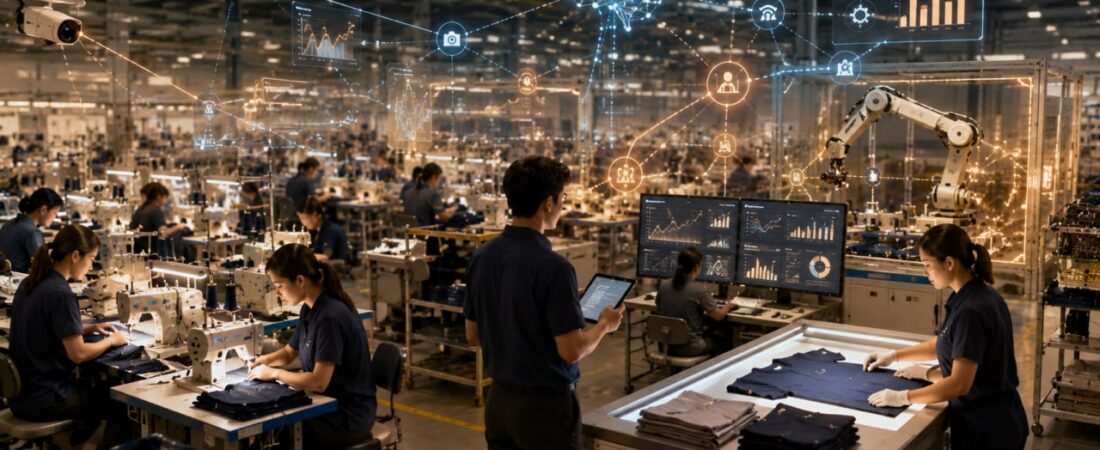
Physical AI in manufacturing is often imagined as humanoid robots walking through factories, picking up parts, sewing garments, loading machines, or replacing operators.
That future may come. But for most factories, especially apparel, textile, footwear, electronics assembly, packaging, and mixed-model production environments, the first practical wave of Physical AI will look less dramatic and more operational.
It will appear as AI systems that can see, sense, decide, guide, adjust, and assist physical operations before full robot automation becomes realistic.
Physical AI in manufacturing becomes practical when it improves real floor decisions before a factory buys robots.
In other words, Physical AI is not only about robots. It is about connecting AI to the real factory floor: machines, operators, cameras, sensors, quality checkpoints, material movement, standard-time data, downtime events, and production decisions.
For factory leaders, the better question is not “When will robots replace workers?” The better question is: which physical operations can AI understand and improve today, before the factory invests in full automation?
Factory answer: what Physical AI means in manufacturing
Physical AI in manufacturing refers to AI systems that interact with the physical factory environment through cameras, sensors, machines, robots, operators, and production data.
For factory leaders, Physical AI in manufacturing should be evaluated by operational impact, not by how futuristic the technology looks.
Unlike generative AI, which mainly creates text, images, or code, Physical AI must understand real-world constraints such as machine speed, operator motion, material variation, defect visibility, cycle time, downtime, layout distance, safety risk, production flow, and quality tolerance.
In a factory, Physical AI becomes valuable when it helps teams make better decisions about physical work. That may include identifying defects, guiding operators, predicting machine problems, balancing production lines, supporting maintenance, or preparing the data layer needed for future robot automation.
Why Physical AI Usually Comes Before Full Robot Automation
Many factory owners want robots. But robots do not succeed in weak operating systems.
If a factory does not have stable processes, clear work methods, reliable standard times, consistent quality definitions, and clean production data, robots often expose the weakness instead of solving it.
This is especially true in garment and apparel manufacturing. Fabric is flexible, parts deform, sewing quality depends on handling skill, and each style can change the operation sequence.
Before buying advanced robots, factories often need AI systems that improve the readiness layer:
- Can the factory see defects early?
- Can standard time be trusted?
- Can line balance be measured daily?
- Can operators receive better guidance?
- Can machine downtime be captured accurately?
- Can the factory separate automation potential from automation fantasy?
This is where Physical AI becomes practical. It creates the bridge between today’s human-centered factory and tomorrow’s more automated factory.
That is why Physical AI in manufacturing should usually start with visibility, guidance, and readiness scoring before major automation spend.
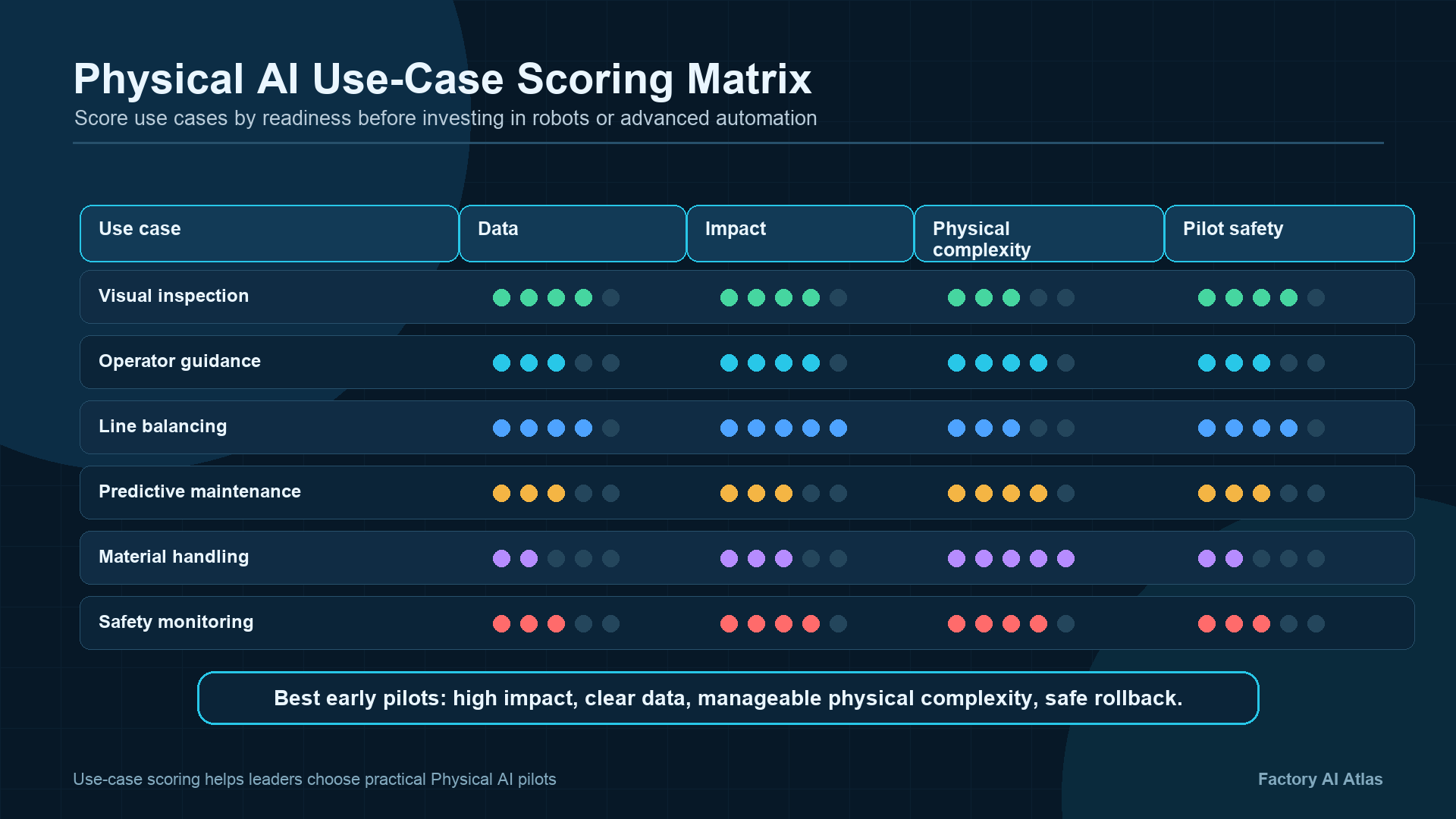
1. AI Visual Inspection for Quality Control
The most immediate Physical AI use case in many factories is visual inspection.
Cameras and AI vision models can detect surface defects, missing components, wrong labels, stains, scratches, shape problems, color mismatch, and assembly errors.
In traditional quality control, inspection depends heavily on human eyesight, experience, fatigue level, lighting condition, and sampling discipline. Physical AI can support QC teams by providing more consistent detection.
For garment factories, this can include fabric defect detection, stain detection, measurement deviation flagging, seam puckering detection, skipped stitch detection, label verification, color shading comparison, and carton label checking.
This does not mean AI should replace all inspectors immediately. A more realistic approach is AI-assisted inspection: the AI flags suspicious items, the human QC confirms the issue, and the system records defect patterns for corrective action.
2. Operator Guidance and Digital Work Instructions
Another practical Physical AI use case is operator guidance.
Factories often depend on supervisors, line leaders, mechanics, and experienced operators to explain work methods. But instructions are not always consistent across shifts, lines, or styles.
In garment factories, small changes in handling method can affect sewing quality, cycle time, rework rate, operator learning curve, line balance, and first-pass yield.
Physical AI can support operators with visual work instructions, step-by-step operation guidance, machine setting recommendations, quality checkpoints, handling reminders, style changeover support, and training prompts for new operators.
Operator guidance is not as exciting as a robot arm. But it can create faster ROI because it improves human work before replacing human work.
3. Line Balancing and Bottleneck Detection
Production lines often lose output not because every operation is slow, but because a few operations create bottlenecks.
Traditional line balancing depends on IE teams, supervisors, manual observation, and production reports. Physical AI can improve this by combining standard-time data, real-time output, WIP movement, operator performance, machine downtime, defect and rework data, and layout constraints.
In garment manufacturing, line balance changes with style complexity, operator skill mix, machine availability, feeding discipline, bundle size, quality rework, absenteeism, and the learning curve during the first days of production.
Physical AI can help identify the current bottleneck, whether it is caused by skill, method, machine, material, or quality, and whether manpower, WIP, method, or standard time needs adjustment.
This connects directly to standard-time data for Factory AI. A factory cannot automate what it cannot measure.
4. Predictive Maintenance and Machine Condition Monitoring
Physical AI can also improve maintenance.
Factories often perform maintenance after breakdown, based on fixed schedules, or based on mechanic experience. Predictive maintenance adds another layer by reading machine signals, usage patterns, vibration, temperature, pressure, sound, error codes, or downtime history.
In garment factories, predictive maintenance may start with simple downtime intelligence before advanced sensors are added: which machine breaks down most often, which machine type causes the most line stoppage, and which maintenance problem affects quality as well as uptime.
Physical AI does not always need expensive sensors from day one. A practical starting point is structured downtime capture. Once the factory records machine issues consistently, AI can identify patterns and recommend preventive action.
5. Material Handling and Internal Logistics Optimization
Full autonomous robots may eventually move materials across factories. But before that, Physical AI can improve internal logistics decisions.
Many factories lose time through delayed input feeding, wrong bundle sequence, excess WIP, missing trims, fabric roll mismatch, long walking distance, unclear storage locations, inefficient layout, or packing congestion.
Physical AI can combine location data, production schedules, WIP status, and layout information to recommend better movement.
If the factory does not know what should move, when it should move, and where it should go, adding robots may only automate confusion.
6. Safety Monitoring and Risk Detection
Physical AI can help factories improve safety by detecting unsafe conditions.
This may include workers entering restricted zones, missing PPE, unsafe machine posture, blocked emergency exits, forklift and pedestrian conflict, abnormal heat or smoke, unsafe stacking, excessive crowding, or fatigue-related risk indicators.
In garment and light manufacturing, safety monitoring may focus on electrical panel access, aisle blockage, needle or cutting area safety, boiler and compressor areas, chemical handling, fire exits, and overcrowded finishing or packing zones.
This area requires careful governance. Factories should define what is monitored, why it is monitored, who receives alerts, how worker privacy is protected, and whether data is used for prevention rather than unfair punishment.
7. Automation Readiness Scoring Before Robot Investment
One of the most important Physical AI use cases is automation readiness scoring.
Before investing in robots, factories need to know whether a process is actually ready. Many automation projects fail because the process was not stable enough.
A factory may buy a robot for an operation that appears repetitive, but the real floor condition includes unstable material quality, frequent style changes, inconsistent feeding, unclear defect standards, hidden rework, poor machine maintenance, inaccurate standard time, weak fixture control, and layout constraints.
Physical AI can evaluate these conditions before capital investment by scoring repetition level, variation level, cycle time stability, quality risk, material handling difficulty, tooling requirement, changeover frequency, data quality, maintenance complexity, and expected payback period.
This is especially useful for garment factories considering sewing automation. For investment review, connect this with a robot automation ROI checklist.
Physical AI use-case source anchors
- NIST manufacturing resources — useful for grounding physical-system improvement in measurement and process evidence.
- OSHA robotics guidance — relevant when physical AI pilots interact with workers, equipment, and safety boundaries.
Physical AI vs Robot Automation: The Practical Difference
Physical AI and robot automation are related, but they are not the same.
Robot automation is about machines performing physical tasks. Physical AI is about intelligence connected to physical operations.
A factory can adopt Physical AI before adopting robots: AI inspection can support QC before robotic handling, AI line balancing can improve output before automated sewing, AI maintenance prediction can reduce downtime before machine upgrades, and AI readiness scoring can prevent poor robot investment.
For a broader definition, see what Physical AI means for smart manufacturing.
Where Garment Factories Should Start
- Standardize the data layer: operation bulletin, SAM/SMV, defect codes, downtime codes, operator skill matrix, line output data, and rework data.
- Select one high-value use case: visual inspection, bottleneck detection, downtime analysis, operator training, or automation readiness scoring.
- Keep humans in the loop: supervisors, IE teams, QC teams, mechanics, and operators must trust the recommendation.
- Connect AI to ROI: every project should connect to defect reduction, rework reduction, downtime reduction, output improvement, learning curve reduction, line balance improvement, or lower automation risk.
For apparel operations specifically, this is why garment factory automation is difficult and why AI sewing machines may come before full sewing robots.
Common Mistakes When Factories Adopt Physical AI
Physical AI factory-leader source notes
For governance and implementation discipline, factory teams can compare Physical AI projects with the NIST AI Risk Management Framework. For the broader production-systems context, NIST also maintains a smart manufacturing resource page.
These references do not replace factory-floor validation. They help management frame risk, measurement, and system integration before deploying Physical AI in manufacturing.
Mistake 1: Starting With Robots Before Process Stability
Robots need stable input. If the process changes every day, robot performance will be inconsistent.
Mistake 2: Ignoring Standard-Time Data
Without reliable SAM, SMV, cycle time, and operation sequence data, it is difficult to evaluate productivity improvement.
Mistake 3: Treating AI as a Dashboard Only
Dashboards are useful, but Physical AI should help teams act. The key question is: what decision improves because of this AI system?
Mistake 4: Skipping the Floor Team
If supervisors, mechanics, QC, IE, and operators do not trust the system, adoption will fail.
Mistake 5: Measuring Technology Accuracy but Not Factory ROI
A model can be technically accurate but operationally useless. Factories should measure both AI performance and production impact.
Physical AI Readiness Checklist for Manufacturers
- Do we have a clear operational problem?
- Can we measure the current baseline?
- Do we have enough reliable data?
- Are defect, downtime, and operation codes standardized?
- Who owns the process after AI gives a recommendation?
- Can the AI output connect to daily management routines?
- Will the floor team trust the recommendation?
- What KPI should improve in 30, 60, or 90 days?
- Is this use case preparing us for future automation?
- Is the ROI stronger than buying equipment immediately?
Final Physical-AI takeaway: bridge use cases before robots
Physical AI in manufacturing is not only about replacing workers with robots. It is about giving factories the ability to see, understand, and improve physical operations.
For most manufacturers, the best first step is not a humanoid robot or fully autonomous production line. The better first step is practical intelligence: better inspection, better work guidance, better bottleneck visibility, better maintenance decisions, better material flow, better safety monitoring, and better automation readiness scoring.
These use cases create value before full robot automation. They also prepare the factory for smarter automation investment later.
For garment and apparel factories, this is especially important. The future of factory automation will not be won only by the company that buys the most advanced robot. It will be won by the factory that understands its process deeply enough to know where AI and automation can create real operational value.
Physical AI use-case questions
What is Physical AI in manufacturing?
Physical AI in manufacturing is AI that connects to real-world factory operations through cameras, sensors, machines, operators, robots, and production data.
Is Physical AI the same as robotics?
No. Robotics focuses on machines performing physical tasks. Physical AI is broader and includes systems that sense, analyze, guide, predict, or optimize physical operations.
What is the best first use case for Physical AI in a factory?
Common starting points include visual inspection, downtime analysis, bottleneck detection, operator guidance, and automation readiness scoring.
Can garment factories use Physical AI before sewing robots?
Yes. AI can improve quality inspection, line balancing, standard-time data, operator training, and automation readiness before full robot adoption.
Why do Physical AI projects fail?
Physical AI projects often fail when factories lack stable processes, reliable data, clear ownership, standardized defect definitions, or measurable ROI.
How does Physical AI support robot automation?
Physical AI helps identify which operations are stable, repetitive, measurable, and ready for automation, reducing the risk of buying robots for immature processes.