In this article
- 1. Start From the Operation Map, Not the Machine Brochure
- 2. The Before/After SMV Is Useful, But It Is Not the Whole ROI
- 3. The Practical ROI Formula for Sewing Automation
- 4. What to Check in the Vendor Claim
- 5. Why This Is Physical AI Thinking, Even Without a Robot
- 6. Buyer-Facing Evidence: What a Factory Should Show
- 7. Factory Decision Checklist Before Approval
- Final factory ROI check
- Related Factory AI Atlas Reading
- Public References
Many garment factories talk about automation as if the machine itself is the strategy. A supplier shows a video. The machine combines two motions. The quoted saving looks attractive. The buyer hears that the factory is investing in productivity. The management team sees a possible labor reduction.
But in a sewing factory, automation does not pay back just because a machine can perform one operation. It pays back when the operation is repeated often enough, the SMV reduction is real on the line, the saved labor can be redeployed, and quality becomes more stable instead of harder to control.
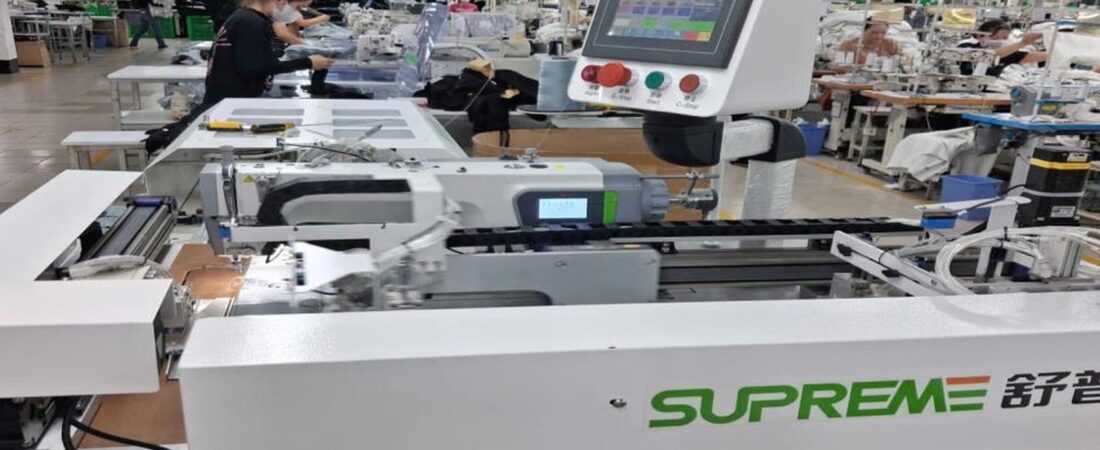
This is why a sleeve cuff machine is a useful example. It is not a futuristic robot. It is a narrow automation tool for a specific, repeated garment operation. For a factory leader, this is a sewing automation ROI problem before it is a machine-buying problem. That makes it exactly the kind of physical automation that many apparel factories should evaluate before chasing larger factory AI promises.
1. Start From the Operation Map, Not the Machine Brochure
The first question is not whether the machine can sew. The first question is which exact operation the machine removes, combines, or stabilizes.
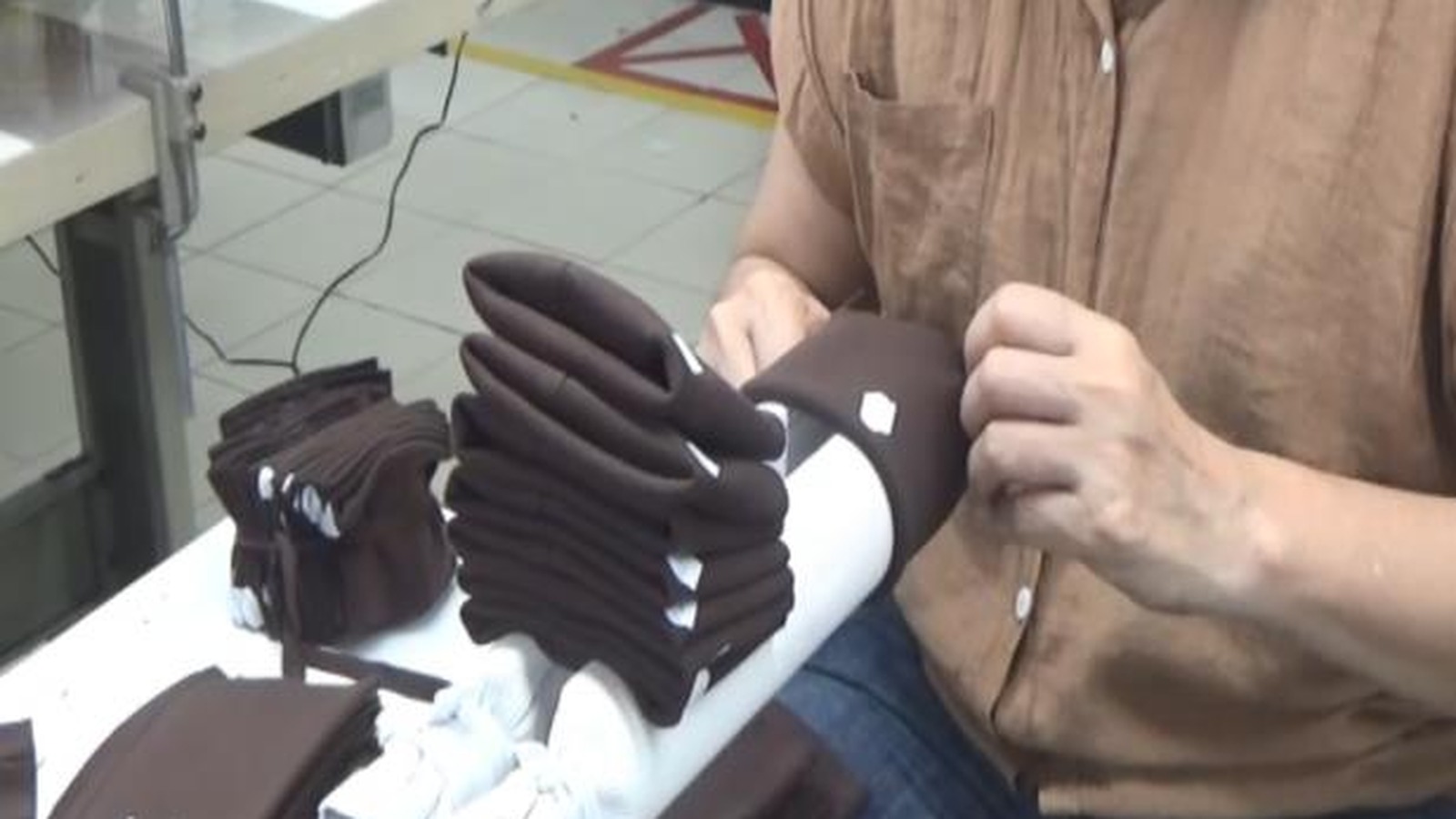
In the reference method sheet used for this draft, the current process is simple: make the sleeve cuff using an overlock process, then invert the cuff using a holder. The improved process uses an automatic cuff machine to combine the cuff-making and inversion work into one automated operation.
That change matters because it attacks a real handling sequence. The operator is not only sewing. The operator is positioning rib material, controlling alignment, handling the cuff after sewing, inverting or preparing it, and keeping the shape consistent before the part moves to the next sewing step.
For factory leaders, this is the right starting point. A sewing automation project is not a procurement project first. It is a method-improvement project first. If the method is not mapped clearly, the ROI calculation will be weak even if the machine looks impressive.
2. The Before/After SMV Is Useful, But It Is Not the Whole ROI
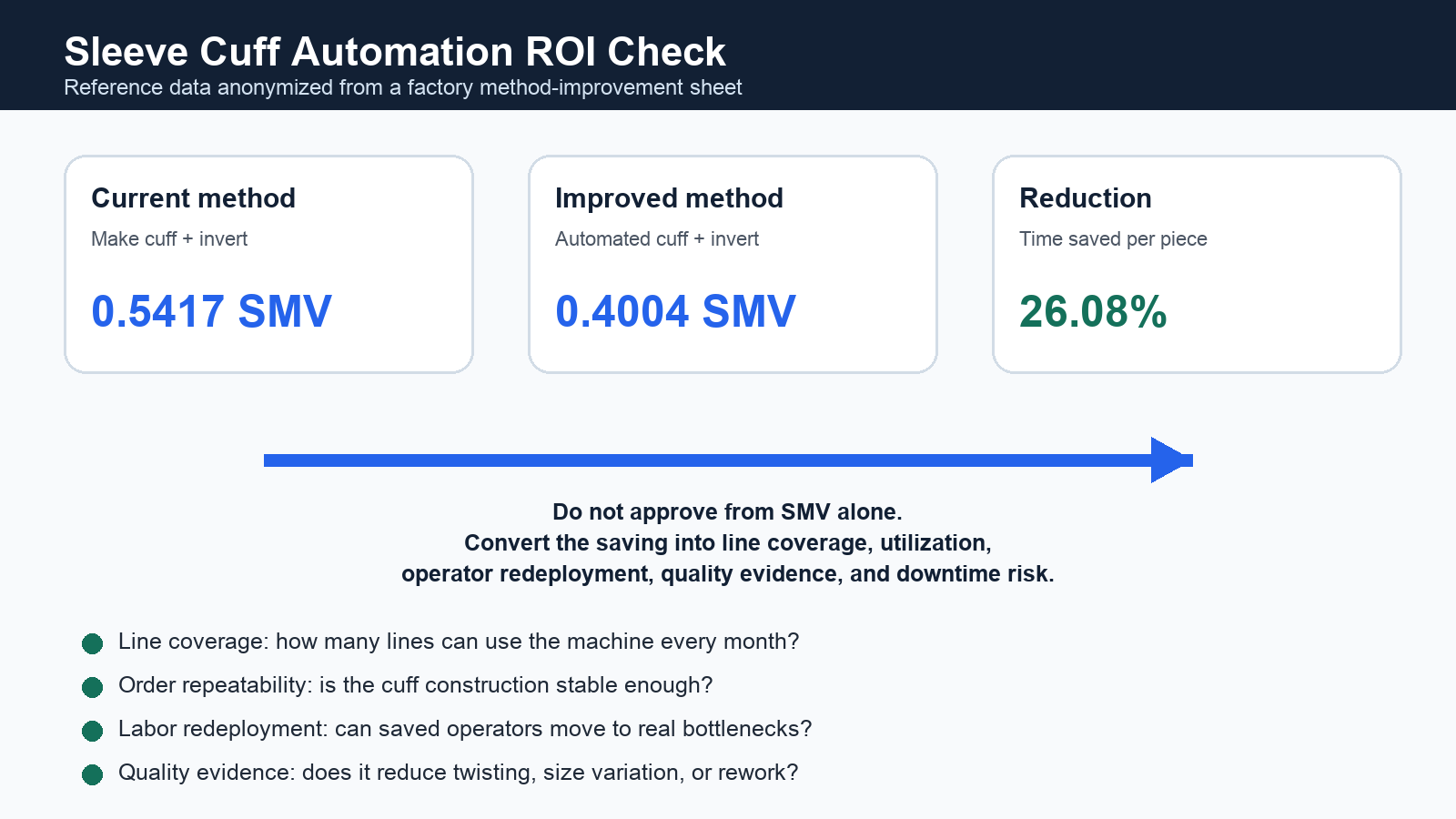
The anonymized reference data shows a clear method improvement:
- Current method: make sleeve cuff plus invert
- Current SMV: 0.5417 minutes
- Improved method: automated cuff plus invert
- Improved SMV: 0.4004 minutes
- Reduction: 0.1413 minutes per piece
- Reduction rate: about 26.08%
At first glance, a 26% reduction looks strong. But a factory should be careful. A percentage saving on one operation is not the same as a payback result for the whole investment.
The saving must be multiplied by production volume, actual utilization, the number of lines that can use the machine, and the number of months the same construction will keep running. If the machine is used only for a short seasonal order, the SMV saving may not cover the purchase, installation, maintenance, and training cost. If the machine can support repeated jacket or hoodie programs across multiple lines, the same SMV saving becomes much more meaningful.
3. The Practical ROI Formula for Sewing Automation
A useful factory calculation must keep time and money in consistent units:
Annual labor-time value = SMV saving per piece × annual applicable volume ÷ 60 × fully burdened labor cost per hour.
Annual net benefit = verified labor-time value + verified annual quality or capacity benefit − annual maintenance, training, energy, tooling, changeover, and downtime cost.
Payback period = total installed investment ÷ annual net benefit.
Annual applicable volume should already reflect realistic line coverage and utilization. An SMV reduction is operating evidence, not automatic cash savings. Count labor value only when the pilot shows a credible redeployment, overtime reduction, capacity gain, or other measurable factory benefit.
Before approving a sleeve cuff machine, the factory should calculate at least these numbers:
- SMV saving per piece: How much time is removed from the measured operation?
- Monthly applicable volume: How many pieces actually use this cuff construction?
- Line coverage: How many sewing lines can keep the machine loaded?
- Utilization rate: How many hours per day will the machine run after changeover and waiting time?
- Operator redeployment: Can the saved labor move to another bottleneck, or does it only create idle time?
- Quality impact: Does the machine reduce twisting, uneven width, seam variation, or rework?
- Maintenance readiness: Who can set, adjust, repair, and restart the machine when it stops?
This is where many automation proposals become weak. They show the SMV saving, but they do not prove monthly utilization. They show a machine running in a video, but they do not show what happens during style changeover. They claim labor saving, but they do not show where the operator goes next.
4. What to Check in the Vendor Claim
Vendor catalog pages for automatic cuff machines often highlight easy operation, automated feeding, cutting, material collection, specification switching, alarm functions, and the possibility for one operator to manage more than one machine. These claims are useful, but they must be translated into factory proof.

For example, “easy to operate” should become a training-time check. Can a normal operator run it after one day, three days, or one week? “High precision” should become a defect comparison. Does the cuff width variation actually improve? “Specification switching” should become a changeover test. How many minutes does it take to switch size or style, and who is qualified to do it?
The most important point is that catalog advantages should never remain as catalog language. They should become pilot questions.
5. Why This Is Physical AI Thinking, Even Without a Robot
In factory AI discussions, leaders often jump from software dashboards to humanoid robots. Apparel manufacturing needs a more grounded path. A sewing line is full of fabric handling, small motion decisions, alignment checks, feeding, folding, trimming, and rework prevention. These are physical problems before they are software problems.
A sleeve cuff machine is not “AI” in the generative sense. It does not write a report or answer a buyer email. But it changes the physical workflow of the factory. It reduces handling time, combines motions, and may stabilize a quality-sensitive part. That makes it part of the broader physical AI and automation roadmap for apparel factories.
The lesson is simple: factories should not wait for a perfect robot strategy before improving physical work. They can start by finding repeated operations where narrow automation creates measurable value.
6. Buyer-Facing Evidence: What a Factory Should Show
If a factory wants a buyer to understand its automation investment, it should not only say, “We bought a new machine.” The buyer needs evidence that the investment protects delivery, quality, and cost competitiveness.
A stronger buyer-facing evidence pack would include:
- Before/after method sheet
- Before/after SMV calculation
- Short operation video from the actual line
- Defect comparison before and after the pilot
- Line coverage plan by style and month
- Operator redeployment plan
- Maintenance and backup plan
- Two-to-four-week pilot result with actual output data
This kind of evidence is especially important for workwear, hoodie, jacket, and rib-cuff programs where similar operations repeat across many production lines. The more repeatable the construction, the more valuable the automation check becomes.
7. Factory Decision Checklist Before Approval
Before approving a sleeve cuff automation investment, ask these ten questions:
- Which exact operation does the machine remove, combine, or stabilize?
- What is the current measured SMV?
- What is the improved measured SMV?
- How many lines can use the machine every month?
- Is the order mix stable enough to keep utilization high?
- How long does style or size changeover take?
- Can the saved operator time be redeployed to a real bottleneck?
- Which defects should improve, and how will they be measured?
- Who owns daily setting, maintenance, and troubleshooting?
- What pilot data will be shown after two to four weeks?
Final factory ROI check
Before approving a sleeve cuff machine, I would not ask only whether the machine is faster. I would ask whether the factory has a repeated bottleneck, a measured baseline, enough monthly volume, a clear operator redeployment plan, and quality evidence that the machine can stabilize.
If those conditions are visible, the machine is not just an equipment purchase. It is a method-improvement project with a measurable factory case. If those conditions are missing, hold the budget until the pilot proves where the machine will run, which labor it frees, and which quality risk it reduces.
Related Factory AI Atlas Reading
- Physical AI in Garment Factories Starts With Data, Not Robots
- AI Lockstitch Machine Pilot: 5 Costly Factory Mistakes to Check Before Buying
- Downtime and Changeover Logs Before Predictive AI