Factory AI Atlas · Readiness Hub
Evaluate the operating conditions before the pilot.
Practical guides, checklists, and decision frameworks for evaluating Physical AI, robotics, computer vision, data readiness, safety, and automation ROI before a factory starts a pilot.
Factory AI Stack
Use the stack to find the real constraint.
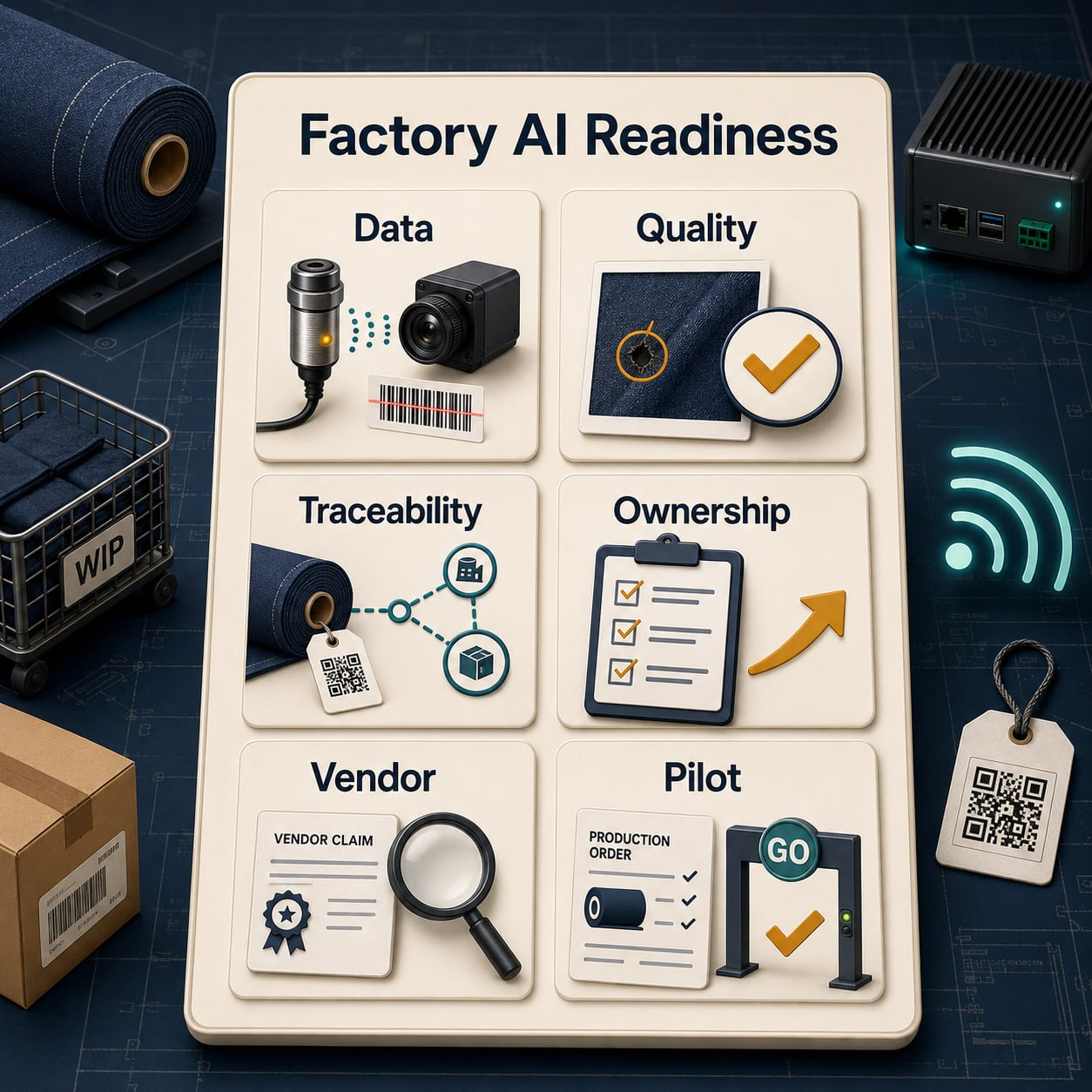
Factory AI readiness is easier to evaluate when the stack is visible: chips and edge devices, sensors and vision, robots and machines, factory systems, human workflows, and the decision layer that connects them.
The question is not only whether a tool uses AI. The question is whether the factory can sustain the process, data, safety case, integration, and operator ownership after the vendor leaves.
Start here
The Factory AI reading path
Start with the concept, test the business case, validate readiness, then review vendor claims before moving from pilot to rollout.
Understand Physical AI
Clarify how sensors, vision, robots, edge AI, and factory systems interact with physical operations.
Read the guideCheck ROI realism
Look beyond robot price and labor replacement. Include uptime, changeover, integration, maintenance, safety, and quality impact.
Review ROI checksValidate readiness gates
Confirm whether the process, data, people, safety rules, and ownership model are stable enough for a pilot.
See validation gatesApply a factory lens
Use difficult verticals like apparel manufacturing to test whether automation claims survive real material, method, and workflow variability.
Read the apparel caseBuild small operating apps
Use WIP, QC, PPC, SMV, 5S, and cutting-room apps to turn repeated daily questions into structured readiness data before robots.
Read the small-app pathStructure the cutting plan
Turn order recap, allowances, cut groups, marker planning, and draft revisions into a traceable production decision layer.
Read the cutting-plan layerGovern costing assumptions
Use AI costing as scenario support while ME/IE teams protect SAM, SMV, efficiency, and production assumptions.
Read the costing guideBuild the flexible operator layer
Use jumper pool rules, skills visibility, and deployment triggers to protect flow when bottlenecks, absenteeism, rework, or sample work disrupt the line.
Read the jumper pool guideDesign the sewing line for visible flow
Compare long lines, zigzag mini lines, and U-lines before assuming that software or AI can solve WIP, walking distance, and bottleneck visibility problems.
Read the layout guideFix garment AI data foundations
Before asking AI to support production decisions, organize the order, production, quality, delay, and decision data that make factory reality visible.
Read the data foundations guideDecision gates
What factory AI readiness really means
Factory AI readiness is not a single software purchase or robot installation. It is the operation’s ability to use AI-enabled systems in a way that improves stability, quality, throughput, safety, or decision-making.
Process stability
Is the work method repeatable enough for automation to improve it rather than expose chaos?
Data readiness
Are defects, downtime, output, routing, and quality signals captured in a usable form?
ROI baseline
Is the bottleneck measured clearly enough to prove whether the pilot changed the economics?
Safety validation
Have layout, people flow, guarding, emergency routines, and operator training been reviewed?
Integration architecture
Can the new system connect to MES, ERP, quality systems, maintenance routines, or local work instructions?
Ownership after vendor exit
Who updates, maintains, audits, and improves the system after installation?
Scorecard preview
Before a pilot, score the operating conditions.
A robot can work technically and still fail operationally. The scorecard keeps the review focused on practical readiness: process, data, ROI, safety, integration, and ownership.
Open the Factory AI Readiness ScorecardVendor Hype Decoder
Turn vendor claims into readiness questions.
Factory AI Atlas does not treat vendor claims as proof. Each claim should be translated into an operating question the factory can test.
Vendor claim
“Plug-and-play deployment”
Factory reality: Layout, safety, operator training, changeover, and integration still need ownership.
Ask before buying: Who owns performance when product mix, routing, or operators change?
Vendor claim
“AI vision accuracy is high”
Factory reality: Accuracy is not the same as a stable inspection process, defect taxonomy, or escalation routine.
Ask before buying: What happens when the model flags a defect but the line cannot act consistently?
Vendor claim
“Fast ROI”
Factory reality: Payback depends on uptime, utilization, integration cost, quality loss, maintenance, and changeover.
Ask before buying: What measured bottleneck will this project improve in the first 90 days?
Continue reading
Recommended Factory AI Atlas resources
Use these guides to move from concept to business case, readiness review, and field-specific automation risk.
AI in Garment Factories
Five practical data foundations every factory should fix before expecting AI to improve planning, quality, delay control, or management decisions.
Read data foundations guideFactory Data Readiness
Five data types that must be organized before AI can support factory decisions reliably.
Read factory data guideWhat Is Physical AI?
A practical guide for smart manufacturing readers connecting AI to sensors, machines, robots, and factory workflows.
Read guideRobot Automation ROI
Seven checks before calculating the business case for robots or automation equipment.
Read checklistCleaning Robot Maintenance
A garment-factory SOP guide for thread entanglement, brush checks, lint buildup, sensor cleaning, error logs, and daily ownership after a cleaning robot pilot.
Review maintenance SOPFactory AI Readiness Scorecard
A practical way to review process stability, data, safety, ROI, and ownership before launching a pilot.
Use scorecardWhy Garment Automation Is Difficult
A hard-mode readiness case showing why flexible materials, methods, and product mix make automation harder.
Read field lensAI Apparel Costing
How AI can support costing scenarios without replacing the ME/IE governance layer behind SAM, SMV, and factory assumptions.
Read costing guideJumper Pool System
How to use flexible operator pools without turning them into informal firefighting or hidden labor buffers.
Read jumper pool guideSewing Line Layout
How traditional long lines, zigzag mini lines, and U-lines change WIP movement, supervisor visibility, and problem response.
Read sewing layout guideFactory AI Needs Semantic Maps
Why factory AI needs to understand WIP, hold areas, rework carts, packing status, and movement meaning before robots or dashboards can make reliable decisions.
Read semantic map guideOperator Skill Matrix for AI Readiness
How operator skill data, flexibility, training gaps, and line-balancing decisions become a practical human data layer for factory AI.
Read skill matrix guideAI Visual Inspection Readiness
Seven checks for defect definitions, image capture, lighting, human review, rework feedback, and buyer-risk control before visual AI adoption.
Read inspection checksNext step
Evaluate the first use case before chasing the technology category.
Start with the bottleneck, then review process stability, data readiness, ROI assumptions, safety, integration, and ownership. That is the practical path from AI presentation to factory decision.