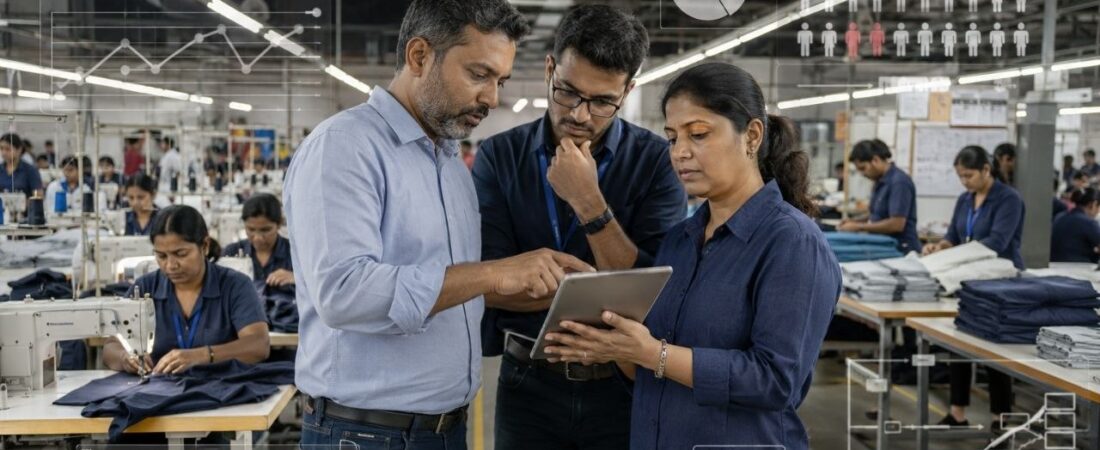
Domain-expert ownership note
Garment factory AI needs domain experts because the hardest work is not writing prompts or code; it is deciding which factory signal is trustworthy, which exception matters, and which recommendation a supervisor can act on during production. Coders can build the tool, but factory people define the operating truth.
Coding skill is treated as factory judgment
The common mistake is to give an AI project to IT alone or to an outside vendor without a production decision owner. The result may look modern, but it often misreads style changeover, skill gaps, rework loops, bundle movement, buyer priority, and line-leader judgment.
Checks before assigning an AI factory project
- Who owns the process definition: IE, production, QA, merchandising, planning, maintenance, or IT?
- Can domain experts label normal exceptions versus abnormal losses in the data?
- Will the AI output change a real decision, or will it become another dashboard that nobody is accountable to use?
Proof requests for domain-expert involvement
- Show how factory experts can edit rules, labels, thresholds, and exception definitions without rebuilding the system.
- Demonstrate one case where expert feedback changed the model output or workflow.
- Provide a governance plan for who approves AI recommendations before they affect production.
Domain-ownership gate
GO if a domain owner can validate the signal and close the action loop. HOLD if the model works technically but lacks operating ownership. REDESIGN if the project treats factory expertise as optional commentary.
Artificial intelligence is often discussed as if the main question is technical skill.
In a garment factory, the better approval question is who owns the production truth behind the model: style changeover, line balance, defect meaning, buyer priority, rework routing, and supervisor action.
Can someone write code? Can they use the latest AI tool? Can they build an automation workflow?
Those skills matter. But they are not the whole story.
Anthropic’s research on Claude Code usage points to a more practical lesson: AI tools do better when the person guiding them understands the work. The report, Agentic coding and persistent returns to expertise, analyzed roughly 400,000 interactive sessions from about 235,000 people between October 2025 and April 2026. It found that people still make most of the planning decisions while Claude handles much of the execution.
That lesson applies directly to factories. For garment factory AI, the first question is not whether a tool can produce an answer. The first question is whether the factory can explain the work clearly enough for the answer to be useful.
A garment factory does not become AI-ready just because it hires a developer or buys a software platform. It becomes AI-ready when the people who understand production, quality, merchandising, industrial engineering, and shop-floor reality can turn their knowledge into clear instructions, usable data, and reliable checks.
In other words, the future of garment factory AI will not belong only to coders. It will belong to people who understand the factory well enough to guide AI, question AI, and catch mistakes before they reach the floor.
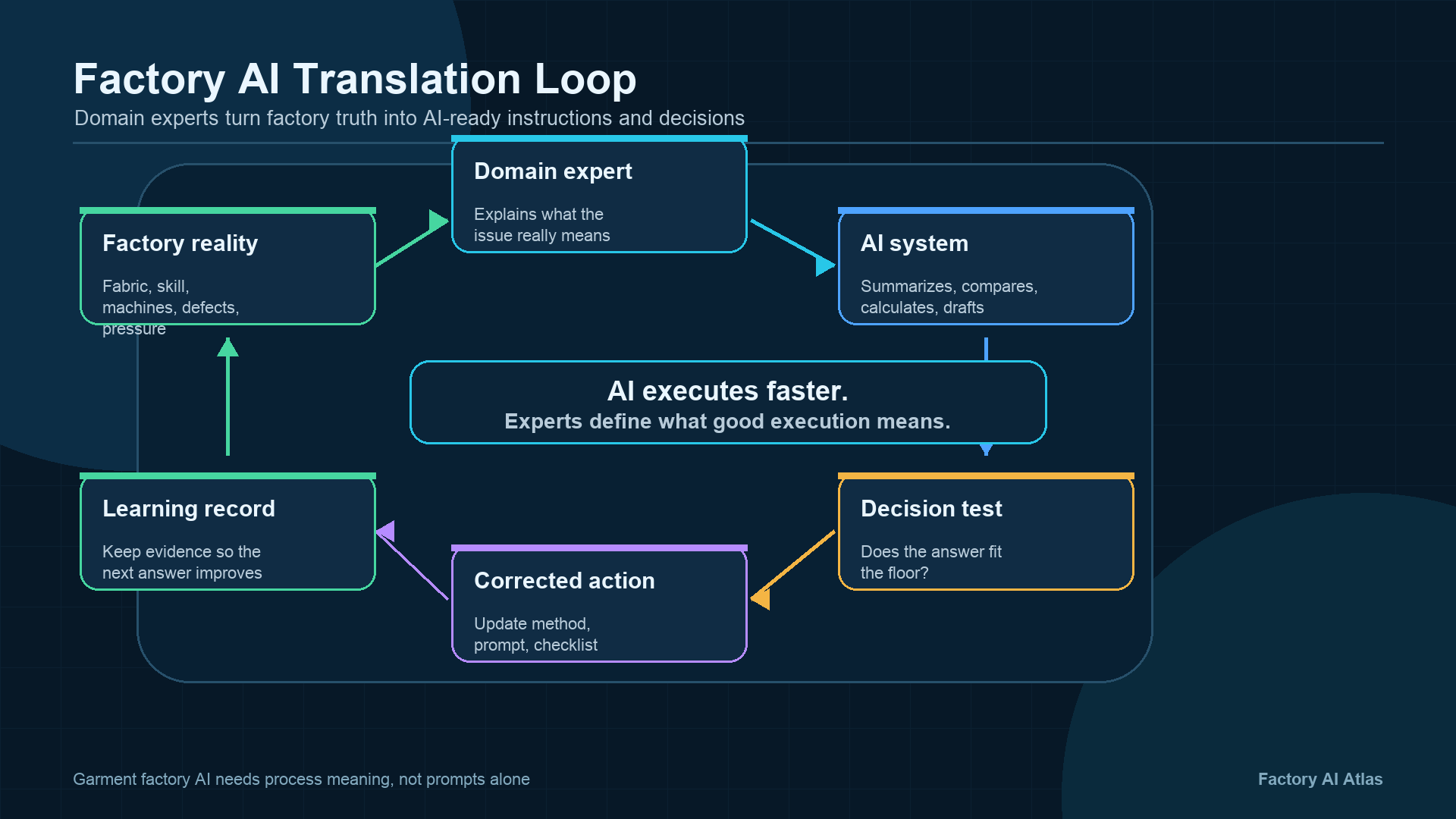
AI can execute, but someone still has to define the work
AI agents are getting better at execution.
They can read files, summarize reports, generate checklists, compare documents, write code, clean tables, draft inspection forms, and produce analysis from messy notes. In many office workflows, that already saves time.
Factories are different from office documents.
A production issue is rarely just one issue. A defect may be linked to fabric behavior, operator skill, machine setting, needle size, line pressure, buyer tolerance, or a weak operation breakdown. A late shipment may come from cutting delay, trim shortage, poor line balance, rework, approval delay, or bad planning assumptions.
AI can help analyze those problems. But it needs someone to explain what the problem means.
For example, an AI system can summarize a sewing defect report. That does not mean it understands whether the defect is a minor internal issue, a repeated process failure, or a buyer claim risk. A QA manager or production leader still has to provide the context.
The same applies to line balancing. AI can calculate differences between target and actual output. It can identify stations with lower productivity. But an IE manager knows whether the bottleneck is caused by operation difficulty, poor feeding, material handling, operator skill, or an unrealistic SMV.
That difference matters. AI is useful when the person using it knows what to ask, what to include, and what to reject.
Factory expertise is not abstract knowledge
In garment manufacturing, domain expertise is not a certificate or a job title. It is the ability to read the floor.
A good production manager can look at a line and sense where the pressure is building. A good QC manager knows which defect may become a buyer issue. A good IE person knows when a cycle time problem is caused by method, layout, or skill. A strong merchandiser knows when a small approval delay will become a delivery risk. A line supervisor knows which operator can handle a difficult operation and which one needs support.
That kind of knowledge is hard to capture in a system. It often lives in people’s heads, notebooks, messaging apps, Excel files, and daily meetings.
This is exactly why AI projects in factories can fail.
The model may be strong. The software may be modern. The dashboard may look clean. But if the factory has not defined its work clearly, AI has very little to learn from.
A garment factory needs to structure its knowledge before it can automate decisions around that knowledge. This is also why factory workflow design should come before AI dashboards. A dashboard built on unclear work only makes unclear work look more polished.
AI transformation is not only an IT project
Many factories still treat AI as an IT topic.
That is understandable. AI tools need systems, data access, permissions, integration, and security. IT teams are needed. Developers are needed. Data engineers can be useful.
But if the project stays only inside IT, it will miss the factory.
IT can connect the system. IE knows the bottleneck. QC knows the defect. Merchandising knows the buyer risk. The line supervisor knows whether the plan can survive the actual floor.
This is why garment factory AI should be treated as a factory knowledge project first, and a technology project second. The technology matters, but the operating judgment gives the technology direction.
A developer can build a defect dashboard. But the QC team must define the defect categories. A system can generate a production risk report. But the production team must define what risk means. An AI tool can help compare planned output and actual output. But IE must check whether the assumptions are realistic. A chatbot can answer questions about SOPs. But someone must make sure the SOPs reflect how the factory actually works.
When factories ignore this, AI becomes a surface layer. It produces summaries, charts, and suggestions, but the operating logic underneath remains unclear.
That is not transformation. That is decoration.
The people who matter in factory AI
The most important garment factory AI users may not look like AI users at first.
They may be production managers, QA managers, IE engineers, merchandisers, cutting managers, finishing managers, packing supervisors, or factory managers.
These people understand the work. If they learn how to guide AI, they can become much more effective.
An IE or GSD specialist can use AI to check operation breakdowns, compare methods, prepare line balancing scenarios, and identify where the assumptions are weak. This connects closely with the need for an operator skill matrix for AI readiness, because skill variation is often the missing context behind output variation.
A QA manager can use AI to group defect records, prepare root cause analysis, compare buyer requirements, and draft CAPA documents. But the QA manager still decides whether the output makes sense. The same principle applies to AI visual inspection in garment factories: the camera may detect a pattern, but the factory still needs a clear defect taxonomy and a human escalation rule.
A merchandiser or MR can use AI to organize order risk, summarize buyer comments, compare approval delays, and prepare follow-up priorities. But the merchandiser still understands the buyer relationship and delivery pressure.
A line supervisor can help AI understand the reality behind the numbers: operator skill gaps, feeding problems, bundle movement, machine trouble, and informal workarounds.
These are not small details. They are the factory.
If those people are excluded from AI adoption, the factory loses the most useful source of intelligence it already has.
Prompt training is not enough
Many companies start AI training by teaching prompts.
That is useful, but it is too shallow for factory work.
The problem is not just whether a manager can write a clean prompt. The problem is whether the manager can explain the factory problem in a way that AI can work with.
A weak instruction sounds like this:
Analyze our sewing defects.
A better instruction sounds like this:
Analyze sewing defects by style, operation, defect type, line, operator skill level, rework frequency, and buyer claim risk. Separate repeated process failures from one-time issues. Show which defects need immediate escalation and which ones need method correction.
That second instruction is not better because the English is prettier. It is better because it contains factory logic.
The same applies to production planning.
Review this production plan against line capacity, style difficulty, current WIP, rework rate, buyer delivery date, and known bottleneck operations. Identify where the plan is likely to fail and what information is missing before we confirm it.
Again, the value comes from domain knowledge.
Good AI use in factories is less about clever wording and more about clear operating judgment.
What garment factories should prepare now
Garment factories do not need to wait for perfect systems before using AI. But they do need better structure. A basic factory AI readiness checklist should start with the knowledge people already use every day.
- Standardize operation names. If the same operation has five different names across lines, AI analysis will be weak from the beginning.
- Define defect categories in buyer-readable language. Defect data should connect to buyer standards, claim risk, and corrective action.
- Connect style, fabric, line, defect, rework, and output data. A defect count alone is limited. A defect count linked to style, fabric, operation, and line is much more useful.
- Build instruction templates for managers. Production, IE, QA, and merchandising teams should have simple templates for asking AI to review plans, summarize risks, or check documents.
- Create verification rules. Managers need to know what should be checked manually, what data should be cross-checked, and what kind of recommendation should be rejected.
- Collect good examples. Factories should save useful AI instructions and useful AI outputs. Over time, this becomes an internal playbook.
- Protect private factory and buyer data. Buyer names, prices, order details, claim information, and confidential production data should not be pasted into public AI tools without clear rules. See our guide to private factory data and public AI tools for a safer starting point.
These steps are not glamorous. But they are the real foundation for garment factory AI that can be checked, trusted, and improved over time.
A factory that cannot describe its own process clearly will struggle to use AI well.
The advantage is factory truth plus AI execution
The useful question is not, “Will AI remove the need for factory experts?”
A better question is, “Which factory experts will learn to direct AI well?”
AI can help managers work faster. It can reduce repetitive documentation. It can organize messy information. It can find patterns that people miss. It can prepare drafts, checks, summaries, and comparisons.
But it still needs factory truth.
It needs someone who knows when a number looks wrong. Someone who knows when a defect is dangerous. Someone who knows when a plan looks good on paper but will fail on the floor. Someone who can explain the difference between normal variation and a real process problem.
That is why domain expertise becomes more valuable, not less.
In the AI era, garment factories should not think only about hiring coders or buying tools. They should also look at the knowledge already inside the factory.
The people who understand the work are the people who can teach AI what the work means. This is also the human layer behind Physical AI in garment factories. Before machines can act in the physical world, people have to define the work clearly enough for AI to read it.
Domain-expert AI readiness questions
Do garment factories need coders to use AI?
Not always. Coders and IT teams help with integration, automation, security, and custom systems. But many useful garment factory AI tasks can start with production, IE, QA, and merchandising experts who know how to define the problem and check the result.
Why is domain expertise important for factory AI?
Factory problems depend on context. A sewing defect, line delay, or delivery risk cannot be understood only from a number. AI needs context about style difficulty, fabric behavior, buyer requirements, operator skill, rework, and production pressure.
Can AI replace production managers or QA managers?
AI can assist them, but it should not replace their judgment. Production and QA managers still need to decide whether an AI suggestion is practical, safe, and aligned with factory reality.
What should factories teach managers about AI?
Factories should teach managers how to describe processes clearly, define exceptions, protect sensitive data, check AI outputs, and turn operational knowledge into repeatable instructions.
What is the first step toward AI readiness in a garment factory?
The first step is to structure factory knowledge. Start with operation names, defect categories, inspection records, rework data, skill information, and simple AI instruction templates. For the broader concept, see our guide to Physical AI in smart manufacturing.
Domain-expert AI governance source anchors
These governance and industry anchors support a practical factory rule: AI projects need technical execution, but the operating definitions must come from people who understand production, QA, merchandising, costing, and buyer requirements. Without that domain ownership, the model may produce fluent outputs while optimizing the wrong factory decision.
- NIST AI Risk Management Framework — useful for grounding AI deployment in governance, validation, accountability, and human oversight.
- ILO apparel-sector resources — relevant context for the operational and workforce realities that domain experts must interpret.