Factory decision note
Do not start with the robot. Start with the work that keeps failing.
If I were reviewing a Physical AI proposal for a real factory, I would not begin with the model name, the robot brand, or the demo video. I would ask where the floor is already losing time, quality, safety, or trust: a defect that returns every week, a material route nobody can see clearly, a machine alarm that gets ignored, or a handling task that changes too much for ordinary automation.
That is the subscriber value of this page. It is not a trend explainer. It is a way to decide whether a Physical AI idea deserves a pilot, needs a smaller evidence project first, or should be stopped before money is wasted.
The mistake factories usually make
Teams see a robot perform one clean task and assume the same behavior will survive factory variation. The hard part is usually not the best-case movement. It is blocked views, fabric or part variation, lighting changes, operator interruptions, maintenance ownership, and who has the authority to stop the action when the AI is unsure.
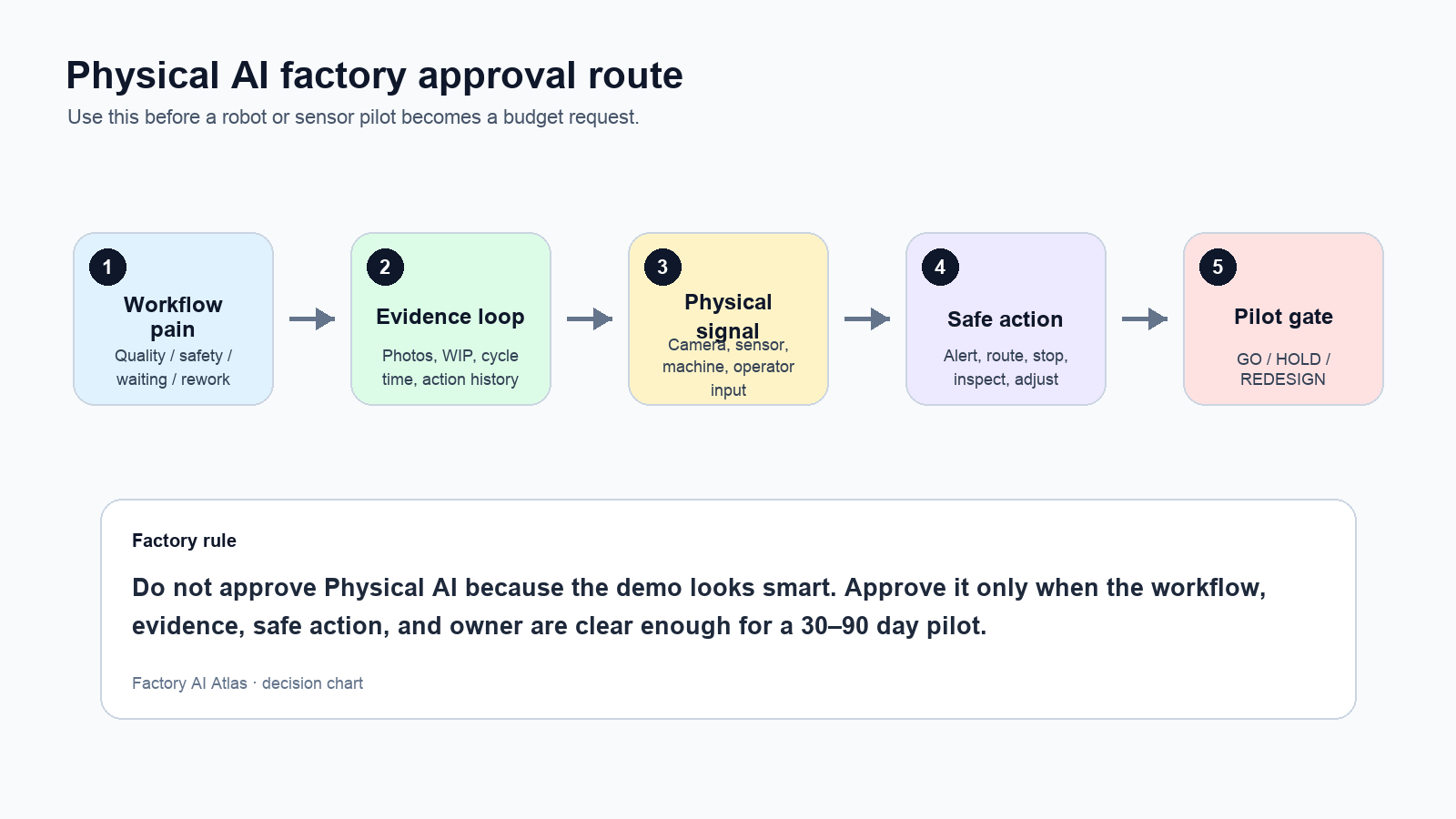
What I would check before approving budget
- The exact physical workflow and the current loss: defect rate, waiting time, rework, safety risk, downtime, or WIP delay.
- The evidence the system can actually read: camera image, sensor signal, machine state, scan, cycle time, inspection result, or operator confirmation.
- The allowed action when confidence is low: stop, alert, slow down, ask for review, or do nothing.
- The owner after the alert: supervisor, QA, IE, maintenance, warehouse, or planning.
Vendor proof requests
- Show the same use case under messy production conditions, not only a highlight reel.
- Show false positives, false negatives, safe stops, overrides, and operator review logs.
- Explain how the AI output becomes a real workflow action, and who can cancel it.
- Provide a 30- to 90-day pilot baseline with acceptance criteria before claiming ROI.
Pilot gate
GO when the use case has a visible loss, readable evidence, safe action rules, and an owner who can respond every shift. HOLD when the idea is useful but the data, SOP, camera position, defect definition, or response routine is not stable yet. REDESIGN when the proposal is mainly a robot purchase with no proof that the factory workflow is ready.
Most people still meet AI through a screen. They ask a chatbot to write, summarize, translate, code, or analyze documents. A factory does not work that way. The useful question is what happens when AI has to deal with fabric, metal, boxes, carts, lighting, machine noise, operator movement, and shift pressure.
In simple terms, Physical AI is AI that has to understand the physical world well enough to support a real action.
Practical definition for manufacturing readers
Physical AI in smart manufacturing means AI systems that understand, monitor, and improve real factory operations through physical-world data such as machines, sensors, cameras, quality evidence, WIP movement, operator skill data, cycle time, and inspection records.
In a factory, that means more than buying a robot. A useful Physical AI system needs stable process data, sensor coverage, standard work, maintenance ownership, quality feedback, and a clear ROI baseline before it can improve the floor.
For garment factories, the first practical examples may be AI-assisted sewing machines, visual inspection support, WIP visibility, cleaning or material-movement robots, broken-needle traceability, and supervisor decision support — not a humanoid robot sewing a full garment from start to finish. For an apparel-specific view, see Physical AI in garment factories.
Physical AI is different because the output eventually touches the floor: a camera finding, a machine alert, a material movement, a robot path, a safety stop, or a supervisor action. That makes the evidence loop more important than the technology label.
The practical factory question is simple: which physical workflow can AI sense, interpret, and improve without creating new safety, quality, or ownership risk?

What Physical AI means on the shop floor
For factory teams, Physical AI is not mainly about replacing people with robots. The first practical value is helping machines, cameras, operators, and supervisors understand the same real-world process more clearly. In apparel and other production environments, that means looking at material movement, defect signals, operator sequence, safety, and process stability before expecting AI to solve the whole operation.
Physical AI in one practical sentence
Physical AI is AI that can perceive, understand, reason about, and act within the physical world.
A normal generative AI model might read a document and produce a summary. A Physical AI system may take input from cameras, sensors, machines, or robots, understand what is happening in a real environment, and support an action: move an object, detect a defect, adjust a route, alert a supervisor, or help a robot perform a task more safely.
This does not mean every factory will suddenly be full of humanoid robots. It means AI is moving closer to real operations.
A simple way to compare the layers:
- Cloud AI: AI running mainly in remote data centers.
- AI PC / on-device AI: AI running closer to the user on a laptop or workstation.
- Edge AI: AI running near the machine, camera, sensor, production line, or warehouse floor.
- Physical AI: AI that uses perception, reasoning, simulation, and action to interact with the real world.
These layers do not replace one another. In many industrial environments, they will work together.
Why factory readers should care
Manufacturing is not only a digital information problem. It is a physical coordination problem.
A factory has people, materials, machines, tools, WIP, defects, movement, waiting time, rework, safety rules, line balance, and delivery pressure. Much of the real value is hidden in the gap between what the system says and what is actually happening on the floor.
This matters because many factory losses are physical before they are digital. A late bundle, a blocked aisle, a repeating defect, or a machine that drifts out of condition often appears on the floor before it appears cleanly in a report.
The scale of industrial automation is already large. According to the International Federation of Robotics, 4.28 million industrial robots were operating in factories worldwide in 2023 — a 10% increase year-on-year in the World Robotics 2024 report.
For example:
- A camera does not just record video; it can help detect whether a process is being followed.
- A sensor does not just collect numbers; it can support early warnings before a machine issue becomes downtime.
- A robot arm does not just repeat a programmed path; it may gradually become better at adapting to object position, shape, or handling conditions.
- A warehouse system does not just assign routes; it can react to people, carts, robots, and congestion in real time.
For a subscriber evaluating vendors, this is the practical shift: do not ask only whether the model can recognize something. Ask whether the recognition changes the next action in a way the factory can verify.
From AI PCs to factory action
Factory AI Atlas follows a simple operating idea: AI is moving closer to the place where work happens.
For manufacturing readers, the path is easier to understand in layers:
- AI servers and cloud models made large-scale generative AI possible.
- AI PCs and NPUs bring more AI workloads onto local devices.
- Edge AI brings intelligence closer to cameras, machines, sensors, and factory networks.
- Physical AI connects AI with robots, smart spaces, vehicles, and industrial actions.
- Smart manufacturing uses these layers to improve visibility, quality, safety, and productivity.
That is why AI PCs and Physical AI belong in the same conversation. The important point is not the PC itself. The point is that more AI decisions can run near the work instead of waiting for a distant cloud workflow.
In manufacturing, this matters because not every workflow should depend only on cloud AI. Factories often care about latency, security, reliability, data privacy, and local control. A quality issue on a line, a machine alarm, or a safety event cannot always wait for a cloud round trip.
How Physical AI differs from generative AI
Generative AI is useful for text, images, code, documents, and structured answers. But a good answer on a screen is not the same as a safe action on the floor.
A chatbot can summarize an inspection report, but a Physical AI system must understand whether a defect photo, fabric behavior, operator motion, WIP delay, or machine condition should trigger a real factory action. This is why private factory data and clear data rules matter before factories connect AI to shop-floor decisions.
Physical AI needs additional capabilities:
Perception
The system must receive signals from the real world. This may include cameras, LiDAR, sensors, machine data, barcode scans, RFID, audio, or operator input.
Spatial understanding
It must understand where things are: objects, people, robots, machines, shelves, pallets, tools, or workstations.
Reasoning under constraints
Physical work has constraints: safety zones, machine speed, material flow, object weight, lighting, line layout, takt time, and human movement.
Simulation and synthetic data
Many robot and autonomous systems need to be trained or tested in simulation before deployment. A digital twin or simulated environment can reduce risk and generate training scenarios that are difficult, expensive, or unsafe to collect in the real world.
Action
The output is not only a sentence. It may become a robot movement, routing decision, inspection alert, machine adjustment recommendation, or operator instruction.
That is the difference that matters in production: Physical AI links perception to action, so the cost of being wrong is higher.
Physical AI vs generative AI vs Factory AI
| Concept | What it does | Factory implication |
|---|---|---|
| Generative AI | Creates or analyzes text, images, code, and documents. | Useful for SOPs, summaries, training material, and knowledge retrieval. |
| Physical AI | Connects AI to sensors, machines, robots, and real-world action. | Needs process stability, machine data, safety rules, and feedback from the floor. |
| Factory AI | Applies AI to production decisions, quality, capacity, maintenance, and ROI. | Works best when standard work, data discipline, and management routines are already visible. |
The practical sequence is usually not chatbot to robot. It is process baseline → data layer → decision support → limited pilot → controlled physical action.
Where it may show up first
The first useful cases are usually narrow. I would look for repeated work where the factory can measure the problem, capture the evidence, and control the action without redesigning the whole operation.
Visual inspection
Computer vision is already used in quality inspection, but Physical AI can make inspection more adaptive. It may help detect defects, classify abnormal patterns, or connect visual findings to process data.
In apparel, electronics, automotive parts, packaging, and consumer goods, this could support earlier detection of recurring quality issues. The hard part is not only model accuracy. It is also lighting, camera position, defect definitions, line speed, false positives, and integration with QC workflows.
Warehouse and material movement
Autonomous mobile robots and smart warehouse systems are natural Physical AI use cases. They need to understand space, avoid obstacles, coordinate with people, and adapt to changing layouts.
The value is not just “robots replace walking.” The bigger value may come from better flow visibility, safer movement, less waiting time, and improved coordination between storage, picking, and production.
Robot arms and handling tasks
Traditional industrial robots are powerful but often need structured environments. Physical AI can help robotic systems become more flexible in grasping, sorting, positioning, and handling objects.
This is especially important when object shape, position, or material condition varies. In manufacturing, variability is often the enemy of automation.
Smart spaces and safety monitoring
Factories and warehouses are dynamic spaces. People, forklifts, carts, robots, and materials move through the same environment. AI-enabled cameras and sensors can help identify congestion, unsafe behavior, blocked pathways, or abnormal activity.
This type of use case may become common before humanoid robots become economically practical.
SOP, training, and operator support
Physical AI does not always need to be a robot. A system that observes a process, compares it with an SOP, and helps an operator avoid mistakes can also be valuable.
For many manufacturers, the first step may be a human-in-the-loop system: AI watches, checks, reminds, explains, and escalates. That is often more realistic than full autonomy.
What this looks like in garment factories
In garment factories, Physical AI does not start with humanoid robots. It starts with cameras, sensors, quality evidence, WIP movement, operator skill data, cycle time, defect photos, inspection records, and production workflow signals that make the physical process visible.
- AI visual inspection: defect photos, lighting conditions, fabric behavior, and buyer acceptance logic become part of the quality evidence layer.
- WIP movement visibility: bundle, cutting, sewing, finishing, and packing signals help the factory see where flow is delayed before automation is added.
- Operator skill data: skill matrix records help AI understand which operations, fabrics, and quality risks each operator can realistically handle.
- Cycle time and line balance: operation-level timing shows whether a process is stable enough for decision support or robotics pilots.
- Workflow action loops: alerts only matter when supervisors, QA, IE, maintenance, or planning teams know who should respond and what evidence confirms the action worked.
For apparel factories, this is why AI visual inspection readiness, operator skill data, and factory workflow design are part of the Physical AI foundation rather than separate digital projects.
A manufacturing reality check
Physical AI is promising, but I would not approve a pilot until these three mistakes are out of the discussion.
Mistake 1: treating Physical AI as a robot purchase
Buying a robot is not the same as deploying Physical AI. The real system includes data, sensors, process design, safety review, operator training, maintenance, integration, and measurement.
Mistake 2: ignoring process stability
Automation works best when the process is already understood. If defect categories are unclear, SOPs change by supervisor, layouts move every week, or WIP data is unreliable, AI will mostly expose the weakness. It will not fix the foundation by itself.
Mistake 3: measuring only labor savings
The value of Physical AI may appear in quality, uptime, safety, throughput, rework reduction, training speed, or better visibility. Labor savings can matter, but it should not be the only ROI lens.
A practical readiness checklist
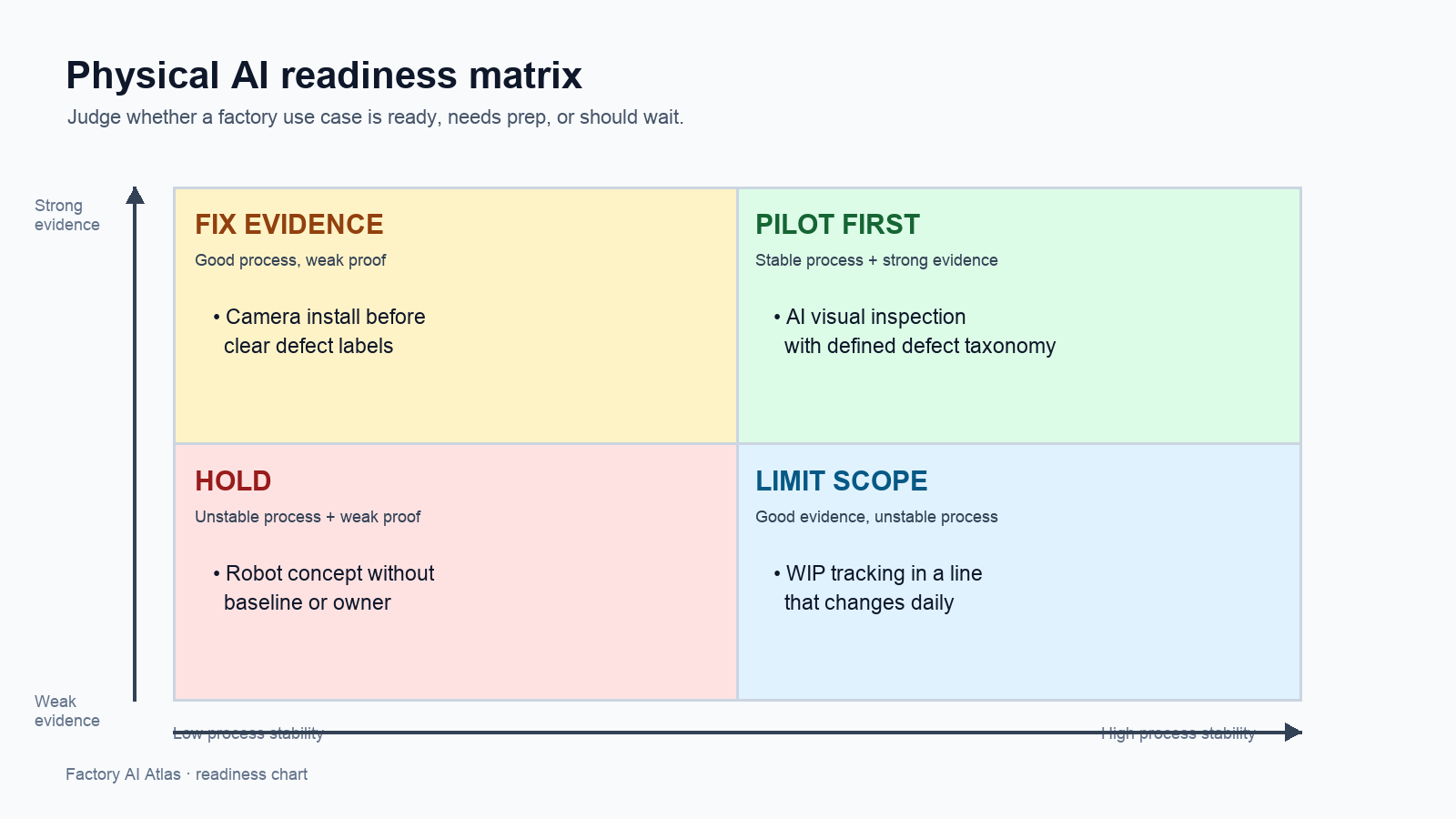
Before asking “Which robot should we buy?”, use this shorter approval check:
- Which physical workflow is painful enough to justify a pilot?
- What baseline proves the problem: defect rate, waiting time, rework, safety risk, downtime, or WIP delay?
- Which evidence will the AI read: photo, sensor, machine signal, scan, cycle time, or operator confirmation?
- What safe action is allowed when the AI is uncertain?
- Who owns the response after the alert or robot action?
- What result would make a 30- to 90-day pilot a clear GO, HOLD, or REDESIGN?
- Can operators and supervisors understand why the system acted?
The best early projects are usually boring in a good way: one painful workflow, one clean baseline, one owner, one safe action, and one decision at the end of the pilot.
Related Factory AI Atlas guides: start with the Factory AI readiness hub, then use Factory AI smoke tests and the Factory AI readiness checklist before buying AI tools or robots.
What I would watch next
For smart manufacturing readers, I would not spend much time debating whether Physical AI becomes a popular technology term. It probably will.
The better question is where it creates measurable operating value first.
Watch these areas:
- AI PCs and edge devices used for local inference, especially where factories need faster decisions close to machines, cameras, and operators.
- Camera-based inspection and smart space analytics, where value depends on defect definitions, lighting control, data quality, and operator workflow.
- Industrial robot platforms becoming easier to train and adapt, while still requiring disciplined ROI, maintenance, safety, and changeover assumptions.
- Simulation and digital twin tools for robot training, especially when teams need to test motion, safety, layout, and process variation before changing the floor.
- Warehouse automation and autonomous mobile robots, where routes, traffic rules, charging space, and material-flow discipline decide whether the pilot works.
- Human-in-the-loop AI systems for SOP, QC, and safety, where AI supports structured decisions instead of replacing operating ownership.
- Clear ROI cases beyond marketing demos, with measurable baselines, acceptance criteria, and a defined operating owner before any pilot begins.
Physical AI is still early. Many announcements will stay as demos. Some will become useful tools only after factories do the unglamorous work: clean up the evidence, define the action, train the people, and measure the result. That is why I would treat Physical AI as an operating-readiness question before treating it as a robotics trend.
Final factory-readiness takeaway
If you are a factory owner, production leader, or buyer-side operations reader, I would take one message from this article: Physical AI is not a shortcut around weak process control. It is a way to make physical work more visible, more measurable, and eventually more controllable.
The first question is not “When will humanoid robots arrive?” It is much more practical: which workflow already hurts enough that better sensing, evidence, and action could pay for a pilot?
If the factory cannot describe the loss, capture the signal, define the safe action, and assign an owner, the project is not ready. If it can do those four things, Physical AI becomes less of a buzzword and more of an operating tool.
For a practical example of how Physical AI decisions connect to factory investment planning, see our robot automation ROI checklist before evaluating your first automation project.
For a broader reading path, see the Factory AI Readiness Hub, which connects Physical AI, automation ROI, and practical factory adoption questions.
For a harder factory-floor example, read 7 Critical Reasons Garment Factory Automation Is So Difficult, which explains why garment automation is especially difficult when fabric behavior, style changes, and quality expectations are unstable.
Author and factory-readiness perspective
Factory AI Atlas is written from a manufacturing operations perspective shaped by hands-on apparel and textile production experience, including overseas factory management, woven and knit operations, production control, quality systems, and operational restructuring.
The site focuses on field-tested, source-linked, and ROI-conscious guidance for AI, robotics, automation, and factory readiness. See the Editorial Policy & Disclaimer for sourcing standards and AI-use disclosure.
Physical AI manufacturing questions
What is Physical AI in manufacturing?
Physical AI in manufacturing is AI that understands real factory conditions and supports decisions or actions in the physical world. It uses signals from machines, sensors, cameras, robots, WIP movement, quality records, operator workflows, and inspection evidence. The goal is not only to produce digital recommendations, but to help the factory sense, interpret, decide, act, and learn from production feedback.
How is Physical AI different from generative AI?
Generative AI mainly creates or summarizes digital content such as text, images, code, documents, or structured answers. Physical AI must understand physical constraints such as material behavior, machine condition, lighting, safety zones, operator movement, line layout, cycle time, and quality variation. In factories, the difference matters because a Physical AI output may influence a real inspection decision, routing action, machine setting, or robot movement.
Does Physical AI mean humanoid robots?
No. Physical AI does not only mean humanoid robots. Robots may become one output of Physical AI, but manufacturing usually starts with narrower systems: AI visual inspection, sensor-based monitoring, autonomous material movement, operator support, smart safety monitoring, or machine condition alerts. A factory can prepare for Physical AI long before it buys a humanoid robot by making its process, data, evidence, and action loops more reliable.
What data does a factory need before Physical AI?
A factory needs physical-world data that describes how work actually happens. Useful data may include process definitions, machine status, sensor signals, camera images, defect photos, inspection records, WIP location, cycle time, operator skill data, maintenance logs, quality evidence, and the history of actions taken after alerts. Dashboards alone are not enough if the underlying workflow and evidence are incomplete.
How can garment factories prepare for Physical AI?
Garment factories can prepare by standardizing operation breakdowns, defect definitions, WIP tracking, operator skill matrices, inspection evidence, and response ownership. Apparel production has flexible fabric, frequent style changes, tactile quality decisions, and many human micro-adjustments. Before robot automation, the factory should make those physical realities visible through cameras, records, cycle-time data, quality photos, and supervisor action loops.
What is the first step before factory robot automation?
The first step is not choosing a robot. The first step is proving that the target process is stable, measurable, and operationally owned. A factory should define the problem, collect baseline data, confirm quality and safety rules, identify who responds to AI signals, and run a small smoke test. If the process cannot be measured or verified, robot automation may only automate weak assumptions.
Why does Physical AI need quality and production evidence?
Physical AI needs evidence because factory decisions depend on what actually happened, not only what a report says. Quality photos, defect categories, inspection results, cycle-time records, WIP movement, and action history help AI connect signals to real consequences. Without evidence, the system may learn inconsistent labels, miss important exceptions, or recommend actions that supervisors cannot trust.
Can apparel factories use Physical AI before buying robots?
Yes. Apparel factories can use Physical AI concepts before buying robots by improving visual inspection, WIP visibility, skill data, maintenance signals, supervisor alerts, and workflow action loops. These steps help the factory understand the physical process more clearly. They also create the evidence layer that future robotics or automation pilots will need if the factory later decides to move from decision support to physical action.
References
- NVIDIA Glossary: What is Physical AI? — https://www.nvidia.com/en-us/glossary/generative-physical-ai/
- NVIDIA Isaac Sim: Robotics Simulation and Synthetic Data Generation — https://developer.nvidia.com/isaac/sim
- Microsoft Learn: Windows AI — https://learn.microsoft.com/en-us/windows/ai/
- International Federation of Robotics: World Robotics 2024 press release — https://ifr.org/ifr-press-releases/news/record-of-4-million-robots-working-in-factories-worldwide