Factory AI Atlas · Article Library
Read the factory AI library by decision, not by hype cycle.
Articles on Factory AI Atlas are organized around the decisions manufacturing teams face before buying robots, AI vision, smart machines, or factory software. Start with the foundation, then move into readiness gates, robot ROI, garment-factory data, and practical pilot examples.
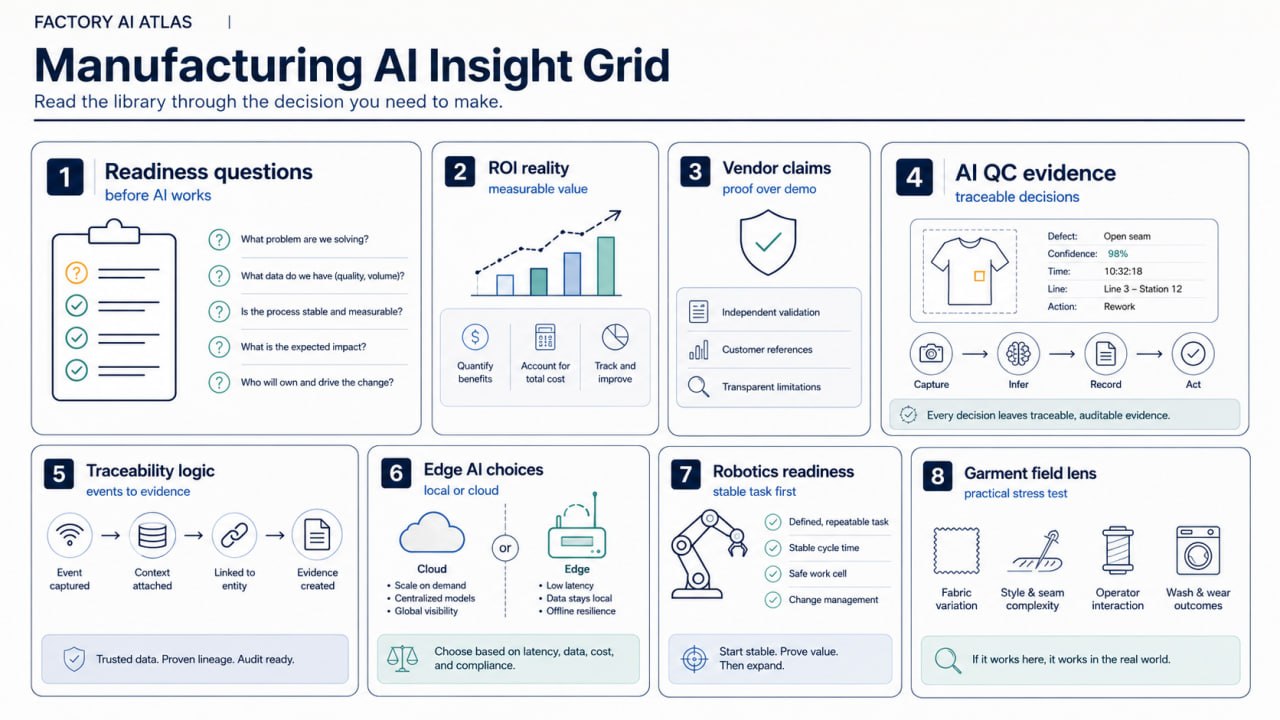
Visual reading map
Read the library through the decision you need to make.
This visual grid groups articles by readiness, ROI, vendor claims, AI QC, traceability, edge AI, robotics, and the garment field lens.
How this page works
Choose the question you are trying to answer.
Use foundation articles to separate Physical AI, robotics, and factory-system layers.
Use readiness gates, scorecards, and data-quality articles before vendor demos.
Use ROI, vendor-question, and field-lens articles to protect budget and operations.
Featured reading path
Start here if you are new to Factory AI.
This path gives a practical sequence: understand the technology layer, check ROI assumptions, assess readiness, then validate pilot gates.
What Is Physical AI? A Practical Guide for Smart Manufacturing Readers
For the last few years, most people have experienced AI through a screen. They ask a chatbot to write, summarize, translate, code, or analyze documents. That vers…
Read article →Robot Automation ROI Fails When the Factory Baseline Is Wrong
Most robot automation ROI calculations get the math wrong before the first number goes in. These seven checks — covering hidden costs, process baselines, and chan…
Read article →Factory AI Readiness Scorecard: A 30-Minute Assessment Before Any AI or Robot Pilot
Factory AI readiness scorecard for deciding whether a factory AI or robotics use case is pilot-ready, needs preparation, or should be avoided for now.
Read article →Factory AI Validation Gates: Prove the Pilot Under Real Production Pressure
A practical Factory AI readiness checklist covering visibility, acceptance tests, execution specs, permission layers, and evidence logs before AI or robot pilots.
Read article →Latest analysis
Recent Factory AI Atlas articles.
The latest posts strengthen the site’s practical manufacturing angle: garment AI data foundations, factory data readiness, AI-assisted Excel workflows, RFID visibility, spreading-machine pilot gates, and lower-risk automation sequencing.
Before AI in Garment Factories, Fix the Data Operators Actually Use
A practical garment AI readiness article showing why production, quality, delay, and decision data must be structured before AI can support factory operations.
Read article →Factory Data Readiness: Organize Operating Data Before AI Pilots
Factory data readiness starts with order, production, quality, workforce, and delivery-risk information that managers can trust before AI adoption.
Read article →AI Excel Is Not About Formulas — It Is About Workflow Design
AI Excel is not just a formula assistant. For factory teams, it can become a practical workflow design tool for KPI dashboards, production data, and management decisions.
Read article →AI Factories Start With RFID, Not Robots
A practical view of why factory AI readiness often starts with RFID, traceability, and operational visibility before advanced robots or full automation.
Read article →Automatic Spreading Machine Pilot Gate: Test the Process, Not the Speed
A factory AI readiness view of automatic spreading machine pilots, focusing on process validation, fabric behavior, controls, and measurable production gates.
Read article →Sewing Line Layout: 7 Essential Ways to Improve Garment Factory Flow
Compare long sewing lines, zigzag mini lines, and U-lines as Lean layout choices for WIP control, visibility, communication, and Factory AI readiness.
Read article →Cutting Plan: A Factory AI Readiness Layer for Apparel
Cutting plans can become a practical data layer for apparel factories when marker logic, roll control, fabric behavior, and production gates are managed clearly.
Read article →AI Apparel Costing: 7 Essential Ways to Support ME and IE Teams
AI apparel costing can support scenario comparison and risk flags, but ME/IE teams must govern SAM, SMV, efficiency, and production assumptions.
Read article →Jumper Pool System: 5 Practical Benefits for Garment Factories
A jumper pool system gives factories a flexible operator layer for bottlenecks, rework, samples, absenteeism, and short-term line balance gaps.
Read article →GSD SAM SMV: 7 Reasons They Are Apparel Factory AI’s Data Layer
GSD SAM SMV can become the standard-time data layer for apparel Factory AI, connecting costing, capacity planning, ME/IE review, and automation ROI.
Read article →Factory AI Validation Gates: Prove the Pilot Under Real Production Pressure
A practical Factory AI readiness checklist covering visibility, acceptance tests, execution specs, permission layers, and evidence logs before AI or robot pilots.
Read article →Garment field lens
Where apparel factories reveal the real bottlenecks.
Garment and textile operations are useful stress tests for Factory AI because fabric is flexible, style changeovers are frequent, manual judgment is still important, and buyer/audit requirements demand traceable control points.
Before AI in Garment Factories, Fix the Data Operators Actually Use
A practical garment AI readiness article showing why production, quality, delay, and decision data must be structured before AI can support factory operations.
Read article →Factory Data Readiness: Organize Operating Data Before AI Pilots
Factory data readiness starts with order, production, quality, workforce, and delivery-risk information that managers can trust before AI adoption.
Read article →Cutting Plan: A Factory AI Readiness Layer for Apparel
Cutting plan turns order recap, quantity review, allowance logic, cut groups, and revision history into a practical Factory AI readiness layer for apparel factories.
Read article →Apparel Factory Small Apps: The Practical Step Before Robots
Small operating apps turn WIP, QC, PPC, SMV, 5S, and cutting-room records into structured readiness data before robots or large AI systems.
Read article →AI Apparel Costing: 7 Essential Ways to Support ME and IE Teams
AI apparel costing can support scenario comparison and risk flags, but ME/IE teams must govern SAM, SMV, efficiency, and production assumptions.
Read article →GSD SAM SMV: 7 Reasons They Are Apparel Factory AI’s Data Layer
GSD SAM SMV can become the standard-time data layer for apparel Factory AI, connecting costing, capacity planning, ME/IE review, and automation ROI.
Read article →The Garment Factory Automation Stack: From Cutting Rooms to Physical AI
The garment factory automation stack connects order data, cutting rooms, WIP visibility, quality intelligence, connected sewing, material flow, edge AI, and Physi…
Read article →7 Critical Reasons Garment Factory Automation Is So Difficult
Garment factory automation is difficult because apparel production combines flexible fabric, sewing micro-decisions, style changeovers, line balancing, quality ju…
Read article →Broken Needle Traceability: A Practical Factory AI Readiness Gate
Broken needle traceability shows how INH-style needle handling can turn needle issue, return, and replacement into reliable factory data for audit readiness and F…
Read article →Digital Product Passport for Garment Factories: Traceability Readiness
Digital Product Passport readiness for garment factories is a data discipline problem that connects traceability, quality, compliance, and production records.
Read article →Before Buying Apparel Automation: 12 Questions Factory Teams Should Ask Vendors
A practical field checklist of apparel automation vendor questions garment factory teams should ask before buying machines, robots, AI vision, or support automation.
Read article →Robots, machines, and lower-risk pilots
Robot-readiness articles before major automation spend.
These articles focus on where robots can fit safely, what to test before a hard-to-reverse investment, and why cleaning, movement, inspection, or supporting workflows may come before fully automated sewing.
Factory Mobile Robots: 7 Checks Before Choosing AGV, AMR or Cleaning Robots
Factory mobile robots can be a lower-risk first automation step. Compare AGVs, AMRs, cleaning robots, automated forklifts, and inspection robots before choosing a…
Read article →Cleaning Robots in Factories: 7 Practical Checks Before Buying
Cleaning robots in factories may be one of the most practical first automation steps. They help teams test routes, safety, ownership, robot ROI, and factory readi…
Read article →Autonomous Cleaning Robots in Garment Factories: What a Real Trial Revealed
A field-based look at autonomous cleaning robots in garment factories, including route coverage, thread and lint problems, ROI limits, and Physical AI lessons.
Read article →Cleaning Robot Maintenance: 12 Essential SOP Checks for Garment Factories
A practical maintenance SOP for garment-factory cleaning robots, focused on thread entanglement, lint buildup, brush checks, daily ownership, and downtime prevention.
Read article →Lower-Risk Robot Pilots for Apparel Factories Before Sewing Robots
A practical guide to lower-risk robot pilots for apparel factories before attempting difficult sewing automation projects.
Read article →AI Sewing Machines Are Arriving Before Fully Automated Sewing Robots
AI sewing machines may become the practical bridge between manual sewing and full robotic sewing automation in garment factories.
Read article →What Garment Factories Should Automate Before Robotic Sewing
A practical garment factory automation roadmap: start with data, WIP visibility, cutting, AI inspection, digital skills, bottleneck equipment, connected machines,…
Read article →Latest operating maps
Newest Factory AI Atlas articles to connect data, people, and visual inspection.
Use these newest pieces after the readiness scorecard when the team needs to map factory semantics, operator skills, or inspection gates before buying another AI tool.
Factory AI Needs Semantic Maps, Not Just Robots
Why factory AI needs WIP, hold areas, rework carts, packing status, and movement meaning before robots or dashboards can make reliable decisions.
Read article →Operator Skill Matrix: The Human Data Layer Apparel Factories Need Before AI
How skill matrices turn operator capability, flexibility, training gaps, and line-balancing decisions into a usable human data layer for AI readiness.
Read article →AI Visual Inspection in Garment Factories: 7 Readiness Checks Before You Buy
Seven practical gates for defect definitions, image capture, lighting, human review, rework feedback, and buyer-risk control before visual AI adoption.
Read article →Complete public library
Browse the complete Factory AI Atlas article library.
Search the full public library or filter by topic. The curated paths above remain the recommended starting point; this complete archive makes every published article directly reachable.
73 public articles
Factory AI Action Assurance: What to Check Before AI Releases Work
A practical seven-part record for checking evidence, permissions, tool paths, telemetry, final state, and human approval before factory AI changes a record or releases work.
Read article →Digital Product Passport for Garment Factories: Why DPP Is a Factory Data Readiness Test
Digital Product Passport rules are often discussed as sustainability compliance. For garment factories, DPP is really a test of product-level data readiness.
Read article →Before AI Inspects the Factory Line, It Needs Real Defect Evidence
Before AI can inspect garments or factory-line output, the factory needs real defect evidence: defect taxonomy, image samples, camera standards, line validation, and a human HOLD / REWORK / RELEASE gate.
Read article →Garment Factory Machines Are Becoming Data Systems, Not Just Equipment
Garment automation is not only about faster machines. Inspection gates, cutting systems, and digital printing platforms are starting to create the production evidence factories need for quality,…
Read article →What Dexterity’s Truck-Loading Robot Teaches Factories About Physical AI
Dexterity’s truck-loading robot is not a model for apparel factories to copy directly. The better lesson is how factories should read messy physical work, variation, safety risk, and ROI before deciding…
Read article →When Sewing Automation Actually Pays Off: A Factory ROI Check for Sleeve Cuff Machines
A practical factory ROI check for sleeve cuff automation: how to evaluate SMV reduction, line coverage, labor redeployment, quality consistency, and payback risk before buying sewing automation.
Read article →AI Lockstitch Machine Pilot: 5 Costly Factory Mistakes to Check Before Buying
AI lockstitch machine pilot decisions should not rely on one vendor demo. Use these five factory checks before approving a pilot budget or buying equipment.
Read article →Factory AI Needs an Action Reliability Layer Before It Trusts Agents or Robots
Factory AI should not trust agents or robots just because their models look smarter. Before action, factories need a reliability layer that checks context quality, world-action drift, defect evidence, and…
Read article →Factory AI Needs an Edge Evidence Gate Before Agents Touch Workflows
Factory AI should not move directly from cameras, QC photos, screenshots, or agent outputs into workflow action. It needs a local edge evidence gate that proves what the system saw, what it extracted, and…
Read article →Factory AI Needs a Deployment Evaluation Layer Before It Trusts Robots
Factory AI deployment evaluation layer checks whether robots, inspection models, documents, and AI agents are ready for real factory decisions before execution rights are granted.
Read article →Downtime and Changeover Logs Before Predictive AI
Downtime and changeover logs turn factory stops, style changes, and ramp-up loss into operating evidence before predictive AI or automation ROI claims are trusted.
Read article →Cloud vs Edge AI in Factories: A Practical Data Decision Matrix
Cloud vs edge AI in factories is a data-routing decision. Use this practical matrix to classify shop-floor data by speed, sensitivity, evidence value, and learning purpose.
Read article →Garment Label Traceability: How QR Labels Reveal Factory AI Readiness
Garment label traceability links QR labels to fabric receiving, cutting, sewing, QC, packing, cartons, and shipment history before AI/MES pilots scale.
Read article →Edge AI for Factories: 7 Decisions That Should Stay Local
Edge AI for factories should start with local decisions, not hardware hype. Use this factory-focused guide to decide what stays local, what gets masked, what becomes a summary, and what can safely move to…
Read article →Factory AI Stack Map: 5 Critical Layers from Chips to Factory Decisions
A factory AI stack is not just chips, software, or robots. Use this 5-layer map to connect edge AI, robots, factory systems, and operating decisions.
Read article →Dark Factories Are Not the Goal — Visible Factories Are
Visible factory readiness comes before dark factories. This draft explains five checks for exception visibility, trusted data, and human-in-the-loop automation.
Read article →Factory AI Data Layer: 7 Critical Checks Before PLC-to-ERP AI
Factory AI data layer readiness starts before model selection. Check whether shop-floor events can move from PLCs and machines to MES, ERP, quality, maintenance, and business decisions.
Read article →Factory AI Needs Skill Transfer Before It Needs More Dashboards
Factory AI needs more than dashboards. Factories must capture transferable knowledge, exception rules, and training evidence before AI can support reliable decisions.
Read article →From Parking Lines to Height Gauges: Why Factories Need Visible Process Limits
Visible process limits turn hidden factory rules into shop-floor signals. Before factory AI can improve decisions, physical standards must be visible at the point of work.
Read article →Factory Energy Data: The Hidden Cost Layer AI Should Understand
Factory energy data turns monthly utility bills into operational signals that AI can connect with machines, lines, production output, compressed air, heat, HVAC, and peak demand.
Read article →Factory AI Readiness: 7 Measurements to Capture Before Automation
Factory AI readiness measurements help teams capture the physical reality of the floor before automation: material travel, operator movement, WIP location, QC loops, layout spacing, and baseline change data.
Read article →Factory AI Agents Need Safety Cases Before They Get Execution Rights
Factory AI agents should begin with read-only and draft-only permissions before high-impact actions receive human release through safety cases, evidence logs, and damage-aware tests.
Read article →Factory Robotics Readiness Matrix: Why Physical AI Starts With Material Flow
Factory robotics readiness matrix for checking material flow, brownfield retrofit constraints, data discipline, safety, and ROI before AGV, AMR, ACR, or AS/RS pilots.
Read article →Why Garment Factory AI Needs Domain Experts, Not Just Coders
Garment factory AI works better when production, IE, QA, and merchandising experts can guide AI tasks, verify outputs, and protect factory reality.
Read article →Physical AI in Garment Factories Starts With Data, Not Robots
Physical AI in garment factories will not start with robots. It starts with six data layers that help AI understand process, material, quality, skill, workflow, and buyer evidence.
Read article →Factory Workflow Design: Why AI Needs Human Action Before More Dashboards
Factory workflow design turns AI signals into owned decisions, actions, and verified improvement. Learn why factories need human action loops before adding more dashboards.
Read article →Buyer Evidence Readiness: 9 Practical Proof Checks Before Buyer Reviews
Buyer evidence readiness is not about having more documents. It is about knowing which evidence proves which factory claim before a buyer review, audit, or compliance discussion.
Read article →Private Factory Data: What Should Never Be Sent to Public AI Tools
Private factory data should not be pasted into public AI tools without clear rules. Here are 10 types of apparel factory information to protect before using AI.
Read article →Local AI for Factories: 7 Critical Lessons from AMD and NVIDIA
Local AI for factories is becoming a practical manufacturing architecture. AMD Ryzen AI Max and NVIDIA DGX Spark show why factory leaders should prepare SOPs, QC evidence, training data, and line-balancing…
Read article →Latin America Apparel Sourcing: 7 Critical Gates for Audit-Ready Factories
Latin America apparel sourcing should not be judged only by distance or cost. Buyers need audit-ready factories with OSH control, training, export readiness, and supplier evidence.
Read article →Textile EPR and Circularity: 7 Critical Evidence Gates for Apparel Factories
Textile EPR is turning circularity into a factory evidence challenge. Apparel factories should prepare seven evidence gates for BOMs, claims, waste, supplier declarations, and AI-ready reporting.
Read article →LG Smart Factory: Why the Factory Itself Is the Next Export
LG smart factory strategy shows why manufacturing know-how is becoming a product — and what apparel factories can learn from factory operating systems.
Read article →Factory AI Smoke Tests: 5 Critical Checks Before Buying AI Tools
Factory AI smoke tests help factories check whether an AI use case can survive real production conditions before buying tools, robots, cameras, or dashboards.
Read article →Factory AI Readiness Checklist: 12 Questions Before Buying AI Tools
Before buying AI software, cameras, robots, or dashboards, factories need to check whether their process, data, people, quality system, and ROI logic are ready.
Read article →Factory AI Needs Semantic Maps, Not Just Robots
Factory AI needs more than robots and sensors. To work in real factories, AI systems must understand WIP, hold areas, rework carts, packing status, and the meaning behind factory floor movement.
Read article →Operator Skill Matrix: The Human Data Layer Apparel Factories Need Before AI
Factory AI cannot optimize a garment sewing line if it does not know which operators can actually perform which operations. An operator skill matrix turns human capability into usable factory data.
Read article →AI Visual Inspection in Garment Factories: 7 Readiness Checks Before You Buy
Before buying AI visual inspection for a garment factory, check defect taxonomy, lighting, fabric variation, image data, false positives, QA workflow, and buyer acceptance rules.
Read article →AI Garment Factory Dashboard: Turning Sewing Line Signals Into Better Decisions
A garment factory dashboard is useful when it connects production signals to an owner, an action, and a checked result.
Read article →Physical AI vs Generative AI: What Factory Leaders Need to Know
Physical AI and Generative AI solve different factory problems. This guide explains what factory leaders need to know before choosing AI tools for planning, quality, production, safety, and automation…
Read article →Physical AI in Manufacturing: 7 Practical Use Cases Before Robots Take Over
Physical AI in manufacturing is not only about robots. These seven practical use cases show how factories can improve inspection, line balancing, maintenance, guidance, safety, and automation readiness…
Read article →Cleaning Robot Maintenance: 12 Essential SOP Checks for Garment Factories
Cleaning robot maintenance in garment factories needs daily brush checks, lint control, sensor cleaning, error logs, and zone-based ownership to prevent downtime.
Read article →Garment Factory Efficiency: The Baseline AI Needs Before It Can Improve Production
Garment factory efficiency can mislead AI if the baseline hides product mix, rework, absenteeism, learning curve, and line-balance problems.
Read article →Garment Line Balancing: Why Bottlenecks Break Factory AI Before Robots Begin
Garment line balancing is where standard time meets real sewing flow. Before Factory AI can recommend manpower, automation, or scheduling changes, it must understand bottlenecks and WIP.
Read article →Garment Standard Time: From Method Improvement to Factory AI
Factory AI cannot improve what the factory cannot measure consistently. Garment standard time turns sewing methods, motion improvement, and production planning into a shared operational language.
Read article →Why Garment Factory Kaizen Is Still About Motion, Not Robots
Robots matter, but most garment factory productivity improvement still starts with method engineering: removing repeated motion, handling, waiting, and unstable work methods across sewing operations.
Read article →Cycle Time: 5 Practical Lessons for Factory AI
Factory AI does not start with dashboards or robots. In apparel manufacturing, it starts with cycle-time visibility at the operation level.
Read article →Before AI in Garment Factories, Fix the Data Operators Actually Use
AI can improve garment factory operations, but only when the right production, quality, and workflow data is already in place. Here are five data foundations factories should fix before investing in AI.
Read article →Factory Data Readiness: Organize Operating Data Before AI Pilots
Factory data readiness is the practical starting point for garment factory AI. Here are the five data areas to organize before serious AI adoption.
Read article →AI Excel Is Not About Formulas — It Is About Workflow Design
AI Excel is not just a formula assistant. For factory teams, it can become a practical workflow design tool for KPI dashboards, production data, and better management decisions.
Read article →AI Factories Start With RFID, Not Robots
AI factories in apparel manufacturing may begin with RFID, QR codes, and garment-level traceability before robots or full automation.
Read article →Automatic Spreading Machine Pilot Gate: Test the Process, Not the Speed
Before buying an automatic spreading machine, garment factories should test the real spreading process — not machine speed alone.
Read article →Sewing Line Layout: 7 Essential Ways to Improve Garment Factory Flow
Sewing line layout choices can reduce WIP, improve visibility, and support Lean garment factories comparing long lines, zigzag mini lines, and U-lines.
Read article →Jumper Pool System in Garment Factories: When Flex Labor Helps, and When It Hides an IE Problem
A field-focused guide to jumper pool systems in garment factories: when flexible labor protects output, when it hides line-balancing problems, and what evidence to check before approving budget or software.
Read article →AI Apparel Costing: How ME and IE Teams Review Assumptions
AI apparel costing is useful when ME and IE teams can review the method, standard time, efficiency, and factory limits behind the number.
Read article →Cutting Plan: A Factory AI Readiness Layer for Apparel
Cutting plan can become a Factory AI readiness layer in apparel by structuring order recap, allowance, cut groups, revision history and production review.
Read article →Apparel Factory Small Apps: The Practical Step Before Robots
Apparel factory small apps turn WIP, QC, PPC, SMV, 5S, and cutting-room records into structured readiness data before robots or large AI systems.
Read article →Broken Needle Traceability: A Practical Factory AI Readiness Gate
Broken needle traceability is a factory control gate: approve the system only when issue, breakage, fragment recovery, release approval, and buyer-ready evidence are connected.
Read article →GSD, SAM and SMV Explained: Standard-Time Data for Apparel Factory AI
GSD SAM SMV can become the standard-time data layer for apparel Factory AI, connecting costing, capacity planning, ME/IE review, and automation ROI.
Read article →Factory AI Validation Gates: Prove the Pilot Under Real Production Pressure
A practical Factory AI readiness checklist covering visibility, acceptance tests, execution specs, permission layers, and evidence logs before AI or robot pilots.
Read article →Before Buying Apparel Automation: 12 Questions Factory Teams Should Ask Vendors
Apparel automation vendor questions for garment factories: fabric behavior, line balance, WIP, data, quality, maintenance, and realistic pilot planning.
Read article →Garment Factory Data Problems That Break AI Projects
A field-focused guide to the garment factory data problems that often break AI projects before dashboards, inspection systems, or automation pilots create value.
Read article →Autonomous Cleaning Robots in Garment Factories: What a Real Trial Revealed
A field-based look at autonomous cleaning robots in garment factories, including route coverage, thread and lint problems, ROI limits, and Physical AI lessons.
Read article →Lower-Risk Robot Pilots for Apparel Factories Before Sewing Robots
A practical guide to lower-risk robot pilots for apparel factories before attempting difficult sewing automation projects.
Read article →Digital Product Passport for Garment Factories: Traceability Readiness
Digital Product Passport readiness for garment factories is a data discipline problem that connects traceability, quality, compliance, and production records.
Read article →The Garment Factory Automation Stack: From Cutting Rooms to Physical AI
The garment factory automation stack connects order data, cutting rooms, WIP visibility, quality intelligence, connected sewing, material flow, edge AI, and Physical AI.
Read article →AI Sewing Machines vs Sewing Robots: What Garment Factories Should Adopt First
AI sewing machines may become the practical bridge between manual sewing and full robotic sewing automation in garment factories.
Read article →What Garment Factories Should Automate Before Robotic Sewing
A practical garment factory automation roadmap: start with data, WIP visibility, cutting, AI inspection, digital skills, bottleneck equipment, connected machines, and material-flow robots before robotic sewing.
Read article →Factory Mobile Robots: 7 Checks Before Choosing AGV, AMR or Cleaning Robots
Factory mobile robots can be a lower-risk first automation step. Compare AGVs, AMRs, cleaning robots, automated forklifts, and inspection robots before choosing a pilot.
Read article →Factory AI Readiness Scorecard: A 30-Minute Assessment Before Any AI or Robot Pilot
Factory AI readiness scorecard for deciding whether a factory AI or robotics use case is pilot-ready, needs preparation, or should be avoided for now.
Read article →Cleaning Robots in Factories: 7 Practical Checks Before Buying
Cleaning robots in factories may be one of the most practical first automation steps. They help teams test routes, safety, ownership, robot ROI, and factory readiness before moving into harder robotics…
Read article →Why Garment Factory Automation Is Difficult: 7 Fabric, Sewing and ROI Challenges
Garment factory automation is difficult because apparel production combines flexible fabric, sewing micro-decisions, style changeovers, line balancing, quality judgment, and narrow ROI windows.
Read article →Robot Automation ROI Fails When the Factory Baseline Is Wrong
Most robot automation ROI calculations get the math wrong before the first number goes in. These seven checks — covering hidden costs, process baselines, and change management — will make your model…
Read article →What Is Physical AI? Definition, Factory Examples, and Readiness
A practical factory-reader guide to Physical AI: how to judge whether a robot, camera, sensor, or edge AI idea is ready for a real production pilot, and what evidence to demand before budget approval.
Read article →No articles match this search. Try a broader factory topic or clear the category filter.
Need a practical next step?
If you are reviewing vendors or considering a pilot, start with readiness and checklists before comparing market maps. The goal is to convert claims into operating questions your factory team can actually verify.